

Industrial Devastation To Natural Abundance
The PQNK System · Chapter 26
Soil Moisture Management
The Water Revolution: Four Sources, One Protocol, Minimum Waste
Release 1.0 · 2026-09-18
If you use “Listen”, the text of the page may be sent to your browser or operating system’s speech provider, such as Apple, Google or Microsoft, depending on the voice your device uses. Pedaver does not process, transmit or store any audio.
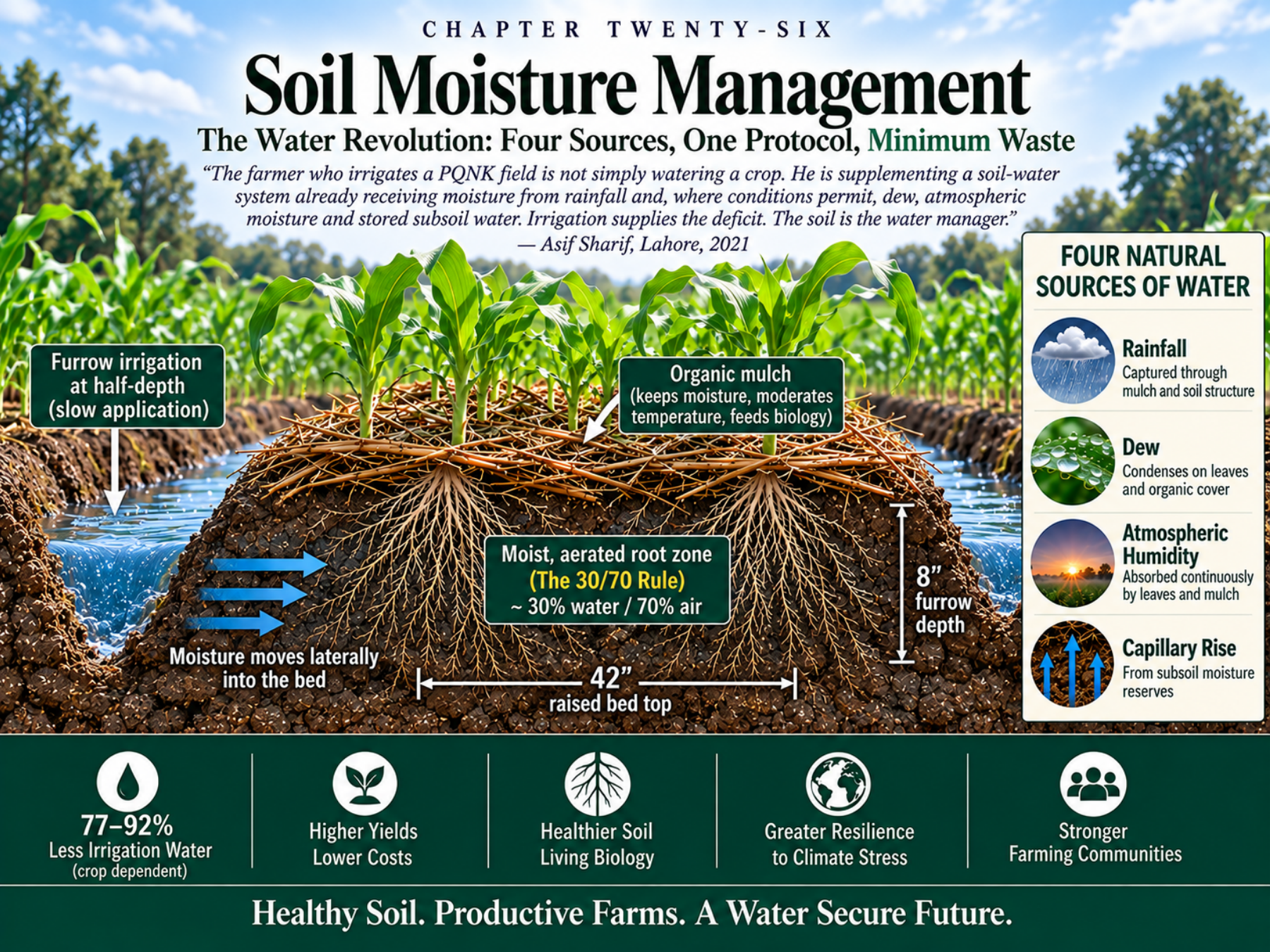
The PQNK bed cross-section: furrow irrigation at half-depth, organic mulch, and a moist, aerated root zone held at the 30/70 Rule, roughly 30 percent water to 70 percent air, alongside the four natural water sources and the documented 77–92 percent irrigation-water saving range.
“The farmer who irrigates a PQNK field is not simply watering a crop. He is supplementing a soil-water system already receiving moisture from rainfall and, where conditions permit, dew, atmospheric moisture and stored subsoil water. Irrigation supplies the deficit. The soil is the water manager.”
Asif Sharif, Lahore, 2021
Water is one of the resources that determines where agriculture is possible and how resilient it can be. In Pakistan’s water-stressed context, falling groundwater levels, uneven canal supply and ageing irrigation infrastructure make water management increasingly important. PQNK approaches the problem from both sides: water supply matters, but so does the soil’s capacity to receive, store and release water while retaining enough air for roots and soil organisms. Restoring that capacity is the purpose of Soil Moisture Management.
Soil Moisture Management (SMM) is PQNK’s framework for managing crop water. It treats the soil profile as the primary water-management medium and seeks to maintain a moist, aerated root zone rather than repeatedly saturating it. The aim is not to eliminate irrigation everywhere, but to use supplementary irrigation only when field observation shows that the soil-water reserve is no longer sufficient for the crop.
HOW THE EARTH LOST ITS WATER SYSTEM
Natural terrestrial ecosystems regulate water through interacting physical and biological processes. Rainfall may infiltrate, run off, evaporate, be stored in soil, move downward by gravity, move upward through capillary processes, and return to the atmosphere through plant transpiration and soil evaporation. Roots, soil structure, organic matter, surface cover and biological activity influence how much water follows each pathway. PQNK seeks to rebuild the agricultural soil so that a larger share of incoming water is captured and retained within the rooting environment.
Conventional field practices can weaken this water-regulating capacity. Repeated tillage disrupts aggregates and continuous root channels; traffic can create hardpan; bare soil is exposed to crusting, heating and evaporation; and inundation temporarily fills much of the pore space with water, reducing oxygen diffusion until drainage restores aeration. PQNK therefore applies four governing rules together: no inundation, no soil disturbance after conversion, continuous organic mulch cover, and encouragement of biodiversity. These rules protect the physical and biological architecture through which SMM operates.
THE OXYGEN-MOISTURE BALANCE
Water and air share the same soil pore network. As water content rises, air-filled pore space falls; as soil dries, air-filled pore space increases but plant-available water declines. Productive root-zone management therefore requires a workable balance between moisture and aeration rather than maximum water content.
During inundation or prolonged saturation, oxygen diffusion through soil is greatly reduced. Sensitive roots and aerobic organisms can become stressed when oxygen remains limited, although the severity depends on crop, soil, temperature and duration. Flood irrigation does not make soil permanently anaerobic: after water drains, air re-enters the pore space. The PQNK concern is that repeated cycles of excessive saturation, together with compaction and surface sealing, narrow the period in which moisture and aeration are simultaneously favourable.
In PQNK, moisture and oxygen are managed together. The raised bed geometry ensures that the bed surface drains into adjacent furrows rather than ponding over roots. The mulch cover maintains surface moisture without sealing the pores that allow gas exchange. The shallow furrow delivery system provides moisture at the bed margin and allows it to move laterally by capillary action rather than flooding the profile. This simultaneous oxygen-moisture continuity is the defining characteristic of a mature PQNK system.
THE FOUR NATURAL WATER SOURCES
Conventional irrigation planning usually focuses on rainfall and applied irrigation. SMM asks the farmer to consider the whole field water balance. PQNK recognises four natural contributors that can reduce the amount of supplementary irrigation required under suitable conditions: rainfall, dew, atmospheric moisture interactions at the surface, and water stored below the immediate root zone that can move upward or be reached by roots. Their relative importance varies greatly with climate, soil, season and groundwater conditions.
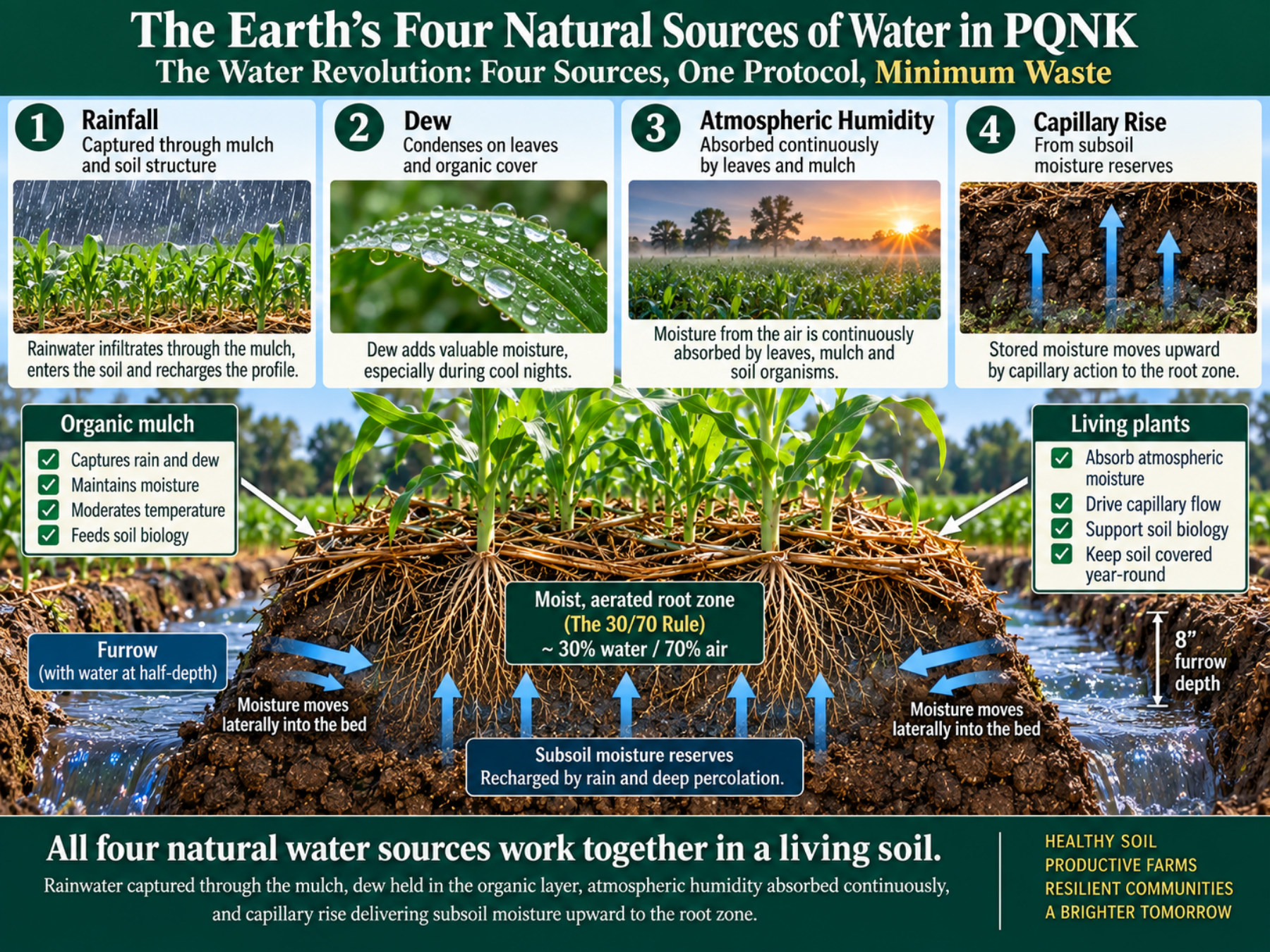
The four natural sources of water available to a PQNK bed — rainfall, dew, atmospheric humidity and capillary rise — captured by organic mulch above and living plants below, feeding the same moist, aerated root zone.
Source One: Rainfall. A well-structured, mulch-covered PQNK field is designed to increase rainfall infiltration and reduce avoidable runoff compared with a sealed, compacted or bare surface. It should not be assumed that every storm will infiltrate completely: rainfall intensity, antecedent moisture, soil texture, slope and drainage still matter. The objective is to capture as much useful rainfall as the field can safely receive and store.
Source Two: Dew. Dew can wet leaves, mulch and the immediate soil surface when surface temperatures fall below the dew point. Mulch can slow the loss of this small moisture input and keep the surface microenvironment cooler and more humid. Its contribution may be useful in dew-prone environments, but it should be treated as a supplementary source rather than a substitute for measured crop water demand.
Source Three: Atmospheric humidity. Humidity strongly affects plant transpiration and evaporation from soil and mulch. Organic residues can also adsorb small amounts of water vapour under favourable conditions. In SMM, the principal importance of humid air is that it changes how quickly the crop and soil lose water. It should not be counted as a fixed irrigation-equivalent volume unless it has been measured locally.
Source Four: Stored subsoil moisture and capillary movement. Water stored below the immediate root zone can contribute to crop supply where soil continuity, texture and groundwater depth permit upward movement, and deep roots can directly explore a larger soil reservoir. Breaking hardpan and rebuilding continuous biological pores improve access to this reserve. The magnitude of capillary rise is site-specific and cannot be assumed to extend several feet in every soil.
WATER, OXYGEN, AND GRADIENTS WITHIN THE RAISED BED
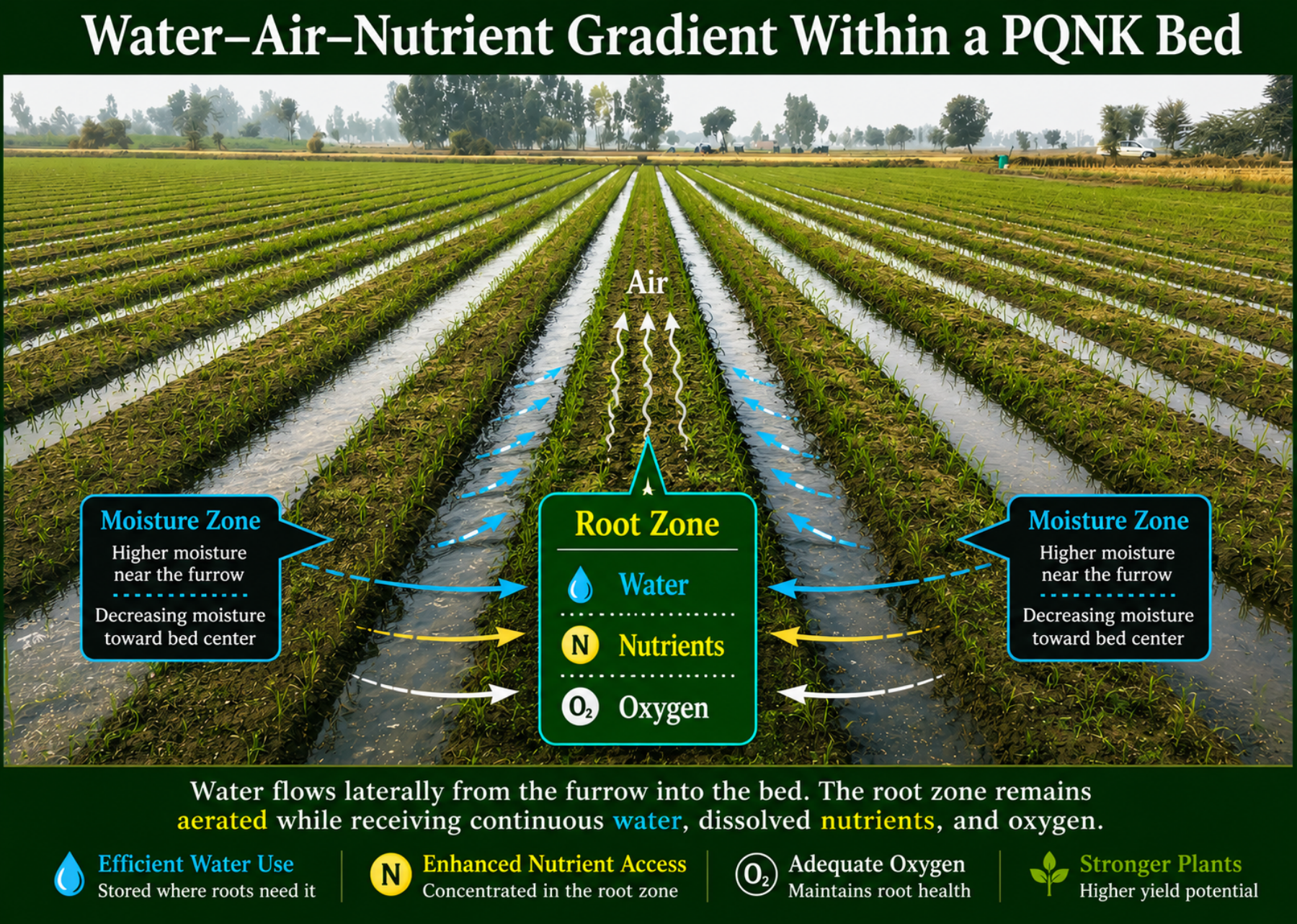
Water flows laterally from the furrow into the bed. The root zone remains aerated while receiving continuous water, dissolved nutrients and oxygen, with moisture highest near the furrow and decreasing toward the bed centre.
A raised bed under PQNK management does not have uniform conditions throughout its profile. It has gradients — zones of varying moisture, oxygen, temperature, and biological activity that shift across the day, the season, and the year, and that the crop’s root system actively exploits.
At the surface of the raised bed, beneath the mulch layer, conditions are relatively moist and moderately warm. This is where decomposition is most active and where the surface biological community is densest. At the bed centre, below the surface layer, conditions are aerobic and biologically active, with oxygen levels sufficient for root metabolism and fungal hyphal growth. At the bed margins, adjacent to the furrow, moisture levels are higher and oxygen is slightly lower — this is where capillary movement from the furrow enters the bed profile.
These gradients allow roots to proliferate where moisture, oxygen, temperature and nutrient conditions are favourable. Flooding temporarily reduces those contrasts by saturating much of the wetted profile, while raised-bed furrow irrigation preserves drier, better-aerated zones away from the furrow. The purpose of PQNK bed geometry is therefore not to create one uniform moisture condition, but to maintain a usable range of conditions across the bed while avoiding inundation of the root zone.
THE HALF-DEPTH RULE: THE SINGLE MOST IMPORTANT SMM INSTRUCTION
The half-depth furrow rule is the practical upper limit used in the standard PQNK bed system. It is deliberately simple so that a farmer can control water without instruments while protecting the bed surface from inundation.
With the standard 8-inch-deep furrow, water is applied slowly to approximately half the furrow depth, about 4 inches. Repeated tractor traffic compacts the base of the furrow, which restricts vertical infiltration straight down through the furrow bottom. Water therefore moves laterally toward the bed and infiltrates mainly through the lower part of the bed profile rather than from directly beneath the furrow. This matters beyond simple water delivery: it encourages roots to anchor deeper in search of water and nutrients, and that deeper anchorage helps protect the crop against lodging. The objective is to wet the root zone without allowing water to overtop and flood the raised bed. Where furrow geometry is adapted to tractor track or local soil conditions, the same principle is retained: supplementary water remains within the lower part of the furrow and the bed surface is not inundated.
Half the furrow depth is therefore a field operating rule, not a claim that every soil receives the same volume or irrigation interval. Timing and frequency are determined by crop demand, weather and the moisture condition of the bed.
READING THE CROP AND SOIL: WHEN TO IRRIGATE
SMM does not prescribe a fixed irrigation calendar. The farmer reads both crop and soil. The PQNK ball test is the primary practical check: soil taken from the active root zone is squeezed in the hand. If it forms a coherent ball and retains adequate moisture, irrigation is delayed; if it is too dry to hold together and crop observation confirms increasing moisture stress, supplementary irrigation is considered. Crop stage and extreme heat must also be taken into account.
Temporary midday leaf droop during very hot, dry conditions is not by itself proof that the soil is dry. Plants may reduce leaf water potential during periods of high atmospheric demand and recover later. Irrigation decisions should therefore combine the ball test, root-zone observation and crop response rather than relying on one visible symptom.
Likewise, visible dew or a damp mulch surface does not prove that deeper soil moisture is adequate. SMM is observation-based, but the observation must be made where the active roots are functioning.
The objective is not to push the crop toward wilting. It is to avoid unnecessary saturation while maintaining sufficient plant-available water for transpiration, cooling, nutrient transport and growth. As soil moisture declines, dissolved-ion concentrations and root-zone chemistry can change, but higher Brix or nutrient density cannot be attributed to a simple ‘concentration effect’ without crop-specific measurements.
ROOT INTELLIGENCE: ROOTS FOLLOW ECOLOGY, NOT JUST WATER
Roots respond to water, oxygen, temperature, nutrient availability, mechanical resistance and biological signals. Their distribution is therefore an ecological response, not a simple movement toward water. Compaction and prolonged oxygen limitation can restrict root elongation, while a moist, aerated and structurally open profile allows roots to explore a greater volume of soil.
Under PQNK, hardpan correction, permanent beds, retained root channels, mulch and SMM are intended to remove those restrictions. Field observations commonly show deeper and more branched rooting as the profile recovers. The exact architecture depends on crop genetics, soil texture, moisture distribution and season, so it should be documented as a field response rather than treated as identical in every PQNK crop.
BIOLOGICAL RESPIRATION: THE SOIL BREATHES
Soil organisms and roots respire, consuming oxygen and releasing carbon dioxide. When soil pores remain water-filled for prolonged periods, oxygen supply falls and anaerobic processes become more important. Depending on soil conditions, this can increase processes such as denitrification and, in strongly reduced environments, methane formation. Short irrigation events and permanent waterlogging are not the same condition, and their biological effects should not be treated as identical.
SMM seeks to keep enough air-filled pore space for root and microbial respiration while maintaining adequate moisture. The practical result is a soil environment that remains biologically active between irrigation events rather than oscillating unnecessarily between saturation and severe drying.
SOIL STRUCTURE AND THE RECOVERY OF AGGREGATION
Soil structure — the arrangement of mineral particles, organic matter, and pore space into stable aggregates — is what determines how water moves, how roots penetrate, and how biology distributes itself through the profile. Aggregate stability is a biological achievement, not a mineral one: fungal hyphae thread through particles like reinforcing rebar, and bacterial exopolysaccharides, sticky secretions produced by an active microbial community, cement those particles into water-stable clusters. These binding agents are continuously produced by living organisms and continuously lost when those organisms are absent. In a biologically depleted soil, degradation outpaces production and structure collapses; in a biologically active PQNK soil, production outpaces degradation and structure accumulates, season after season, including in soils, such as the yellow sandy soils common to parts of Pakistan’s citrus and vegetable belts, where the mineral texture itself will never change. Texture is geological and permanent. Structure is biological and entirely within the farmer’s reach.
The surface soil is a major zone of root activity, residue decomposition and exchange with the atmosphere. Earthworms and fungi often respond positively when disturbance is reduced, organic residues are retained and moisture is moderated. Their abundance, however, depends on climate, soil, species, pesticide history and surrounding habitat, so PQNK does not prescribe a fixed season in which they must return.
Fungal networks likewise rebuild when host roots, organic substrates and suitable moisture are continuously available. Mycorrhizal development can improve plant access to water and nutrients, while earthworm channels can increase macroporosity and provide pathways for roots. These organisms are useful indicators of recovery, but the field, not a calendar, determines the rate at which their functions become significant.
Fungal continuity recovers alongside earthworm activity, and is equally sensitive to disturbance. A single tillage pass severs the fungal hyphal network throughout the ploughed layer; flood irrigation kills the aerobic fungi that build it. Once tillage and inundation stop, fungal hyphae — which can extend several millimetres a day under favourable conditions — rebuild a continuous network across a raised bed within a single season, using the mulch layer as their carbon substrate. By the third or fourth season, mycorrhizal networks are sufficiently developed to measurably improve crop nutrient and water access. Earthworms and fungi are ecosystem engineers rather than passive residents: earthworm burrows become root pathways, earthworm casts become microhabitat for bacteria and fungi, and fungal networks transport carbon, water, and nutrients across distances no single root could reach alone. Their return is not a side effect of SMM. It is the mechanism through which every other recovery described in this chapter becomes self-sustaining.
WEED AND PEST REGULATION THROUGH ECOLOGICAL BALANCE
Weeds and pests respond to many interacting factors. Disturbance, bare soil, crop uniformity, plant nutrition and predator habitat can all influence pressure, but neither weeds nor pests disappear automatically when SMM is adopted. PQNK uses continuous mulch, crop diversity and reduced disturbance to make the production environment less favourable to some weeds and to provide habitat for beneficial organisms.
Mulch suppresses many light-sensitive weed seedlings and a closing crop canopy adds competition. Beneficial insects, spiders and other predators can contribute to pest regulation where habitat and food webs are maintained. During transition, however, severe weeds may still require targeted herbicide use and insect pests may require treatment when damage reaches the established PQNK threshold of about 10 percent. These are transitional safeguards, not contradictions of the long-term biological objective.
The expected direction is reduced dependence on intervention as soil cover, crop vigour and ecological complexity improve. The rate and degree of reduction vary by crop, season, pest complex and management; PQNK therefore does not attach weed or pest recovery to a fixed second-, third- or fourth-season timetable.
BIOLOGICAL COOLING: SMM AS TEMPERATURE REGULATION
Bare soil exposed to strong solar radiation can become extremely hot in Pakistan’s summer, with surface temperatures in field observations approaching 60-70°C. Organic mulch can lower soil-surface temperature substantially, often by tens of degrees under strong radiation, while also reducing evaporation. The exact difference depends on mulch thickness, moisture, canopy, soil colour, wind and time of day.
SMM combines this physical insulation with maintained soil moisture and progressive canopy shading. Plant transpiration also cools leaves and contributes to the field microclimate. The objective is not a fixed 30°C cooling claim for every field, but a more buffered root-zone temperature and slower loss of soil moisture than under exposed bare soil.
PLANT PHYSIOLOGY: THE CROP REFLECTS THE UNDERGROUND CONDITION
Crop appearance reflects genetics interacting with the root-zone environment. Compaction, nutrient imbalance, salinity, oxygen limitation and water stress can all alter rooting, leaf condition, flowering and yield. Flood irrigation is therefore one possible source of stress, not a universal explanation for every weak crop.
As the PQNK soil environment improves, field observations may show deeper rooting, steadier growth and improved reproductive performance. These changes should be read together with soil moisture, crop stage and weather. The purpose of SMM is to provide a stable moist-aerated environment in which the crop can express its genetic potential, not to promise that every variety will follow the same visible recovery timetable.
HOW IRRIGATION REQUIREMENT CHANGES AS THE SYSTEM MATURES
One of the clearest signs of improving SMM is that the field can often maintain adequate root-zone moisture for longer between supplementary irrigations. The change is biological and hydraulic, not calendar-driven.
Early transition: irrigation frequency may still resemble the conventional baseline because soil structure, root depth, mulch cover and biological activity are only beginning to recover. The farmer nevertheless uses the half-depth furrow rule and the ball test from the start.
Across succeeding crops: as root channels accumulate, mulch is maintained and the soil profile becomes better structured, irrigation intervals may extend and the volume applied per crop may decline. The rate differs with soil, crop, rainfall, humidity, temperature, wind and water quality.
Sustained PQNK: some crops and locations may eventually require very little supplementary irrigation, while others will continue to need it. There is no universal second- or third-season threshold. The field water balance determines the requirement.
WATER SAVINGS BY CROP: WHAT THE NUMBERS MEAN
The strongest PQNK water evidence should be expressed as measured or documented crop comparisons, not as a claim that all savings arise from one mechanism. Savings can result from eliminating ponded water, reducing exposed wet surface, improving infiltration and storage, accessing deeper moisture, changing irrigation frequency and applying only the deficit required by the crop.
Wheat: the established PQNK field comparison used in this book reports water use at about 19 percent of the conventional reference, equivalent to approximately 81 percent saving. This is a system-level field comparison, not a universal irrigation schedule for all wheat fields.
Cotton: the established comparison reports PQNK water use at about 23 percent of the conventional reference, approximately 77 percent saving. Actual irrigation frequency varies with climate, soil and crop stage.
Sugarcane: the established comparison reports PQNK water use at about 12 percent of the conventional reference, approximately 88 percent saving. This should be understood as a documented PQNK comparison rather than a universal percentage for every sugarcane field.
Rice: the established mature-PQNK comparison is approximately 513,950 litres per acre against 6,579,200 litres per acre for the stated flooded reference, about 8 percent of the conventional water use, or roughly 92 percent saving. This is a production-system comparison; it is not a claim that rice plant transpiration itself falls by 92 percent.
Across the crop records used in this book, documented savings range from approximately 77 to 92 percent relative to the stated conventional references, but this is not a fixed ceiling and there is no single universal figure. The actual saving on any given field depends on rainfall, the maturity of the bed and its mulch cover, the crop, and how closely irrigation is matched to genuine plant demand rather than habit. In a mature, well-mulched PQNK bed in an area receiving roughly 400 mm of annual rainfall, supplementary irrigation can become unnecessary altogether: a large share of conventional irrigation is applied out of habit or fear of crop loss rather than because the plant is actually short of water, and the ball test exists precisely to tell the difference. These figures should remain attached to their crop, location and management context rather than being converted into a universal promise or a fixed percentage range.
SALINITY: A HYDROLOGICAL AND CHEMICAL PROBLEM
Salinity is both a hydrological and a chemical problem. Salts are naturally present in soils and irrigation water, but crop injury occurs when soluble salts accumulate in the root zone to concentrations that reduce water uptake or create ion toxicity. Poor drainage, shallow saline groundwater, high evaporation and saline irrigation water can all contribute.
Flood irrigation over a compacted or poorly drained profile can worsen salt redistribution where large volumes of water are followed by strong surface evaporation. PQNK addresses the hydrological side by breaking hardpan, reducing unnecessary water application, maintaining mulch and improving drainage through the profile. Because irrigation volume under PQNK is so much lower than under continuous flood irrigation, the total salt load entering the field from a given water source is correspondingly lower too, a genuine advantage explained in full later in this chapter.
Where salts have accumulated, the conversion water wash after hardpan breaking provides the first leaching opportunity. Water quality, drainage, soil chemistry and crop salt tolerance must then guide continuing management. Recovery time cannot be fixed at two or three crops.
RAIN-RESPONSIVE AGRICULTURE AND GROUNDWATER RECHARGE
A better-structured, mulch-covered field can accept and store a larger share of rainfall than a compacted, crusted or bare field. At landscape scale, increased infiltration can contribute to groundwater recharge where geology, drainage and groundwater conditions allow it. It should not be claimed that every infiltrated litre becomes recharge; much of the stored water may later be used by plants or returned to the atmosphere.
The practical PQNK objective is therefore rain responsiveness: reduce avoidable runoff, retain water in the soil profile and allow rainfall to contribute as fully as possible to crop and subsoil moisture. Effects on aquifer levels or river baseflow require catchment-scale measurement and should not be inferred from a single field.
SMM IN RAIN-FED AND DRYLAND CONDITIONS
In rain-fed and dryland farming, SMM focuses on capturing rainfall, protecting it from rapid evaporation and giving roots access to the largest practical soil reservoir. Hardpan correction where present, permanent soil cover, retained roots, biodiversity and minimum disturbance remain central. Bed geometry and runoff management must be adapted to local topography and rainfall intensity.
Where annual rainfall is sufficient and well distributed, a mature PQNK field may reduce or eliminate supplementary irrigation. That outcome depends on rainfall, soil storage, rooting depth and atmospheric demand; it is not tied to a second or third-season deadline.
FLOOD IRRIGATION VS. SMM: THE COMPARISON
Flood irrigation wets a large soil surface and can temporarily saturate much of the upper profile. SMM instead confines supplementary water to the furrows and protects the bed surface from inundation. The comparison is therefore between two different water-delivery architectures, not between ‘water’ and ‘no water.’
Evaporation: flood-irrigated fields can lose substantial water through soil and open-water evaporation, but the fraction varies widely with climate, crop canopy, soil and irrigation practice. PQNK reduces the exposed wetted surface and protects the bed with mulch, thereby reducing avoidable evaporation without claiming that evaporation is eliminated.
Surface condition: water moving over bare, weakly aggregated soil can contribute to crusting and surface sealing. Permanent mulch and the absence of bed-surface flooding protect aggregates and maintain infiltration pathways.
Salt balance: where drainage is restricted and evaporation is high, repeated irrigation can contribute to salt accumulation. SMM reduces unnecessary salt loading by applying less irrigation water, while hardpan correction and appropriate leaching help move salts below the active root zone when drainage permits.
MANAGING SALINE IRRIGATION WATER: TEST THE WATER AND THE SOIL
TDS alone is not sufficient to determine whether irrigation water is safe. Electrical conductivity, sodium adsorption ratio, bicarbonate and specific ions, together with soil texture, drainage, crop tolerance and climate, determine the actual risk. A handheld TDS meter is useful for screening, but laboratory water and soil analysis is the proper basis for a management decision where salinity is significant.
Lower-salinity water generally presents less risk, but even modest salt concentrations can accumulate if drainage is poor. Conversely, some salt-tolerant crops can use more saline water where drainage and leaching are adequate. PQNK therefore does not prescribe universal 1,000, 2,000 or 4,000 ppm cut-offs as stand-alone rules.
Where better-quality canal, rainwater or groundwater is available, blending can reduce salt loading. Where leaching is required, it must be planned around drainage capacity and the chemistry of the soil and water. Gypsum is useful specifically where sodium hazard and soil chemistry justify calcium amendment; it is not a universal treatment for all saline water.
Crop choice is another management tool. Salt-tolerant crops can be used while the field is being corrected, whereas sensitive vegetables, nurseries and young orchards require greater caution. The objective is to keep salts from accumulating in the active root zone faster than water movement and crop removal can manage them.
The PQNK principle remains the same: minimise unnecessary irrigation volume, keep the soil covered, maintain an open profile, and use measured water quality rather than assumptions. Where the only available water is highly saline, local agronomic and water-quality advice is necessary before deciding how it can safely be used.
The conversion wash and subsequent SMM address the field’s hydraulic condition, but they do not change the concentration of salts entering in irrigation water. Long-term sustainability therefore depends on the total salt balance: salt entering with water, salt leaving through drainage or harvest, and salt remaining in the root zone.
SALT LOAD, NOT TDS ALONE: THE PRINCIPLE BEHIND WATER QUALITY
The practical question is not simply how concentrated the irrigation water is, but how much total salt enters the field and whether the profile can move that salt away from active roots. Because PQNK applies far less water for the same crop, often on the order of ten times less than continuous flood irrigation, it also introduces a correspondingly smaller total salt mass from the same water source, even without any change in water quality. In the rice comparison already cited in this chapter, roughly 513,950 litres per acre against 6,579,200 litres per acre means PQNK irrigation delivers only about 8 percent of the salt mass a flood-irrigated field would receive from an identical source. This is a genuine structural advantage of the system, not a detail to set aside, and it is why water that would be unsuitably saline under continuous flood irrigation can sometimes be used successfully under PQNK. It does not mean reducing volume removes the need for adequate leaching where salts do accumulate.
PQNK changes the soil-water architecture in ways that compound this advantage. Because hardpan is corrected, water and the salts it carries can move down through the profile rather than concentrating in a shallow, compacted root zone, so drainage genuinely reaches below the roots instead of pooling against a barrier. An active, biologically developed rhizosphere further buffers root-zone chemistry, consistent with the pH effect already noted. Reduced total salt input, a real drainage pathway below the root zone, and biological buffering together explain why PQNK fields can often tolerate higher-TDS water than a comparable flood-irrigated field drawing on the same source. This does not make saline water chemically harmless: where drainage is genuinely restricted, salt can still accumulate regardless of how little water is applied.
Root-zone pH can differ from bulk-soil pH because roots and microorganisms alter the rhizosphere through proton exchange, respiration, exudates and nutrient uptake. PQNK field observations of a more favourable rhizosphere are consistent with this principle, but a universal near-neutral root-zone pH should not be assumed without measurement.
The result is a management threshold that is field-specific. Water quality, soil chemistry, drainage, crop tolerance and irrigation volume must be considered together. The purpose of the decision process is not to declare a water source universally safe or unsafe, but to prevent damaging salt accumulation in the root zone.
FROM EXTRACTION TO REGENERATION
Every agricultural system removes water and harvested biomass from the field. The PQNK objective is not literal closure but greater regeneration: protect the structures and biological processes that allow the soil to receive the next rainfall, retain residues and roots, and reduce dependence on repeated physical reconstruction and excessive irrigation.
Mulch protects and feeds the surface community. Retained roots contribute carbon and channels below ground. Furrow irrigation supplies moisture without inundating the bed surface. Over succeeding crops, these practices can improve soil structure and water buffering. Long-term productivity must still be measured; it should not be claimed to increase indefinitely without limit.
FOOD QUALITY, NUTRIENT DENSITY, AND SEED VITALITY
SMM can influence crop quality indirectly through water status, root activity, nutrient availability and the soil biological environment. Flavour, Brix and concentrations of compounds such as allicin, quercetin or carotenoids are crop-specific traits affected by genetics, maturity, environment and post-harvest handling as well as soil management. PQNK field observations are valuable evidence, but broad nutritional superiority should be supported by direct comparative analysis.
The same caution applies to seed. Seed filling, reserves, germination and seedling vigour are influenced by the condition of the mother plant and its environment. Farmers may observe stronger seed from well-managed PQNK crops, but genetic change should not be inferred, and season-to-season improvement should be documented rather than assumed.
The wider objective is resilience: a field with better soil structure, deeper rooting, continuous cover and lower dependence on purchased inputs may be better able to absorb drought, heat or input-price shocks. The degree of resilience remains crop- and site-specific.
WHAT THIS CHAPTER HAS ESTABLISHED
Soil Moisture Management is PQNK’s framework for keeping water and air in a productive relationship within the root zone. It combines permanent raised beds, hardpan correction, continuous mulch, retained roots, biodiversity and observation-based supplementary furrow irrigation. The standard operating limit is approximately half the furrow depth, while the timing and frequency are determined from the field rather than a calendar.
Rainfall, dew, atmospheric humidity and stored subsoil moisture can all influence the field water balance, but their contributions vary by environment. Supplementary irrigation supplies the deficit that remains. Across the established crop comparisons used in this book, PQNK irrigation-water savings range from approximately 77 to 92 percent relative to the stated conventional references; these are field-system comparisons, not universal reductions in plant physiological water requirement.
The central principle is simple: do not manage water in isolation. Manage the living soil that receives it. A moist, aerated, covered and biologically active profile can make each unit of water more useful while reducing avoidable loss. Chapter Twenty-Seven turns to the surface component that protects this water system every day: organic mulch.
Chapter Twenty-Seven: Organic Mulch