

Industrial Devastation To Natural Abundance
The PQNK System · Chapter 27
Organic Mulch
Nature’s Blanket: Thermostat, Food Source, Weed Suppressor, and Carbon Engine
Release 1.0 · 2026-09-18
If you use “Listen”, the text of the page may be sent to your browser or operating system’s speech provider, such as Apple, Google or Microsoft, depending on the voice your device uses. Pedaver does not process, transmit or store any audio.
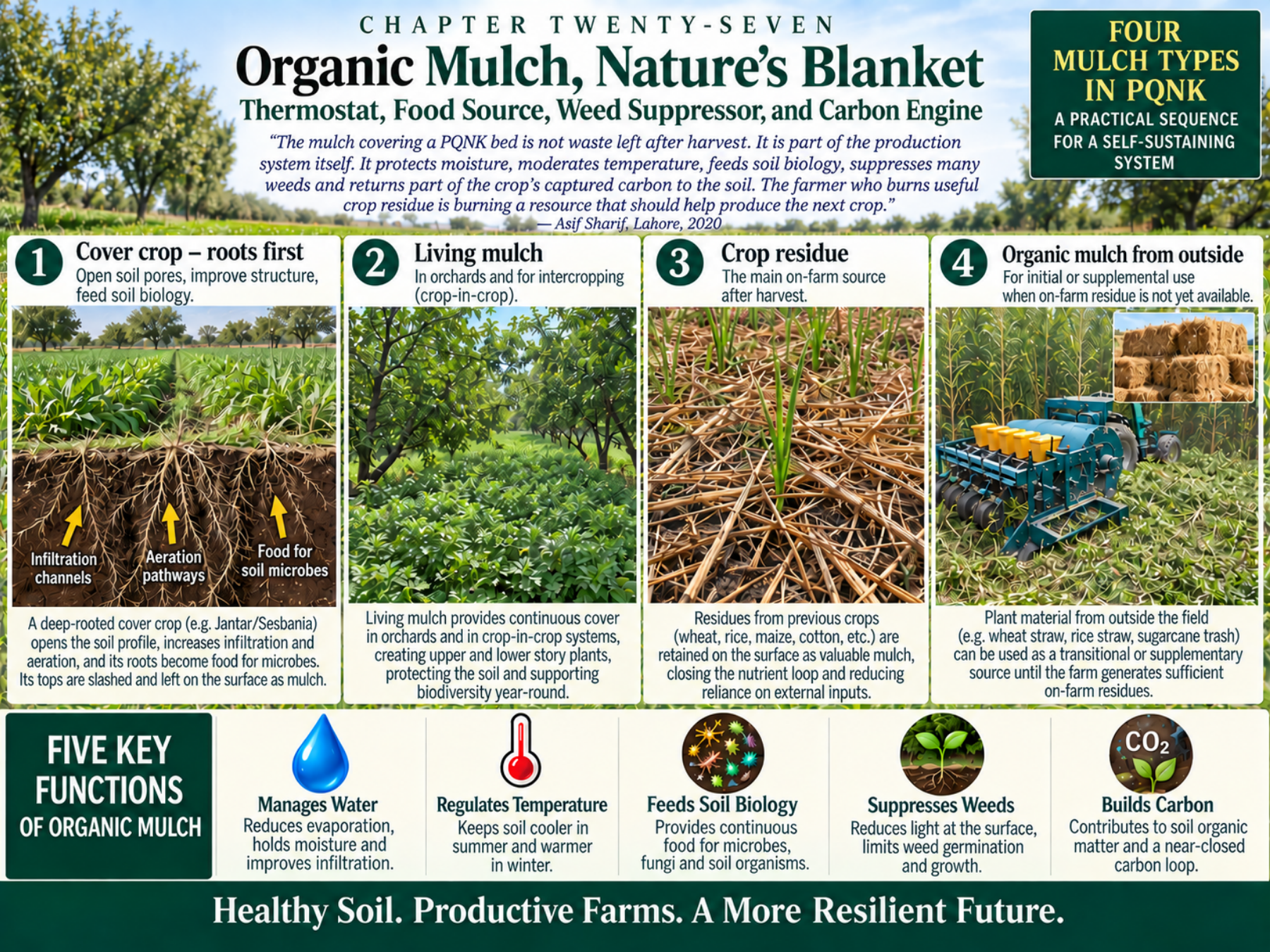
“The mulch covering a PQNK bed is not waste left after harvest. It is part of the production system itself. It protects moisture, moderates temperature, feeds soil biology, suppresses many weeds and returns part of the crop’s captured carbon to the soil. The farmer who burns useful crop residue is burning a resource that should help produce the next crop.”
Asif Sharif, Lahore, 2020
Of all the physical elements of the PQNK system, organic mulch is the most visible, the most immediately understandable, and the most frequently underestimated. Farmers who first hear about PQNK often describe the mulch requirement as straightforward, a layer of straw on the surface of the beds. Simple. Obvious. Something they could do tomorrow. What they typically underestimate is how many biological functions that three-inch layer is performing simultaneously and how many of the system’s most distinctive results, the water savings, the weed elimination, the biological recovery, the carbon accumulation, depend on its presence and its continuity.
This chapter develops the full account of organic mulch in a PQNK system: how the first mulch is grown in the field through a cover crop, how retained crop residues maintain the cover thereafter, the major functions mulch performs, how depth and texture are adapted to the crop and planting method, and how the surface layer changes as decomposition and biological activity progress. The principle is continuous organic cover; the material and thickness are managed according to field conditions rather than a fixed seasonal clock.
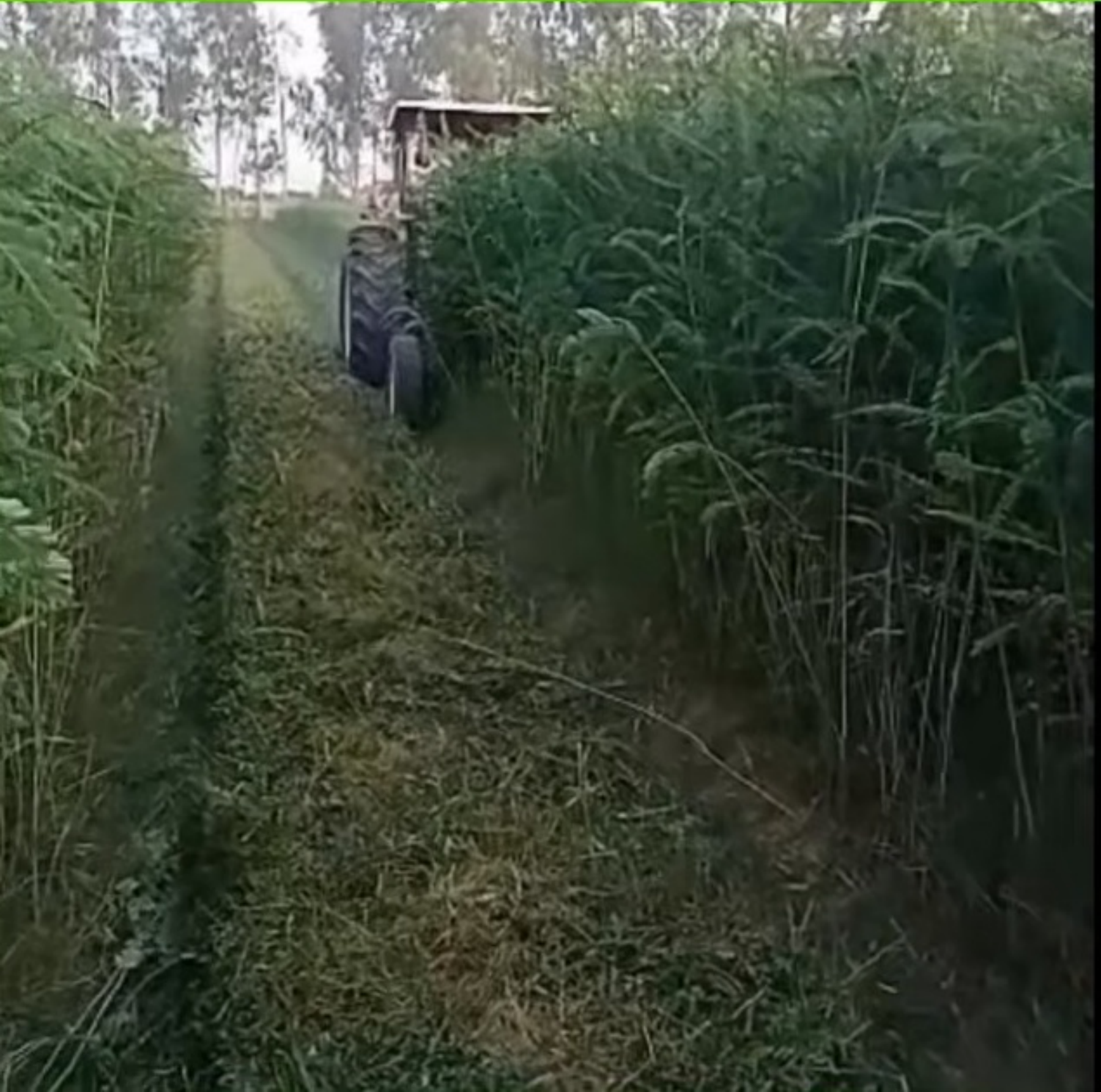
Actual field evidence from the attached PQNK video: standing biomass being managed in the field. The first cover crop grows the first mulch where practical; roots remain in the bed and the tops become surface cover.
MULCH TYPES AND THE PQNK PRIORITY ORDER
PQNK uses two complementary forms of biological soil cover: living cover and dead organic mulch. Living cover is supplied by growing plants, beginning during conversion with a vigorous cover crop such as Jantar (Sesbania) where agronomically appropriate. After termination, the roots remain undisturbed in the bed and the above-ground biomass becomes the first organic mulch. Thereafter, properly managed residues from succeeding crops become the continuing mulch source. Synthetic plastic sheeting is not organic mulch and does not fulfil the PQNK rule that soil remain covered with organic material.
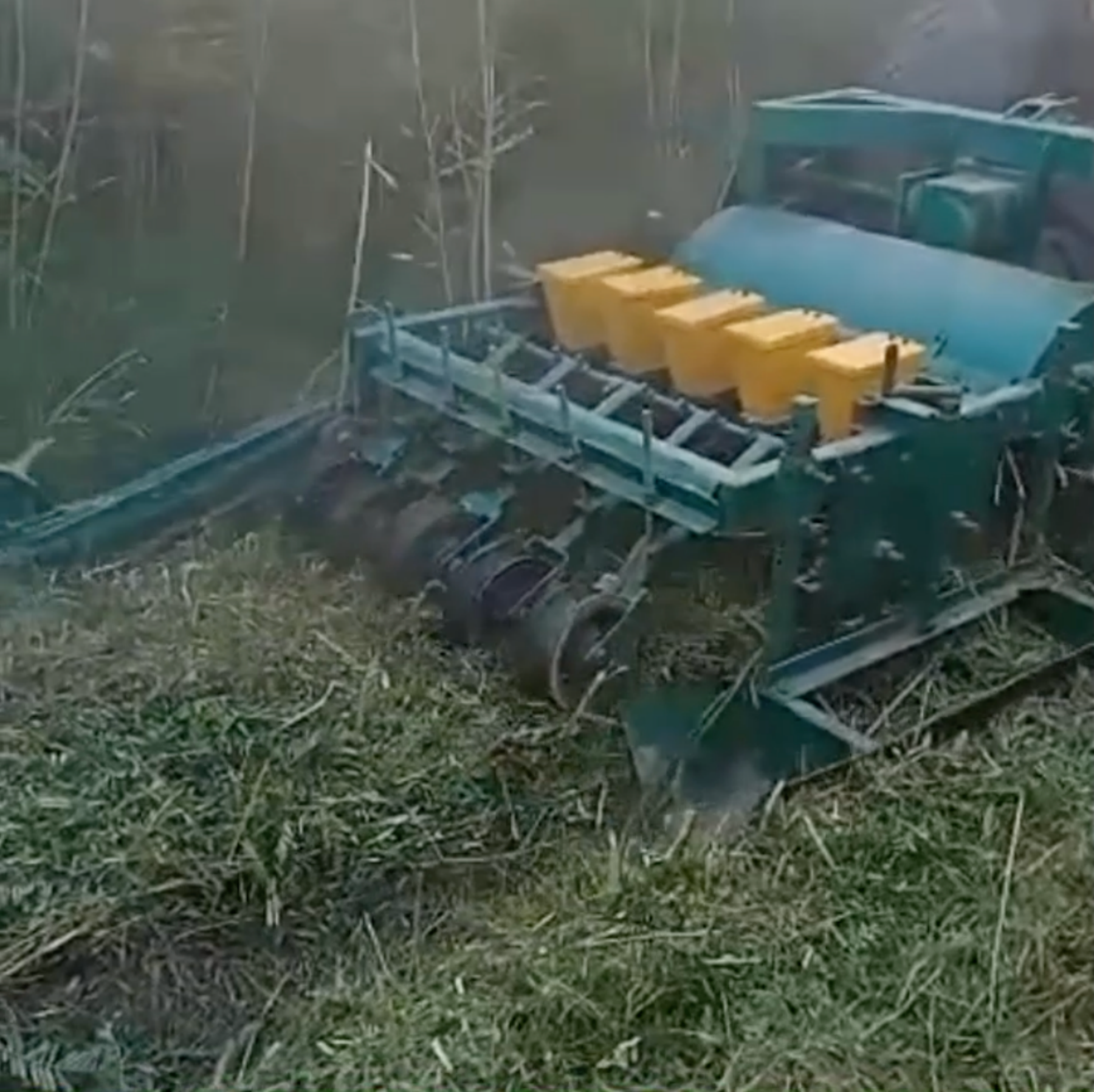
Actual field evidence from the attached PQNK video: machinery managing plant material at the soil surface. The objective is to place or retain organic biomass as cover without rebuilding or tilling the permanent bed.
TWO PRACTICAL SOURCES OF MULCH
The field video on mulch types identifies two practical sources of organic mulch: plant material brought from outside the field, and plant residue produced by the previous crop. Both can protect the soil, but they play different roles in the PQNK transition. The preferred long-term direction is for the field to become increasingly self-supplying through cover-crop biomass and retained crop residues. Outside plant material is therefore a useful transitional supplement where the field has not yet produced enough biomass to maintain continuous cover, not the permanent foundation of the system.
During initial conversion, the first cover crop should be grown in the same field wherever practical. Its roots remain in the permanent beds to open and biologically occupy the soil, while its above-ground biomass is laid on the surface as the first mulch. If this biomass does not provide complete protection, suitable plant material from outside the field can be added to close the gaps. From succeeding crops onward, properly managed crop residues become the principal continuing source of mulch.
The first cover crop is an important biological step in conversion. Jantar (Sesbania), where suitable, provides rapid canopy cover and a vigorous root system that penetrates the opened profile, creates root channels, feeds soil organisms and begins rebuilding structure. When the crop is terminated, the roots are retained in the soil and the above-ground biomass is laid on the surface. In this way the field grows its first mulch rather than depending on a purchased blanket of residue.
Dead organic mulch is the surface residue layer that follows the living cover crop. Once normal PQNK crop production is established, each crop contributes roots below ground and usable residues above ground to the biological environment inherited by the next crop. Residues may differ greatly in texture, density and decomposition rate, so management is adapted to the crop and planting method while the governing requirement remains unchanged: the soil surface stays continuously protected with organic material.
WHAT ORGANIC MULCH IS AND WHAT IT IS NOT
Organic mulch in PQNK is any plant-based material applied to the soil surface to maintain continuous coverage. It is not compost, compost is decomposed organic matter intended for incorporation into soil. It is not green manure, a cover crop intended for tillage incorporation. It is not a soil amendment in the conventional sense. It is a surface layer that stays on the surface, decomposes from below, and performs its biological functions precisely because it is at the interface between the atmosphere and the soil rather than within either.
The distinction matters because farmers familiar with composting or green manuring sometimes want to mix surface residues into the soil. PQNK does not do this. Incorporation would disturb the permanent bed and interrupt the surface biological layer. High-carbon residues mixed into soil can also cause temporary nitrogen immobilisation during decomposition. Left on the surface, residues decompose progressively at the soil-mulch interface, where fungi, bacteria, soil fauna, moisture and roots interact without rebuilding a tilled seedbed.
THE FIVE FUNCTIONS OF ORGANIC MULCH
Organic mulch in a PQNK system performs five distinct biological functions simultaneously. Each function contributes to a different dimension of the system’s performance, and each is maximised by the same condition: continuous, thick, uninterrupted surface coverage.
Function One: Water management. Mulch greatly reduces direct soil evaporation by shading the surface, reducing wind exposure and interrupting direct solar heating. It does not eliminate evaporation, and the amount saved varies with climate, canopy, mulch thickness and soil moisture. The mulch surface can also intercept rainfall and dew, slow runoff, and help maintain a cooler, more humid soil-surface microenvironment. Its water-management value is therefore both protective and hydraulic: more incoming water can be retained in the rooting environment and less is lost unnecessarily from exposed soil.
Function Two: Temperature regulation. Bare soil exposed to strong summer radiation in Pakistan can reach very high surface temperatures, with PQNK field observations approaching 60–70°C. Organic mulch buffers this heating and can reduce soil-surface temperature by tens of degrees under strong radiation. The exact temperature beneath the mulch depends on thickness, moisture, canopy, soil colour, wind and time of day. The biological purpose is not to hold every field at one fixed temperature, but to protect the root-zone surface from the extreme thermal fluctuations experienced by bare soil.
Function Three: Weed suppression. Many weed seedlings are strongly inhibited when an adequate mulch layer blocks light and physically obstructs emergence. Mulch therefore reduces weed pressure, but it does not prevent every weed species or every established perennial from emerging. Weed response depends on species, residue depth, gaps in cover, seed reserves and field history. During transition, severe weeds may still require targeted control. The long-term objective is to reduce weed pressure by keeping the soil covered and avoiding the repeated disturbance that continually creates new germination opportunities.
Function Four: Biological food source. The organic material in the mulch supplies carbon and other substrates to decomposer organisms at the soil surface. Fungi, bacteria and soil fauna progressively process the residue, contributing to nutrient cycling, aggregation and pore development. Earthworms, where climate and field conditions support them, can carry decomposing material into the surface soil and create biopores. Mulch therefore acts as a continuing energy source for the biological community, while living roots provide an equally important carbon pathway below ground.
Function Five: Carbon return and accumulation. As mulch decomposes, part of its carbon returns to the atmosphere through respiration and part can be incorporated into microbial biomass, aggregates and more persistent soil organic matter. Retaining crop residues therefore returns a portion of photosynthetically captured carbon to the soil rather than removing or burning it. Whether soil becomes a net carbon sink, and by how much, depends on the balance between carbon inputs, decomposition, erosion and other losses and must be established by measurement rather than assumed from mulch presence alone.
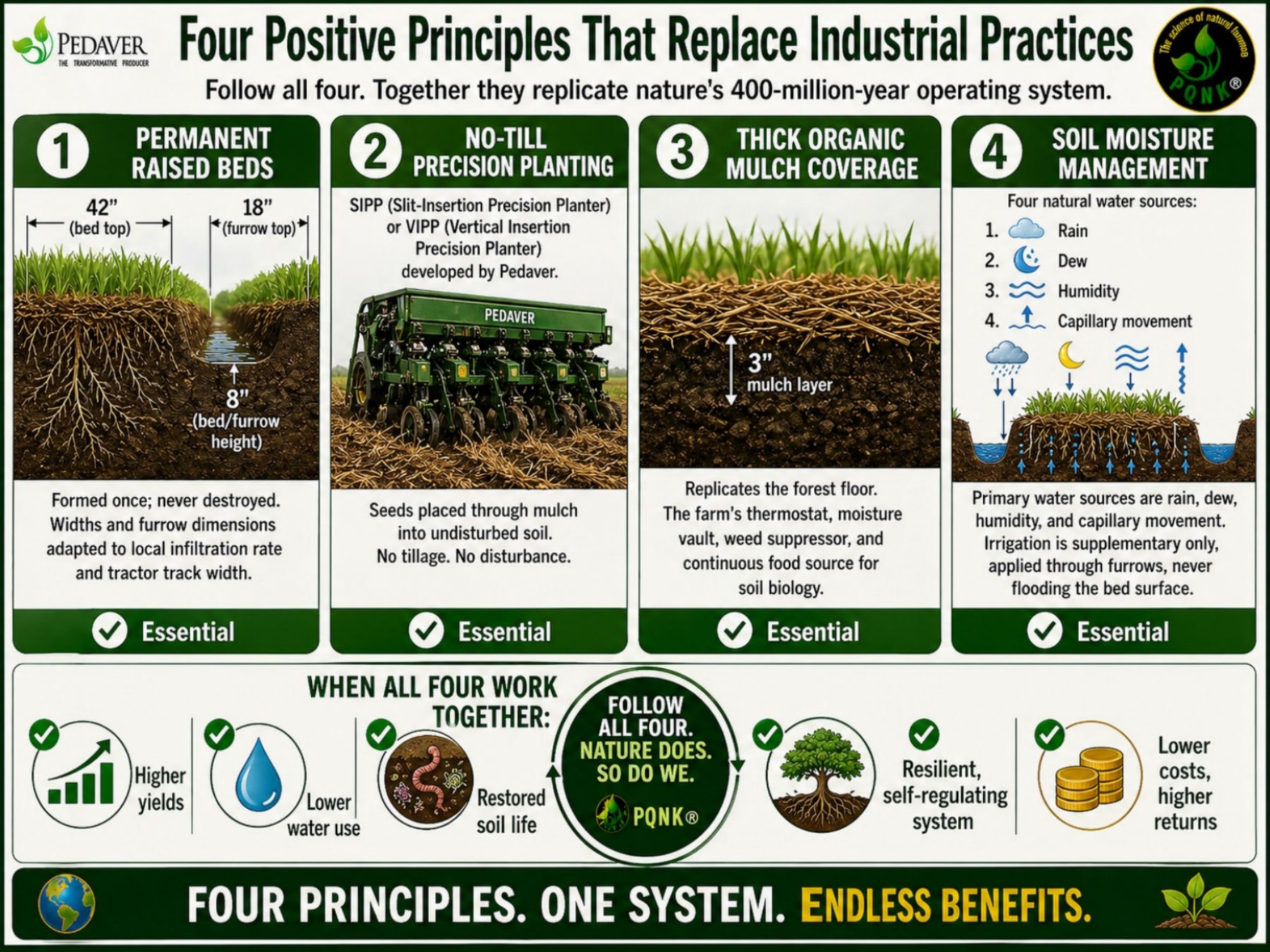
Four Positive Principles That Replace Industrial Practices: Raised Beds, No-Till Planting, Thick Mulch, Precision Irrigation.
MULCH DEPTH: THE CRITICAL PARAMETER
Of all mulch-management decisions, continuity of cover is the governing requirement. Thickness must be sufficient to protect the soil from direct solar exposure and substantially restrict light reaching the surface, while still allowing the planted crop to emerge through the planting slit. Because residues differ in density and structure, PQNK does not treat one depth as universally correct for every material and crop.
For loose straw materials such as wheat or rice straw, a layer of roughly 3 to 4 inches can be a useful field starting point where it provides continuous light-blocking cover. The practical test is the soil surface itself: if sunlight is reaching substantial areas of soil through gaps, the layer is too open or too thin. The required amount should then be adjusted to residue type, crop, weather and planting method.
For denser or coarser materials such as cotton stalks, sugarcane trash or maize stover, the effective thickness may differ because the residues settle and block light differently. Shredding, crimping or arranging coarse material can improve surface contact and reduce gaps. Mixed residues are acceptable. The objective is not a fixed number of inches but continuous organic protection compatible with crop emergence and field operations.
The mulch layer must remain functionally continuous as residues weather and decompose. Where gaps develop, available on-farm organic material can be redistributed or supplemented. As the crop canopy closes it adds shade, but the surface cover remains important between crops and during early establishment, when bare soil would otherwise be most exposed. In a sustained PQNK system, residue management from each crop is planned so that the next crop inherits a protected surface rather than a cleared seedbed.
MULCH TEXTURE AND SEED-SPECIFIC CONSIDERATIONS
Depth is not the only variable that matters at planting. The mulch layer also needs to suit the seed going into it. Broadleaf seeds such as beans and sunflowers, and narrowleaf seeds such as grasses and grains, push through the soil surface differently, and the mulch above them should be adjusted accordingly. Seed size carries its own logic: small seeds, lettuce and carrots among them, need a finer, lighter mulch layer so their limited reserves are not obstructed on the way up, while large seeds such as corn or squash can tolerate a thicker layer without difficulty.
The reason this matters is that a germinating seed has only a finite store of energy in its embryo to reach sunlight. A mulch layer that is too thick, too dense, or simply mismatched to the seed can exhaust that reserve before the seedling ever breaks the surface, stunting or killing the plant before it has begun. This is why the SIPP/VIPP no-till planter creates a precise slit through the mulch at the exact moment of planting: rather than asking the seed to force its own way through an undisturbed layer, the planter gives it a clear, unobstructed path to daylight, matched to the seed’s own limited energy budget.
MULCH SOURCES IN THE PQNK AGRICULTURAL SYSTEM
Pakistan’s agricultural system produces enormous quantities of organic residue annually that are currently managed as a waste problem rather than a resource. The burning of wheat straw, cotton stalks, and rice straw is visible from the air across Punjab and Sindh in every post-harvest period, representing the atmospheric release of the carbon, nitrogen, and biological energy that PQNK’s mulch layer would have used to build the next season’s soil. The farmer who burns his crop residue is incinerating his most valuable asset.
Wheat straw: A major rabi residue in Punjab and a useful mulch material. Its fibrous structure provides durable surface cover and decomposes progressively. Where wheat precedes a kharif crop, retained straw can become an important part of the mulch inherited by the following crop. The amount available varies with variety, yield, harvest method and how much residue is removed from the field.
Cotton stalks: A woody residue that decomposes more slowly than soft straw. Stalks can be chopped, shredded or crimped where necessary to improve surface contact and permit the next planting operation. Their value lies in durable carbon-rich cover, but the quantity and handling requirement vary with crop growth and harvest method.
Rice straw: High silica content that makes it resistant to decomposition, a property that is a disadvantage in composting systems but an advantage in surface mulch applications where longevity of coverage is desirable. Generates large quantities per acre and is currently a major burning problem in Punjab’s rice districts.
Sugarcane bagasse: The fibrous residue of sugarcane milling and the dry leaves and tops from the harvest. Available in large quantities in sugarcane districts. Excellent light-blocking properties and moderate decomposition rate.
Maize stovers: Stem, leaf, and cob residue from maize harvest. High volume per acre. Best shredded or crimped before application to prevent the tall stalks from creating gaps in surface coverage.
Cover crop biomass: During initial conversion, the first cover crop is deliberately grown in the field so that its roots open and biologically occupy the soil while its above-ground biomass becomes the first mulch. Jantar (Sesbania) is the standard PQNK example where suitable, although other locally adapted cover crops may be used. In later crop sequences, additional cover crops can be inserted where useful for continuity, diversity or residue production. They are terminated without tillage, roots remain in the soil, and the tops remain on the surface.
THE MULCH ACROSS SEASONS: HOW IT CHANGES
The mulch layer in a PQNK system is not static. It changes continuously as fresh biomass is added, older residues decompose, roots remain in the soil and the biological community develops. These changes are better understood as stages of establishment than as fixed seasons, because decomposition and residue production vary with crop, climate, soil biology, moisture and management.
Initial biological cover: After the permanent beds are formed, the first cover crop is grown in the field. Its living canopy protects the surface while its roots penetrate the profile. When terminated, the roots remain undisturbed and the above-ground biomass is laid down as the first organic mulch. At this stage the surface layer performs immediate physical functions while biological colonisation and decomposition begin at the soil-mulch interface.
Developing residue layer: As succeeding crops are planted and harvested without rebuilding the bed, retained residues accumulate in different stages of decomposition. Fresh material protects the surface while older material nearer the soil is progressively processed by fungi, bacteria and soil fauna. Root channels from previous crops remain below ground. The rate of this development is field-specific and should be read from residue continuity, soil condition and biological activity rather than from a crop count.
Sustained residue cycle: When crop-after-crop management produces enough usable residue to maintain continuous cover, the field becomes increasingly self-supplying in mulch material. Some systems may reach this condition quickly; others may need additional biomass for longer. Harvest still exports matter from the field, so PQNK should be described as a near-closed-loop biological production system rather than a literally closed loop. The objective is sustained internal recycling with minimal dependence on imported mulch.
First, the cover crop grows the biological blanket. Then each succeeding crop adds to it. As the soil and residue cycle develop, the field increasingly produces the surface protection required by the crop that follows. The field, not the calendar, determines how quickly that condition is reached.
WHAT NOT TO DO: COMMON MULCH MISMANAGEMENT
Do not burn crop residue. Burning converts the carbon, nitrogen, sulphur, and micronutrient content of the residue into atmospheric gases and ash. The ash contains mineral residues but none of the biological energy or structural carbon that the residue would have provided. Burning is the most common and most wasteful form of mulch mismanagement in Pakistani agriculture. It is understandable as a field-clearing convenience but represents the destruction of the most valuable biological resource the farm produces.
Do not incorporate the mulch. Mixing or tilling the mulch into the soil violates the no-tillage prohibition and produces a burst of decomposition that consumes soil oxygen, harms aerobic organisms, and may temporarily immobilise nitrogen as the high-carbon material decomposes. The mulch performs its biological functions at the surface. Leave it there.
Do not apply mulch too thinly. A thin mulch layer fails at all five functions simultaneously. Light penetrates to weed seeds. Evaporation continues from the partially exposed surface. Temperature moderation is inadequate. Carbon supply to the biological community is insufficient to sustain the decomposer activity that drives biological recovery. If in doubt about depth, always apply more.
Do not remove the mulch before planting. Some farmers, accustomed to the clean seedbed of conventional tillage, want to remove the mulch before seeding to create the bare surface they are familiar with. This removes the biological layer that the SIPP planter is designed to seed through. The PQNK planter places seeds through the mulch. The mulch stays. The planter adapts to it. Not the other way around.
THE ECONOMIC LOGIC OF MULCH
For a farmer beginning PQNK, the practical mulch question is how to establish continuous organic cover while the permanent biological system is still being built. The preferred answer is to grow the first mulch in the field through the initial cover crop, retaining its roots and laying its above-ground biomass on the bed. Where that biomass is insufficient for complete protection, locally available organic residues may be added as a transitional supplement. The aim is to move as quickly as field conditions allow toward residue self-sufficiency rather than create a recurring purchased-mulch requirement.
The economic value of mulch comes from several functions operating together: it protects a substantial structural water saving that shifting to PQNK produces on its own, it suppresses weeds and so can reduce labour or herbicide demand, it moderates soil temperature and protects the biological environment building beneath it, and it recycles residue material that the farm has already produced rather than requiring a purchased input.
Water is the clearest example of how these functions compound. Moving from flood or conventional furrow irrigation to the PQNK bed-and-furrow geometry produces an immediate reduction of more than 70 percent on its own: water is confined to a narrow furrow rather than spread across the field surface, the furrow bottom compacted by tractor traffic keeps that water moving laterally into the bed rather than draining straight down, and the exposed water surface during each irrigation event is far smaller than under flood application. Mulch then protects this saving rather than creating it: the covered bed surface stops the water that has moved laterally into the root zone from evaporating once it arrives, and it blocks the capillary pathway that would otherwise wick stored soil moisture back up to an exposed surface and lose it to the air. Together, these effects mean far less water is applied at each irrigation, and the interval between irrigations lengthens as moderated soil temperature, reduced capillary loss, and absorbed dew and atmospheric humidity keep the root zone supplied between events. As the field matures, irrigation increasingly becomes a supplement reserved for extreme conditions; in a well-mulched bed receiving adequate rainfall, supplementary irrigation can become unnecessary altogether, with retained rainfall, dew and humidity continuing to supply the root zone.
The established PQNK crop comparisons in this book report irrigation-water savings of approximately 77 to 92 percent relative to their stated conventional references. That documented range is the combined result of the immediate structural saving from bed-and-furrow geometry described above and the extended irrigation interval that mulch and soil biology make possible over time; it should not be attributed to mulch in isolation.
As crop residues accumulate and are properly managed, dependence on outside mulch can decline. The speed of that transition depends on biomass production, crop sequence, residue removal, decomposition rate, climate and the completeness of surface cover. PQNK therefore does not promise that mulch becomes self-sufficient by a second or third season. The economic objective is simpler and more defensible: retain and reuse the farm’s own biological material wherever possible, reduce recurring purchased inputs, and allow the field to build its own protective residue cycle over time.
WHAT THIS CHAPTER HAS ESTABLISHED
Organic mulch is one of the most multifunctional elements of the PQNK protocol. Its major functions include water conservation, temperature buffering, weed suppression, biological feeding and the return of crop carbon to the soil. It is the agricultural counterpart of the litter layer seen in natural terrestrial ecosystems, including the Amazon reference system discussed in Chapter Eighteen. PQNK combines that surface protection with permanent beds, retained roots, no tillage after conversion, Soil Moisture Management and biodiversity. The governing principle is not a universal three-inch blanket or a fixed seasonal timetable. It is continuous organic cover managed so that the soil remains protected while the crop can grow through it.
The next chapter establishes the engineering framework of the PQNK machinery system: the distinction between one-time conversion machinery and the low-disturbance tools used after permanent beds are established, and the ecological reasoning that governs every implement in the PQNK toolkit.
Chapter Twenty-Eight: PQNK Machinery Engineering