

Industrial Devastation To Natural Abundance
The PQNK System · Chapter 29
SIPP and Precision Planting
The Machine Revolution, Every Seed in Its Right Place
Release 1.1 · 2026-09-29
If you use “Listen”, the text of the page may be sent to your browser or operating system’s speech provider, such as Apple, Google or Microsoft, depending on the voice your device uses. Pedaver does not process, transmit or store any audio.
“The conventional seed drill was designed to drop seed randomly along a furrow cut through a tilled bed. We needed a planter that could place each seed individually through three inches of straw into undisturbed soil beneath. No such machine existed. We built it. That is the SIPP. It is not a modification of a conventional planter. It is a different idea entirely.”
Asif Sharif, Lahore, 2018
The biological framework of PQNK requires no-till seeding through an established organic mulch layer at dramatically reduced seed rates and precise individual seed placement. This requirement represents a complete departure from conventional seeding technology: broadcast seeders, which distribute seed randomly across a prepared surface; drill seeders, which penetrate a tilled seedbed with multiple coulters at fixed spacing; and transplanting systems, which establish seedlings in flooded conditions. None of these technologies can deliver what the PQNK biological system requires.
The development of the SIPP, Slit Insertion Precision Planter, and subsequently the VIPP, Vertical Insertion Precision Planter, represents one of the most important agricultural engineering contributions of the PQNK programme. These are not off-the-shelf machines adapted for a new purpose. They are precision seeding systems designed from first principles for the specific requirements of PQNK’s no-till, mulch-covered, permanent raised bed system. This chapter describes what they do, why they work, how they differ from conventional planting technology, and what results they produce when correctly operated.
THE ENGINEERING LINEAGE: WHY THE SEED OPENER, NOT THE SEED METER, WAS THE UNSOLVED PROBLEM
Every mechanical planter, including the SIPP and VIPP themselves, is actually two machines built to look like one. The seed meter decides which seed goes into the ground and when; the seed opener decides how the soil is disturbed to receive it. Agricultural engineering spent two centuries refining the seed meter, plate cells, vacuum drums, finger pick-ups, until singulation accuracy became a solved problem. The seed opener received almost none of that attention. For twelve thousand years, from the sharpened planting stick through the hoe, the animal-drawn plough, and the shoe, hoe, disc, tine, and rotary openers fitted to mechanical drills, every seed-opening method has shared the same underlying strategy: disturb a continuous channel of soil the full length of the row, then drop seed into it. The tools changed; the strategy did not.
That inherited strategy carries a cost conventional seed-rate tables never measure directly: disturbed soil volume, the total quantity of soil structure broken to place a given quantity of seed. A continuous slit opener disturbs soil along the entire row whether or not a seed occupies that exact point, exposing organic matter to oxidation, breaking fungal networks, and creating a uniform channel that invites weed germination along its full length. Nature does not plant this way. A seed falling from a parent plant, carried by wind, water, or an animal, lands and germinates at a single point; the surrounding soil is left entirely undisturbed. No naturally regenerating system disturbs soil in a continuous slit to place what is, at every individual point, a discontinuous event.
The VIPP’s vertical insertion principle is the PQNK response to that mismatch. Rather than opening a continuous channel and dropping seed at intervals along it, the VIPP disturbs soil only at the precise point, a cone under half an inch wide at its base, widening to about an inch at the surface, roughly an inch and a half deep, where each individual seed will actually sit. Disturbed soil volume per seed falls accordingly, and the undisturbed soil between insertion points retains its structure, fungal networks, and moisture intact. This is the engineering argument beneath the biological and economic case made throughout this chapter: the SIPP and VIPP are not simply more accurate seed meters bolted to a conventional opener. They are the first seed openers in the technology’s twelve-thousand-year history designed around the seed’s own point of placement, rather than the row’s continuous line.
WHY PRECISION SEEDING MATTERS: THE BIOLOGY OF PLANT SPACING
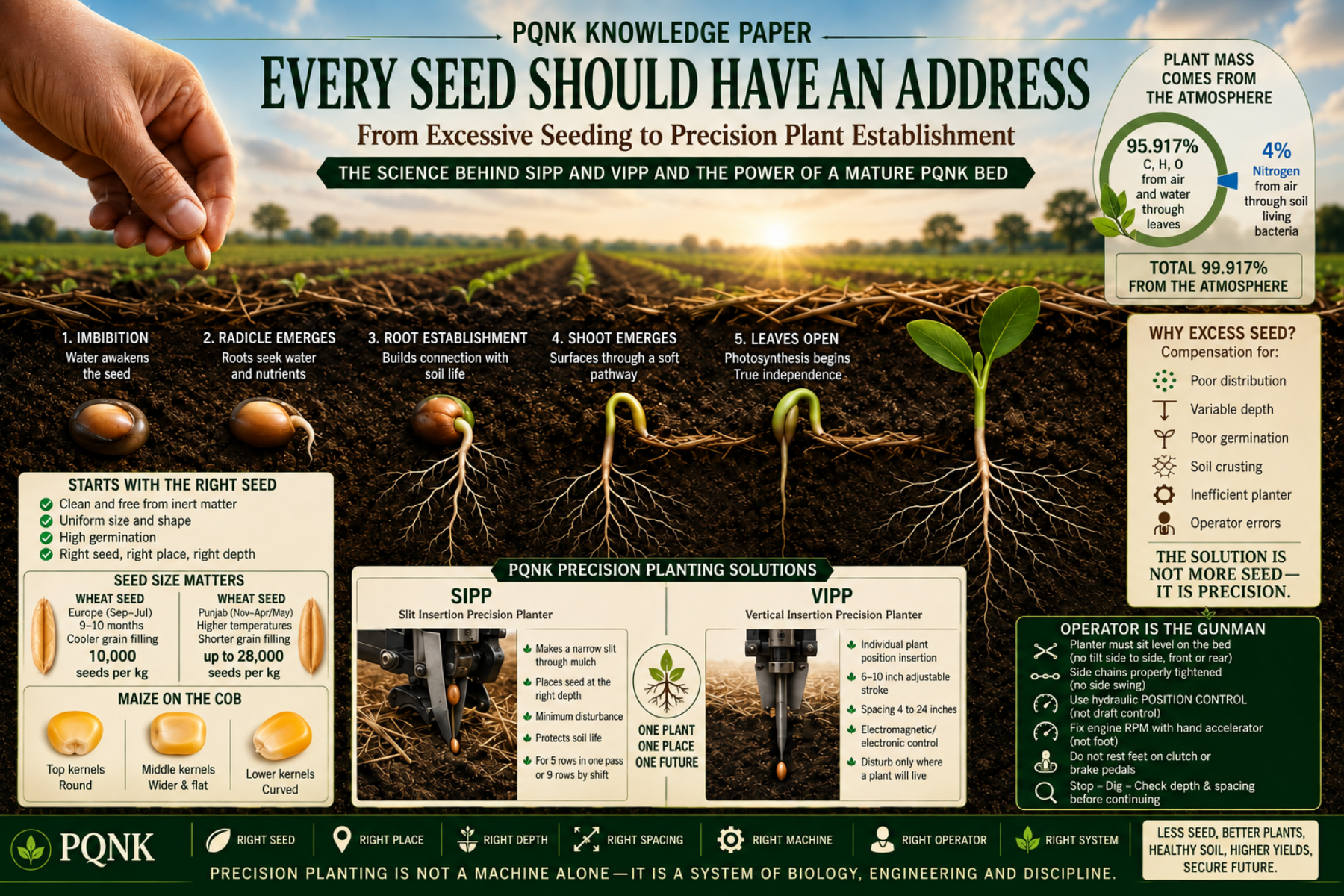
In conventional broadcast seeding, seed is distributed across the field at high rates and germination produces a dense, irregularly spaced stand of seedlings. The density compensates for the inefficiency: because many seeds will not germinate, or will germinate in positions where they compete excessively with neighbours, or will be eaten by birds and insects, enough seed is applied to ensure that an adequate plant population survives the attrition of germination and early establishment. In a wheat crop, this means applying 50 kilograms per acre when a precision-seeded crop requires 4.24 to 8 kilograms. The waste is enormous; the compensating logic has been accepted as inevitable for generations.
In PQNK precision seeding, every seed is placed individually at the correct depth, in a pre-drilled channel through the mulch layer, at precisely the spacing required for the intended plant population. Germination rates are higher because every seed is in optimal conditions: consistent depth, consistent moisture, consistent soil contact, consistent temperature. Establishment losses are lower because the mulch protects germinating seeds from desiccation and temperature extremes. The resulting stand is even, well-spaced, and every plant has adequate root zone, light access, and nutritional supply for full productive development.
The biology of what happens when plants are given adequate space is the key to understanding why PQNK’s lower seed rates produce higher yields. A plant with adequate space develops a larger, deeper root system that accesses more of the mineral bank. It produces more tillers (in cereals) or more branches and bolls (in cotton) because it is not competing for light or root space with the plants immediately beside it. It produces larger, more nutritionally dense grain or fruit because its biological nutrition is not diluted by sharing the available mineral supply with an unnecessarily dense stand. The conventional farmer who applies 50 kg of wheat seed per acre is not producing a better crop than the PQNK farmer who applies 8 kg. He is producing a more crowded one that yields less per plant.
This case for precision spacing has a further foundation the industry’s weight-based seed-rate tables obscure: a kilogram of seed is not a fixed number of future plants. Depending on variety, growing environment, and the length and severity of the grain-filling period, wheat seed lots can vary from roughly 10,000 grains per kilogram in long-season, cooler grain-filling regions such as Europe, up to 28,000 grains per kilogram in the sub-continent’s shorter, hotter grain-filling season. The same variability exists within a single plant: kernels from the tip, middle, and base of one maize cob differ measurably in shape and packing geometry even though they are genetically identical. A precision metering mechanism, built around the physical dimensions of the seed passing through it, cannot be handed an ungraded, dimensionally inconsistent seed lot and still perform to specification. Cleaning and grading the seed for uniform size is therefore the first operation of precision seeding, and it precedes calibration rather than substituting for it.
THE SIPP: SLIT INSERTION PRECISION PLANTER
The Slit Insertion Precision Planter is the primary precision seeder of the PQNK system. It was designed to solve a specific mechanical problem: how to place individual seeds at a precise depth and spacing through an organic mulch layer 3 to 4 inches thick without disturbing the mulch or the soil structure beneath it.
The SIPP achieves this through a mechanism centred on a seed roller with cells machined to hold exactly one seed of the intended crop. As the roller rotates, each cell picks up a single seed from the seed hopper above, carries it to the release point, and drops it into a pre-opened channel cut through the mulch layer and into the soil. The channel is opened ahead of the seed drop by a narrow coulter that slices the mulch without displacing it and penetrates the soil to the required depth. Behind the seed drop, a closing wheel gently firms the soil around the seed and draws the mulch partially back over the channel, leaving enough space for the seedling to emerge, maintaining surface coverage while ensuring soil-to-seed contact.
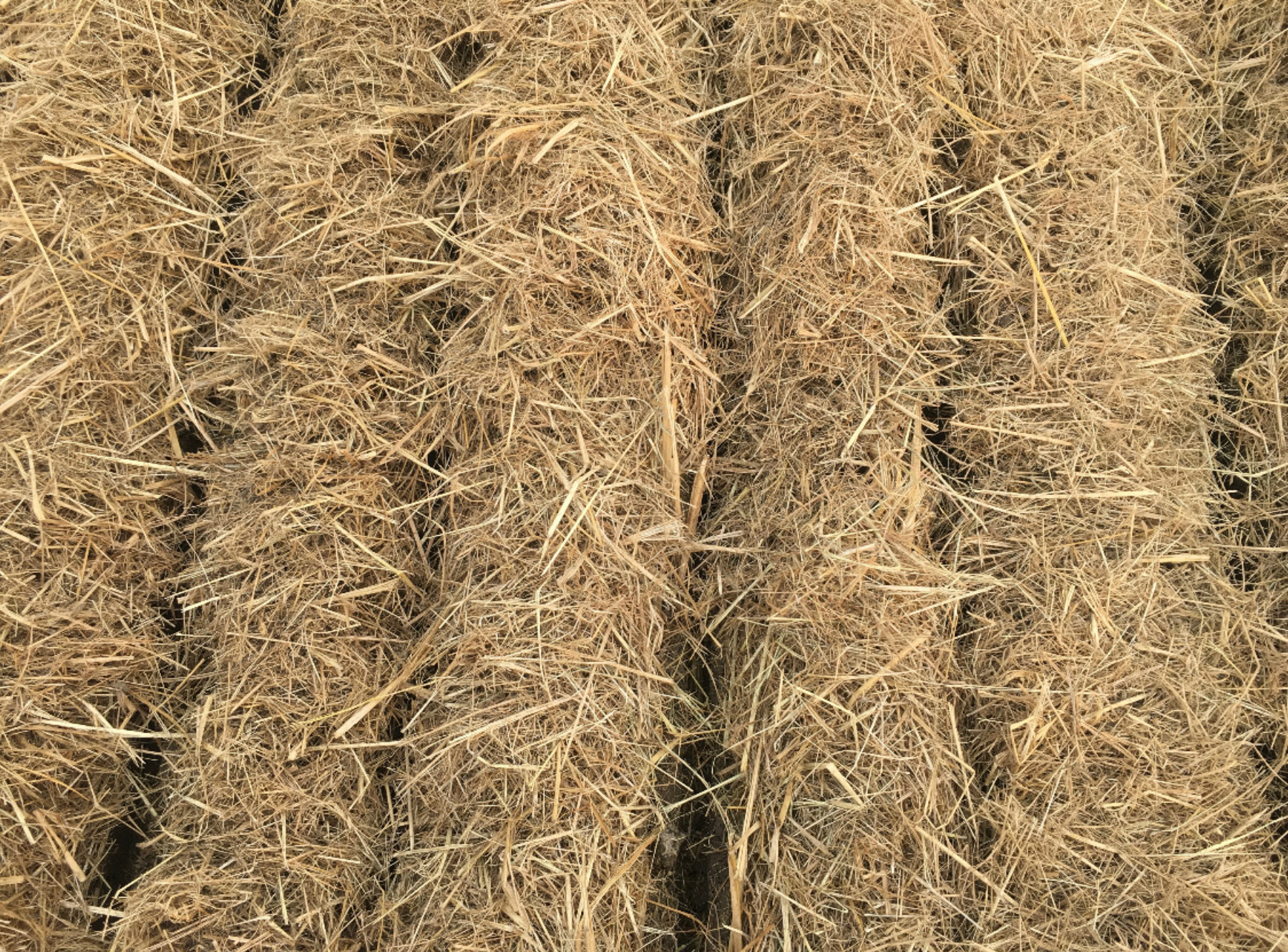
The SIPP places seed through the mulch without disturbing it, leaving behind only a narrow gap above each seed for the young seedling to emerge through.
Key SIPP specifications: Seeding depth adjustable from 1 to 3 inches for different crops and soil conditions. Row spacing adjustable to match the specific crop and bed width requirements. Roller cell size interchangeable for different crop types: a large-seeded roller for soybean, maize and cotton, a small-seeded roller for rapeseed, carrots and for fine-seeded vegetables. Operating speed of 3 to 5 km/h for optimal placement precision. A detachable front-mounted crimper and mulcher terminates standing cover crops, tall stands such as Jantar as well as short ones such as beans, and spreads the residue evenly as mulch in the same pass as seeding; the same attachment can also redistribute residue left uneven by a combine harvester without a chopper. Where this function is not needed, the crimper-mulcher can be removed and the SIPP operated as a standalone planter.
The number of rows planted per pass is itself a calculated decision rather than a fixed machine limitation. The present SIPP architecture plants five rows in a single pass across the 42-inch PQNK bed described in the preceding chapter. Where crop architecture and target plant population call for higher row density, the SIPP can be operated a second time over the same bed, offset to insert four additional rows between the original five, producing nine rows on the same 42-inch top. This is not an arbitrary crowding of the bed; the choice between a five-row and a nine-row pass follows from the same starting question that governs every other PQNK planting decision, the crop architecture and target population the field is meant to carry, with the planter configuration set to deliver it.
THE VIPP: VERTICAL INSERTION PRECISION PLANTER
The VIPP, Vertical Insertion Precision Planter, is a development of the SIPP concept engineered for a different problem: heavy, non-brittle crop residue (corn stalk, sugarcane stalk, cotton stalk, and rice straw) that resists a clean, continuous cut. Where the SIPP’s coulter opens one continuous horizontal slit down the row, 2 inches wide and 2 inches deep, held uniform for the length of the pass, the VIPP does not cut a continuous line at all. Each planting unit instead pokes straight down, opening a single, discrete, cone-shaped hole for every seed: under ½ inch wide at the bottom, a full inch wide at the top, and adjustable 1 to 3 inches deep. The narrow base concentrates the seed at one exact depth in firm contact with moist soil; the wider top gives seedlings, both narrow-leaf and broadleaf, room to emerge through mulch without hindrance. Because there is no continuous edge for tough, fibrous residue to drag against, the VIPP holds seed depth consistent under exactly the conditions that cause a disc-based opener to skip or lose depth. Further, VIPP can plant seeds in a standing crop without disturbing it, which we call crop-in-crop.
The choice between SIPP and VIPP in the field therefore comes down to residue, not spacing: both machines adjust seed-to-seed distance within the row the same way, and both plant five rows per pass across the 42-inch PQNK bed, with a second offset pass adding four more rows for nine total, exactly as described for the SIPP above. Where residue is light or brittle enough for the coulter to cut a clean, uniform slit pass after pass, the SIPP is the faster choice. Where the mulch is heavy and non-brittle, corn stalk, sugarcane stalk, cotton stalk, rice straw, the VIPP’s vertical poke holds seed depth consistent regardless. The SIPP and VIPP are complementary tools for this reason: most PQNK farmers use the SIPP for their primary cash crops and add the VIPP when residue conditions call for it, or when the operation includes sowing additional seed directly into established crop, and/or heavily mulched beds.
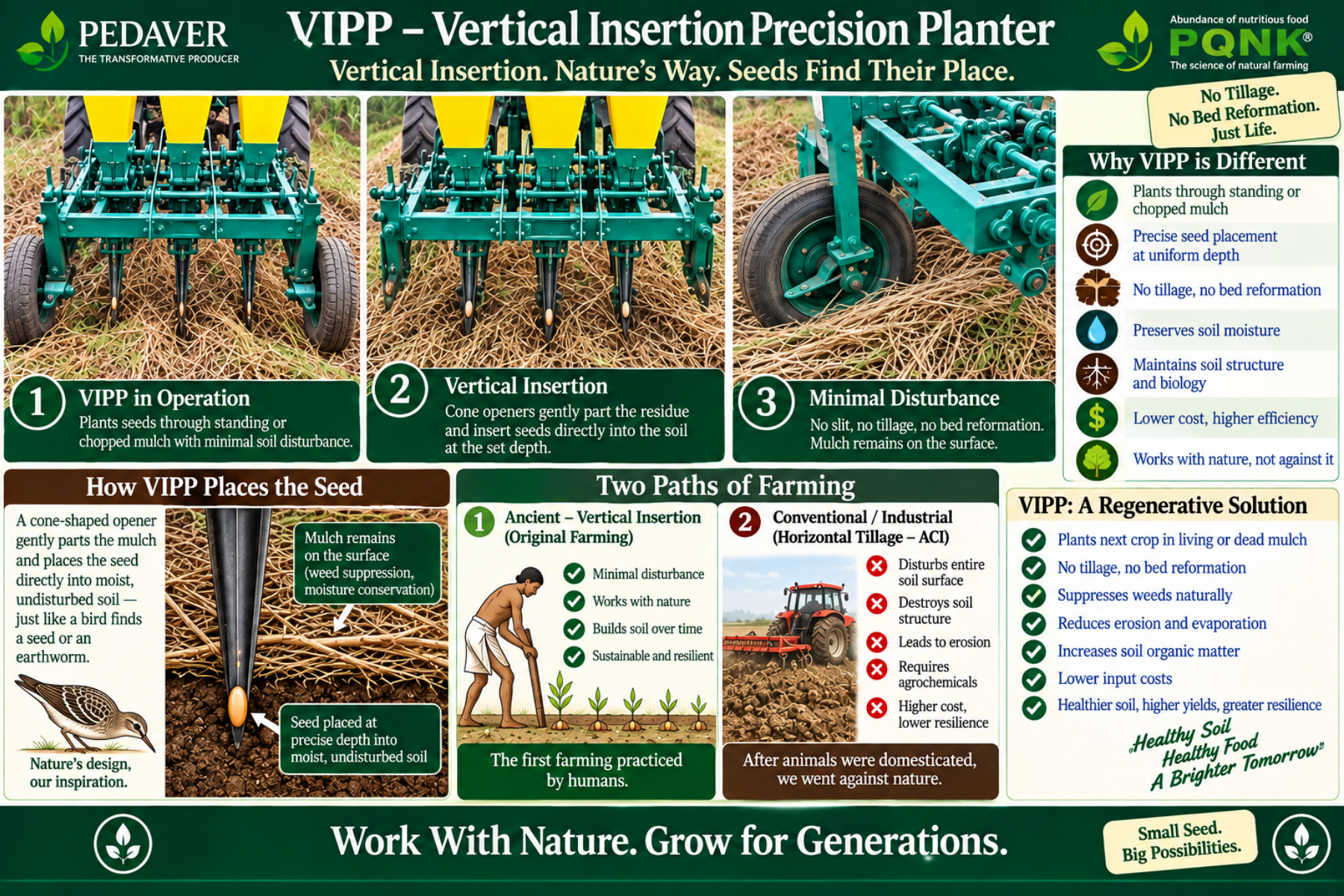
The VIPP’s engineering challenge is greater than the SIPP’s, because it replaces a continuous channel with a series of discrete insertions timed to the tractor’s forward movement. Plant spacing requirements across PQNK crops range from roughly 4 to 24 inches, and the vertical stroke itself typically needs to be adjustable within about 6 to 8 inches depending on the thickness of the mulch layer covering the bed. The insertion mechanism must descend, deliver the seed, and withdraw within the time the forward speed allows, with the moving mass controlled precisely enough to resist lateral deflection and with stroke timing recalculated continuously as ground speed changes. It is this synchronisation problem, rather than the insertion concept itself, that has directed PQNK’s ongoing development of the VIPP toward electromagnetic and electronically controlled actuation, which offers finer timing control than a purely mechanical linkage can provide.
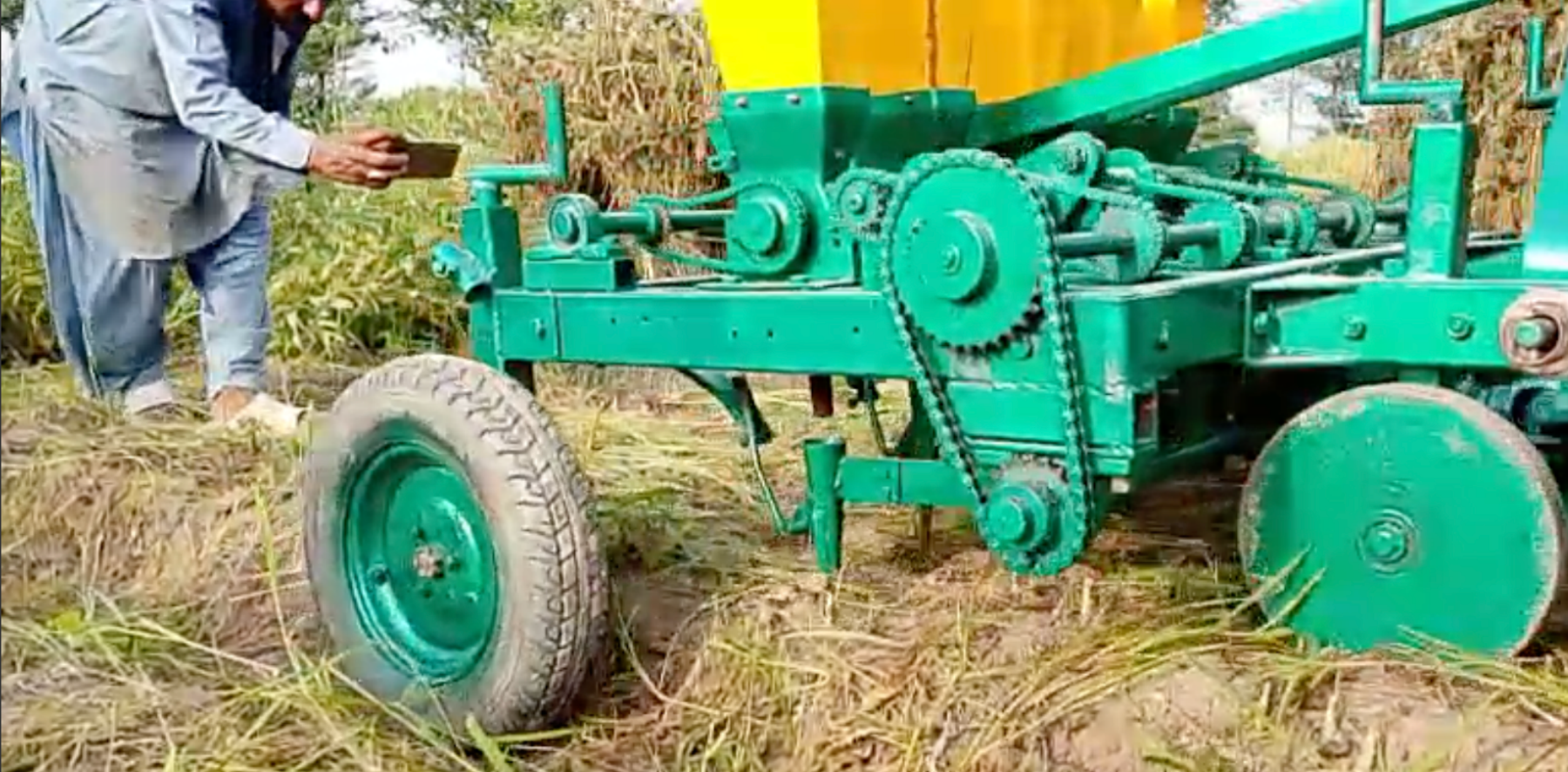
Five row tractor mounted VIPP, mechanical actuation.
The seed-rate figures below are not the product of an arbitrary reduction target; they follow from reversing the conventional calculation itself, starting from the panicle count the field needs to carry rather than from a seed-weight recommendation. Wheat seed size itself varies enormously with growing environment: in a nine-month season with a long, cool grain-filling period, such as much of Europe, a kilogram of seed can hold as few as 10,000 grains, because each one has time to fatten fully; in the sub-continent’s short spring, grain-filling is compressed into a fraction of that time, and a kilogram of the same crop can hold up to 28,000 grains. PQNK’s target is set from the plant side of this equation: over a million panicles per acre, each carrying an average of 80 grains, to reach a yield in the region of 3.5 tonnes per acre.
The standard PQNK layout, five rows across the 42-inch bed at 8 inches seed-to-seed, is built to deliver that panicle count directly: at this spacing each hill tillers out to around 20 panicles, and roughly 62,000 hills per acre carry the crop past the million-panicle mark. Because not every seed germinates, PQNK recommends dropping two seeds per hill rather than one, which brings the requirement to 124,000 seeds per acre; at a Punjab-average seed size of roughly 26,000 seeds per kilogram, that is under 5 kilograms of seed.
For a farmer’s first PQNK wheat crop, PQNK recommends 8 kilograms per acre rather than this calculated 5, to absorb the inaccuracies of a first attempt: an uncalibrated planter, an unfamiliar seed lot, beds that have not yet fully matured. As placement accuracy improves, the beds mature, and plants are pruned to encourage additional tillers per hill, the seed rate can be brought down season by season toward the lower figures precision seeding makes possible, the same direction of travel the NARC trial’s 4.24 kilograms per acre represents at the more experienced end of that range.
SEED RATES: THE PQNK RECOMMENDATIONS
The seed rate reductions achievable through PQNK precision seeding are among the most immediately credible evidence for farmers considering the transition: the seed bill alone declines dramatically in the first season, without any requirement to wait for the biological system to mature or for yield improvements to materialise. The following table sets out PQNK’s recommended seed rate, spacing and planter settings by crop.
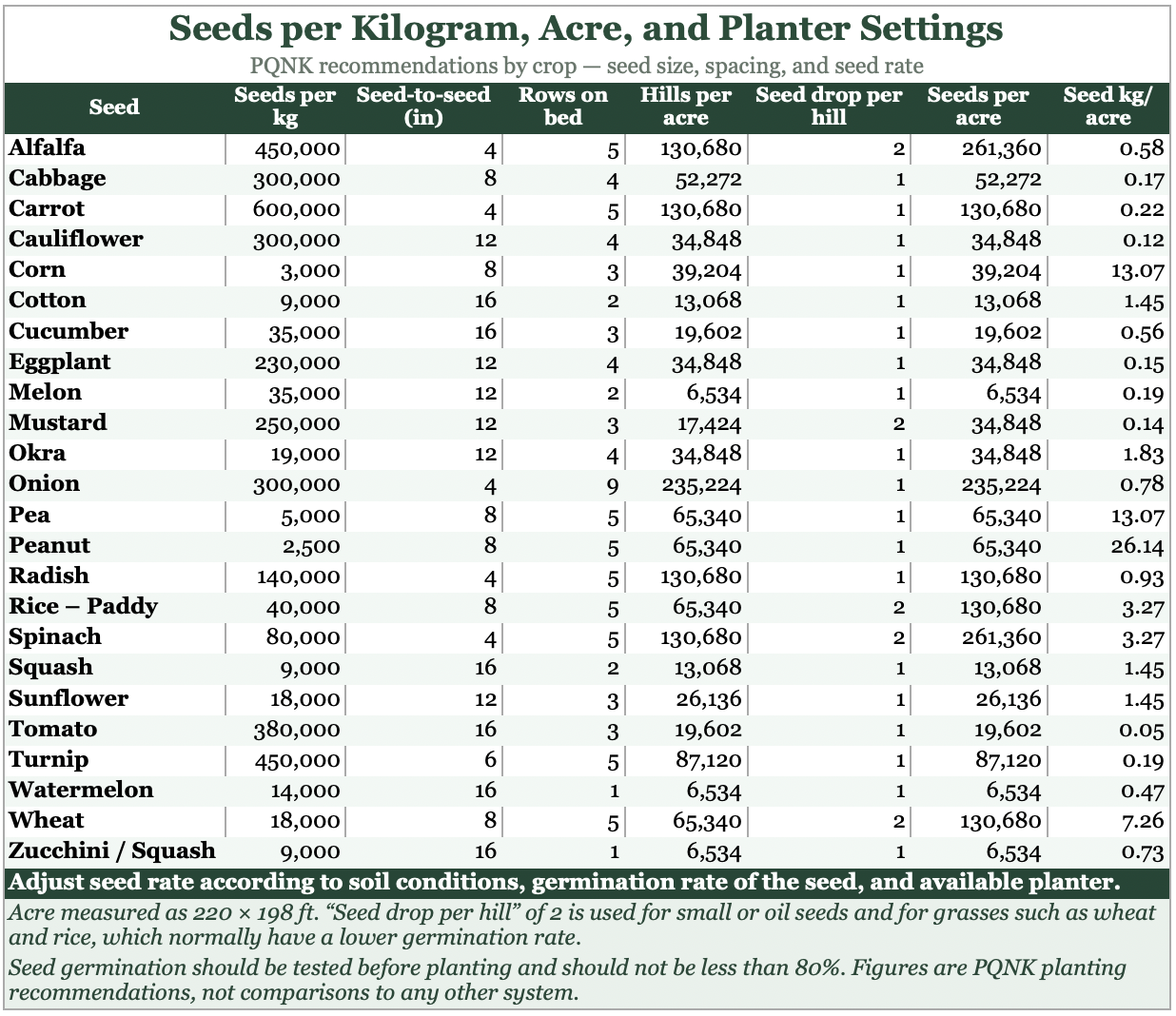
The wheat seed rate reduction deserves special attention because wheat is Pakistan’s most important food security crop and because the NARC trial data provides independently validated figures. The NARC trial documented a PQNK wheat seed rate of 4.24 kilograms per acre against the conventional 50 kilograms per acre, a reduction of about 92%. The PQNK treatment produced a cost of production of Rs. 11,660 per acre against the conventional Rs. 26,236, with a projected profit per acre of more than Rs. 130,000 at 80% planting precision.
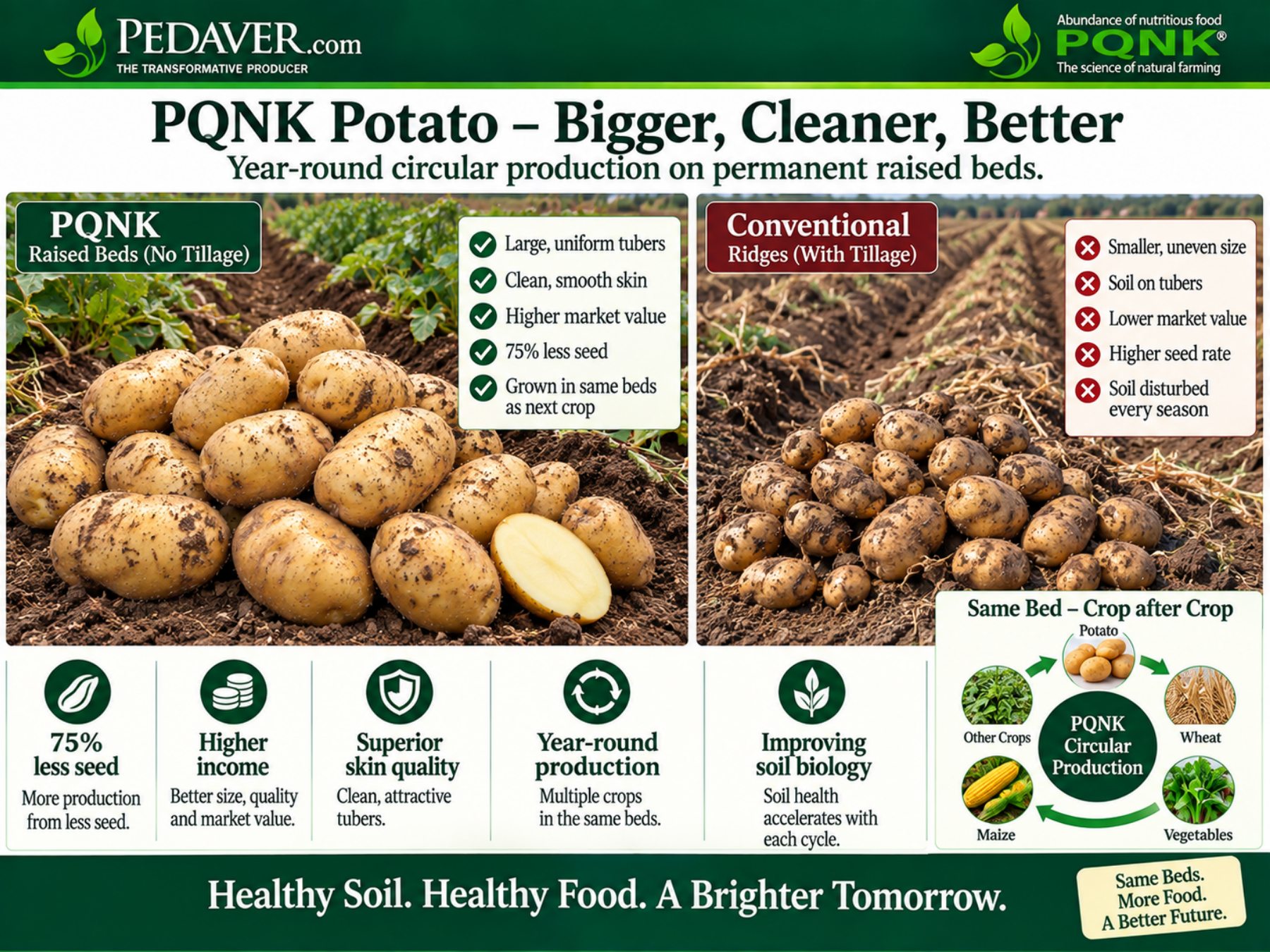
The potato seed rate reduction represents the largest absolute cost saving of any single PQNK crop input reduction: from 600 to 800 kilograms per acre of seed potato to 150 to 200 kilograms. At current seed potato prices, this reduction alone represents a saving that exceeds the total PQNK machinery cost within a single potato crop cycle. The precision placement of seed potato pieces at correct spacing also improves tuber size uniformity and market grade, adding a quality premium to the cost reduction. For potato and other tuber crops, a separate no-till planter is required.
WHY LOWER SEED RATES PRODUCE HIGHER YIELDS
The most counter-intuitive claim in precision seeding is that applying dramatically less seed produces more yield. The mechanism operates through three interacting biological effects.
Effect One: Root zone access. A wheat plant growing in a 50 kg/acre broadcast stand has approximately 15 to 20 plants per square foot, competing for root zone with its immediate neighbours. A PQNK precision-seeded plant at 8-by-8 inch spacing has 2.25 plants per square foot but in a regular grid pattern that maximises each plant’s root zone access. Each plant has more productive tillers per hill; with a larger root zone, it develops a more extensive root system that accesses more mineral nutrition and more soil moisture. The per-plant yield of a wider-spaced plant substantially exceeds that of a crowded one.
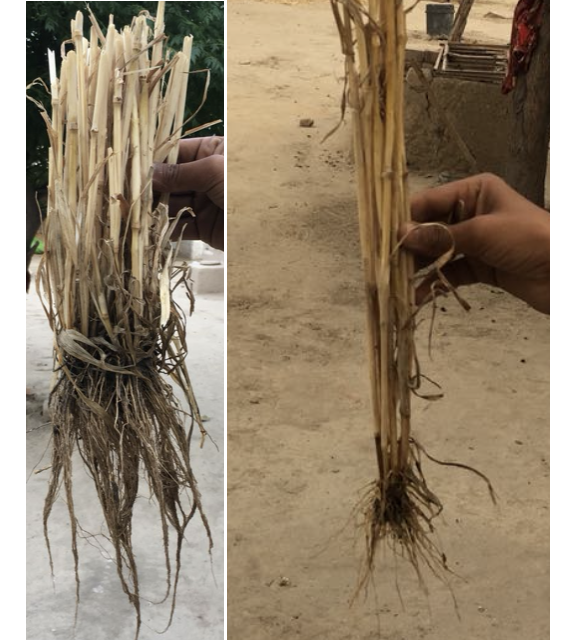
Root and tiller development, PQNK versus conventional wheat, 2017/18: the PQNK plant (left) has produced a dense mass of tillers and a correspondingly extensive root system, against the conventional plant’s (right) few tillers and sparse roots from the same growing season.
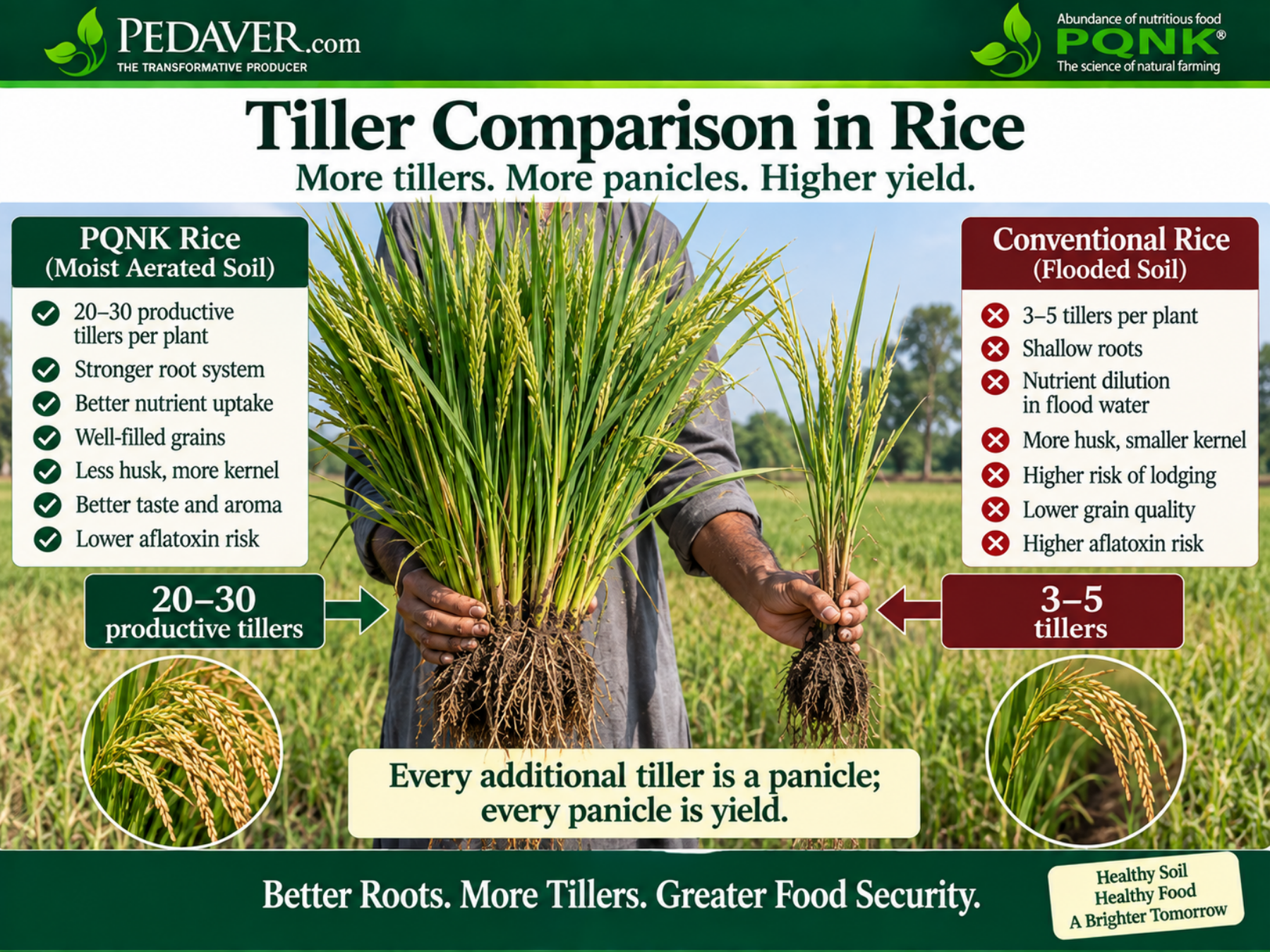
Effect Two: Tiller and boll production. Wheat plants produce tillers, additional productive stems, in proportion to their available root zone and light access. A crowded broadcast stand produces mainly primary tillers; a well-spaced precision stand produces primary, secondary, and tertiary tillers from each plant, multiplying the number of grain heads per unit area. The NARC trial PQNK wheat averaged 29 tillers per plant, with a maximum of 86, against 3.8 and 3.42 in the two conventional treatments. Even at a lower plant density, the total tiller count per acre exceeded the conventional stand’s tiller count while producing heavier grain heads from the superior mineral nutrition of the PQNK soil. The same effect appears in rice, where PQNK’s moist, aerated bed produces roughly 20 to 30 productive tillers per plant against 3 to 5 under continuous flooding.
Effect Three: Canopy architecture. A well-spaced precision-seeded crop stand develops a canopy architecture that maximises light interception by individual plants while providing the inter-row space that the SIPP requires for the next crop cycle’s seeding. In a broadcast stand, light competition causes etiolation, the stretching of plants toward light, that weakens stems, increases lodging risk, and reduces the photosynthetic efficiency of the canopy. In a precision-seeded stand, each plant has sufficient light access to develop compact, strong-stemmed, photosynthetically efficient architecture.
The conventional farmer buys 50 to 60 kilograms of wheat seed per acre, broadcasting it because it is the cheapest seed option available. But broadcasting is inherently imprecise: after the seedbed is prepared, seed is scattered unevenly, the soil is tilled again, and a wooden plank drags behind to cover it. Some seed ends up buried too deep to emerge; some stays in the upper layer and dries out before it can establish. The extra seed is not a margin of safety, it is compensation for this inefficiency. The Ayub Agricultural Research Institute’s own figures make the scale of that waste explicit: measured against the total seed sown, 60 kilograms at roughly 26,000 seeds per kilogram, the seed-to-tiller ratio is only 1 to 1.5. Measured instead against only the seed that actually germinates and establishes, the same fertile soil produces 12 to 15 tillers per plant. Both figures are correct; they answer different questions. The low ratio exposes how much of the conventional farmer’s seed bill buys nothing but failure, while the higher one shows what the surviving plants are still biologically capable of. The PQNK farmer buys 4.24 kilograms, and because precision placement means nearly every seed sown is a seed that germinates, its 29-tiller average already stands on that higher, per-plant basis, with none of the wastage the conventional ratio conceals.
OPERATING THE PLANTER: PRACTICAL GUIDANCE
Mounting the planter on a tractor: The planter must be properly balanced before work begins: it should not tilt left or right, or lean forward or backward, but sit level on the bed. A level planter is what ensures every row places its seed at the intended depth. Attach the lower links first, left side then right, and only then connect the top link. Lift the planter slowly; if it tilts to one side, use the adjustment gear on the right link arm and lower the machine again to confirm the tilt is gone. Next, correct any front-to-back tilt using the top link: lengthen it if the planter tilts forward, shorten it if it tilts backward. Lift and lower the planter once more to confirm it now settles level on the bed. Then tighten the side chains on the lower links so the planter stays in line with both the tractor and the bed profile. Set the hydraulic system to position control to keep seed depth accurate, run the engine at 2,000 RPM, and engage low third gear for the forward speed that keeps the planter synchronized with the tractor.
Seed grading and cleaning. Most seed companies supply seed that is already graded: uniform in size and shape and free of inert matter, exactly what precision planting requires. Where seed has not been graded or cleaned, sieve it to separate out undersized and oversized seed, dust, straw fragments, and anything else that is not seed. This step is what makes planting accuracy possible.
Calibration before each crop. The SIPP and VIPP require calibration of the roller cell size to the seed lot being used. Seed size varies between varieties and between harvest years; a plate calibrated for one variety may double-seed or skip-seed with a different variety. Before each planting operation, test the planter over a one-metre section and count the seeds placed against the expected number for the row length and spacing. Adjust the roller and/or cell size and its revolution until the count matches the target.
Operating speed. The SIPP and VIPP are precision instruments. Operating at higher speed increases seed bounce at the drop point, reduces placement accuracy, and can cause the coulter to skip over mulch rather than cut through it. Follow the above-given guidelines for accuracy. The time saving from operating faster is not worth the placement accuracy lost.
Coulter depth. The coulter must penetrate the full depth of the mulch layer and into the soil beneath. A coulter that rides on top of the mulch places seed in the mulch rather than in the soil, producing poor germination. Set the coulter depth to mulch depth plus seeding depth, and verify by stopping the planter mid-field and checking the seed channel depth manually.
Moisture at seeding. Precision-seeded crops require adequate soil moisture at the seeding depth for reliable germination. In a PQNK system with an established mulch layer and functioning water management, this moisture is typically present in the mulch-protected soil even after an extended dry period. If the soil at seeding depth feels dry, a light pre-plant irrigation at half-furrow depth restores moisture to the seeding zone before planting.
Tractor wheel width. The tractor’s wheel width matters as much as the planter’s calibration. Tractors built to pull heavy loads use wide wheels or wide tyres for maximum traction; row-crop tractors use narrow wheels, typically nine to thirteen inches wide. Conventional agriculture needed narrow wheels to pass through a standing crop without crushing it during in-season hoeing and spraying. PQNK restricts field operations to planting and harvesting, so that original need is largely gone, but narrow wheels remain essential for a different reason: on a mature PQNK bed, tractor traffic stays within the permanent furrow, and a wide tyre does not fit a narrow furrow cleanly. It presses against the furrow walls, the same shoulders the furrow is meant to leave undisturbed, and repeated passes compact and harden them. A hardened furrow wall is a sealed one: water applied to the furrow can no longer move sideways into the bed at the rate the bed’s biology requires, and lateral infiltration slows. A narrow, row-crop tractor avoids this, sitting within the furrow without forcing its walls outward.
Calibration itself should be completed before the planter ever reaches the tractor. The actual graded seed lot intended for the field, not a generic reference sample, should be loaded into the machine, the metering mechanism turned through a known number of revolutions, and the seed collected separately from each row for counting and comparison. Misses, doubles, damaged seed, and any inconsistency between metering units should be identified and corrected on the bench, where the fault can be isolated to the machine alone.
Only once the planter is confirmed mechanically correct in isolation should it be mounted on the tractor; mounting introduces its own set of variables, and a planter carried onto the field with an uncorrected bench fault will simply reproduce that fault across every row.
Two further operating disciplines protect that same precision once the tractor is moving. The hydraulic system should be set to position control rather than draft control, so that the planter holds its set working position regardless of the small variations in soil resistance that draft control was designed to respond to; a seed placed too deep or too shallow because the hydraulics reacted to changing resistance is no less misplaced for the reason being invisible to the operator. Engine speed should be fixed with the hand accelerator rather than left to the foot accelerator, whose natural variation as the operator’s leg moves and the tractor crosses uneven ground translates directly into inconsistent forward speed and inconsistent seed spacing; the foot should likewise stay off the clutch and brake pedals during the planting run itself, since partial clutch pressure and unintended braking disturb the same forward speed the metering mechanism depends on.
PQNK describes the training of a planter operator in deliberately blunt terms: he is the gunman. A correctly graded seed lot, an accurately calibrated machine, and a properly levelled and mounted planter can still be defeated by one untrained operator selecting the wrong gear, allowing engine speed to drift, resting a foot on a pedal, or failing to notice a blocked seed tube; the planting operation itself takes a few hours, but its errors remain in the field for the entire season, since plant-to-plant spacing cannot be corrected after emergence. For this reason, PQNK treats the first pass of any planting run as a test rather than a result. The tractor is stopped after a short distance, the mulch is carefully parted, and the seed is found and examined directly, for depth, for spacing, for contact with moist soil, and, on broad-leaf crops, for a clear emergence pathway. Only after this direct inspection confirms the machine is performing as intended does the operator continue; the first few metres of a planting run are meant to expose a mistake, not the first acre.
THE MULCH CRIMPER: TERMINATING COVER CROPS WITHOUT TILLAGE
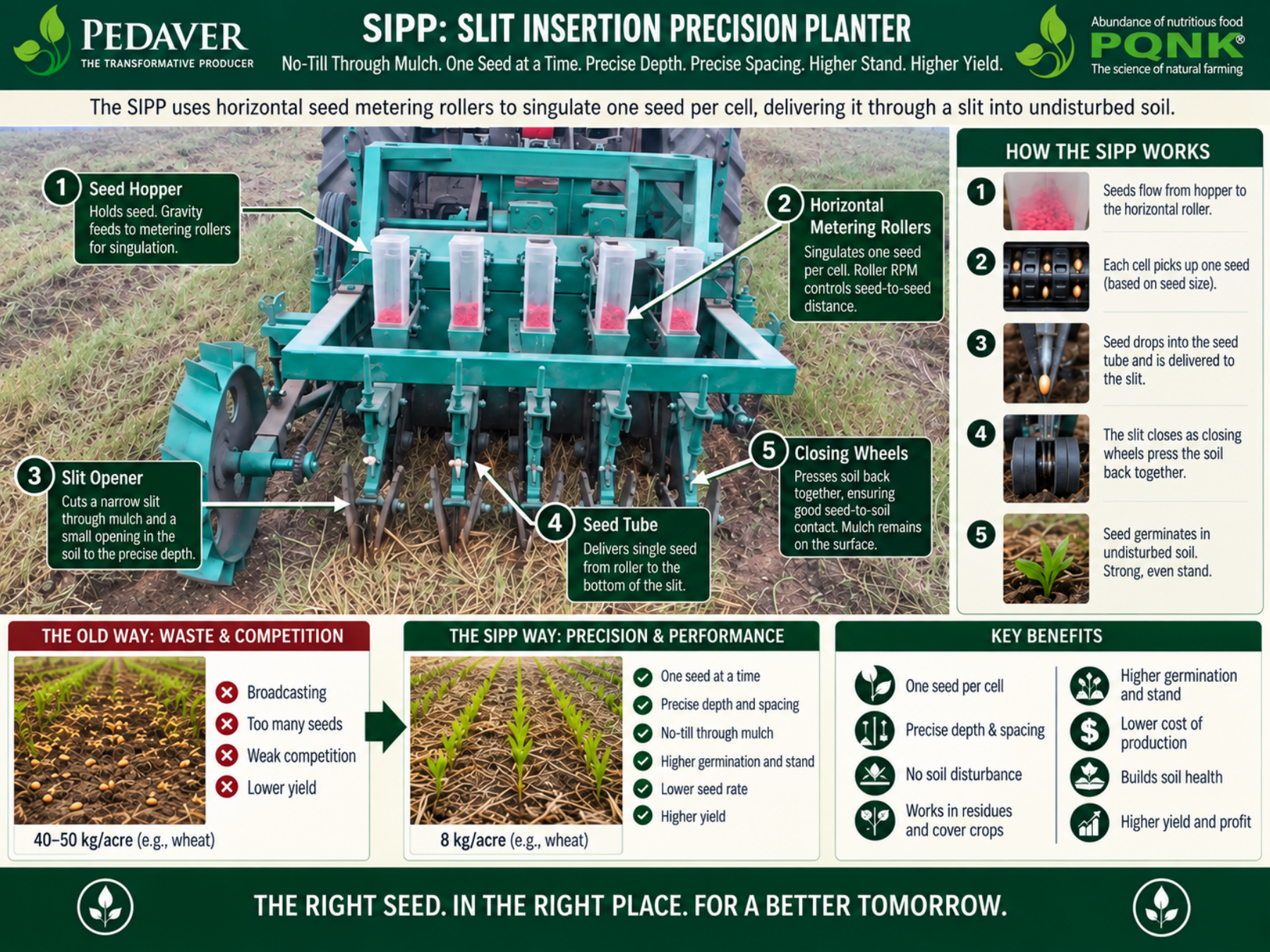
SIPP, Slit Insertion Precision Planter: No-Till Through Mulch, Precise Depth, Precise Spacing, Higher Stand.
The mulch crimper is a detachable, front-mounted attachment on the SIPP, used in PQNK rotations that include cover crops. A cover crop sown between main crops, cowpea, field pea, sorghum, sunn hemp, or any fast-establishing nitrogen-fixing or biomass species, must be terminated before the following main crop is seeded without tillage and without herbicide. The crimper handles both tall, heavy-biomass cover crops such as Jantar (Sesbania) and shorter ones such as beans, mechanically crimping or flattening the stems at intervals that prevent the plant from continuing to grow while preserving the stem intact, so that the terminated plant lies flat on the bed surface as an instant thick mulch layer. The same attachment is also useful where a crop has been harvested by a combine without a chopper, leaving residue unevenly distributed that needs spreading before the bed can be seeded through it.
The timing of crimping is critical. A cover crop crimped before flowering has not yet completed nitrogen fixation and decomposes rapidly, providing a brief mulch effect before losing its structural integrity. A cover crop crimped at or after flowering has completed its nitrogen fixation contribution and decomposes more slowly, providing several weeks of mulch coverage through the early establishment of the following main crop. The optimum crimping timing is crop-specific and is documented in the relevant PQNK cover crop knowledge paper.
In a single pass, the crimper-mulcher terminates the cover crop, or evens out combine-harvested residue, immediately ahead of the SIPP’s own row units, which seed the following main crop into the freshly prepared mulch in the same forward motion. This combination reduces field operations, saves fuel and time, and minimises the period between cover crop termination and main crop establishment, important for maintaining weed suppression continuity. The VIPP does not carry this attachment, a deliberate simplification: where crimping or mulch redistribution is not required, its vertical-insertion mechanism runs on its own without the added complexity of a front attachment. The SIPP, doing all of these jobs in a single pass, is correspondingly harder to operate well; an untrained driver is more likely to compromise seed placement than on a simpler machine, which is part of why PQNK insists on the calibration and operator discipline described earlier in this chapter.
AVAILABILITY AND ACCESS: THE MACHINERY CHALLENGE
The SIPP and VIPP represent the primary machinery barrier to PQNK adoption at national scale. Unlike the subsoiler, which is available from multiple manufacturers and has broad applicability beyond the PQNK system, the SIPP and VIPP are purpose-designed for PQNK’s specific seeding requirements. They are not yet in mass production through Pakistan’s mainstream agricultural machinery sector.
Pedaver Research (2025) identified the government subsidy of the four key PQNK machines, subsoiler, bed shaper, precision planter (SIPP/VIPP), and mulch crimper, as the single most important policy intervention for accelerating PQNK adoption. The economic case is straightforward: the capital cost of subsidising the PQNK machinery package for Pakistan’s 20 million farming families is a fraction of the annual fertiliser and pesticide import bill that PQNK adoption would eliminate. The subsidy is not an expenditure. It is the smallest possible investment in the elimination of the largest recurring cost in Pakistan’s agricultural economy.
WHAT THIS CHAPTER HAS ESTABLISHED
This chapter has described the complete engineering case for the SIPP and VIPP precision planters: the twelve-thousand-year gap between seed-meter and seed-opener technology, the biological reasoning behind precision spacing, the mechanical specifications of both machines, the seed-rate reductions of 75 to 95 percent across major crops that reward the transition in the very first season, and the operating discipline, from calibration to mounting to gunman-level training, that determines whether that precision is actually delivered in the field. The results, an average of 29 wheat tillers per plant, 200 cotton bolls per plant, 12.84 tonnes of rice per hectare, are what happens when every seed is given the exact conditions to become what it is biologically capable of. None of this depends on what kind of seed goes into the machine. The next chapter turns to that question directly: what seed PQNK plants, and why that choice matters as much as the precision with which it is placed.
Chapter Thirty: The Seed Is Potential, the Soil Is the Production System