

Industrial Devastation To Natural Abundance
The PQNK System · Chapter 28
PQNK Machinery Engineering
Tools That Serve the Ecosystem
Release 1.0 · 2026-09-19
If you use “Listen”, the text of the page may be sent to your browser or operating system’s speech provider, such as Apple, Google or Microsoft, depending on the voice your device uses. Pedaver does not process, transmit or store any audio.
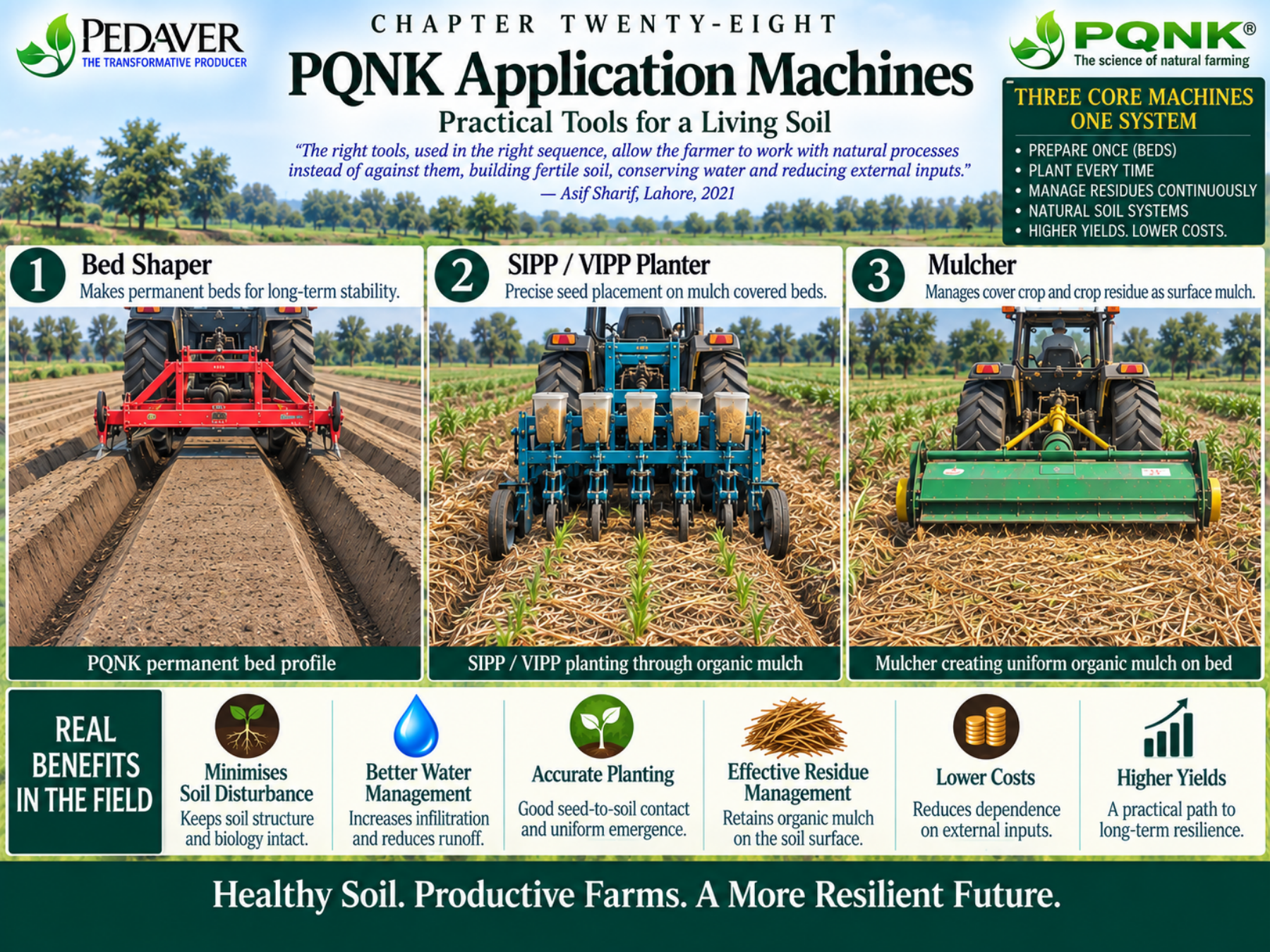
“Conventional agriculture is the history of increasingly powerful machines deployed to compensate for increasingly degraded biology. Every machine in PQNK serves the opposite purpose: it creates the conditions for biology to perform what no machine can permanently replace.”
Asif Sharif, Lahore, 2024
The history of modern agriculture is, in many respects, the history of machinery. Over the past century, tremendous effort has been devoted to increasing the power, speed, capacity, and efficiency of agricultural equipment. Larger tractors, wider cultivators, more sophisticated harvesters, more powerful tillage implements, and increasingly specialized machines have transformed agricultural production throughout much of the world. These developments undoubtedly increased the farmer’s ability to perform work faster and at greater scale.
But they also, as the preceding chapters have documented, progressively replaced the biological functions of the living ecosystem with mechanical force. The machine became a substitute for the soil’s structural integrity, for the root system’s water distribution capacity, for the mycorrhizal network’s nutrient delivery, for the biological regulation of pests, and for the organic matter cycling that conventional tillage systematically destroyed. The machine got stronger as the ecosystem got weaker, and the industrial logic presented this as progress.
PQNK machinery operates from a fundamentally different premise. Every machine in the PQNK system is designed either to restore the conditions within which the ecosystem can rebuild itself, or to maintain the conditions within which the rebuilt ecosystem continues to function. Not a single PQNK machine exists to compensate for a collapsed biological function. They exist to create the architectural and physical conditions within which biological functions can operate. This distinction determines every engineering decision, every operational protocol, and every specification in the PQNK machinery system.
This chapter describes each machine, its function, its design principles, and the ecological reasoning that determines how it is used.
THE DIFFERENCE BETWEEN TRANSITION MACHINERY AND MAINTENANCE MACHINERY
Before describing individual machines, the most important conceptual distinction in PQNK machinery engineering must be established: the difference between transition machinery and maintenance machinery.
Transition machinery is used once, or a small number of times, to physically convert a conventionally managed field into a PQNK field. Its work is preparatory and foundational. Once the ecological architecture it creates is established and biologically active, transition machinery is no longer needed for that field. A farmer who has completed the full PQNK transition on a field will not require the transition machines on that field again, barring extreme circumstances. This is a critical economic feature of the system: the largest capital investment in the transition is a one-time cost, not a recurring one.
Maintenance machinery is used seasonally, typically at planting time and harvest, to introduce new crops into the existing PQNK ecological architecture without disturbing it. The design principle for all maintenance machinery is minimum soil disturbance consistent with accurate seed placement and crop establishment. These machines operate within the living system rather than reconstructing it. Their design criteria are fundamentally different from those of conventional agricultural machinery, which is engineered to work in degraded, compacted, biologically depleted soil.
Understanding this distinction also clarifies the economics of PQNK machinery adoption. The capital cost of the full machinery set, particularly the transition equipment, is real and must be financed. But it is a finite investment that eliminates recurring input costs rather than adding to them. The conventional farmer who spends annually on fertilizer, pesticide, fuel for repeated tillage operations, and irrigation energy is making an infinite commitment. The PQNK farmer who invests once in the transition machinery is making a finite commitment that reduces the annual cost of farming from that point forward.
THE HARDPAN BREAKER: THE MOST IMPORTANT MACHINE IN THE ENTIRE SYSTEM
The hardpan breaker (the subsoiler) is the first machine used in the PQNK transition and the most consequential. No other machine in the entire system produces a more immediate or more lasting ecological transformation. The reasoning is straightforward: the hardpan, as documented in Chapter Twenty-Five, is the single greatest physical constraint on the performance of the living ecosystem in most agricultural soils. It blocks root penetration, prevents water infiltration, restricts oxygen movement, limits the vertical range of soil biology, and maintains the shallow root architecture that makes the plant dependent on surface-applied inputs. A PQNK system built above an intact hardpan is not a PQNK system. It is a constrained system performing below its potential on top of an unresolved structural problem.
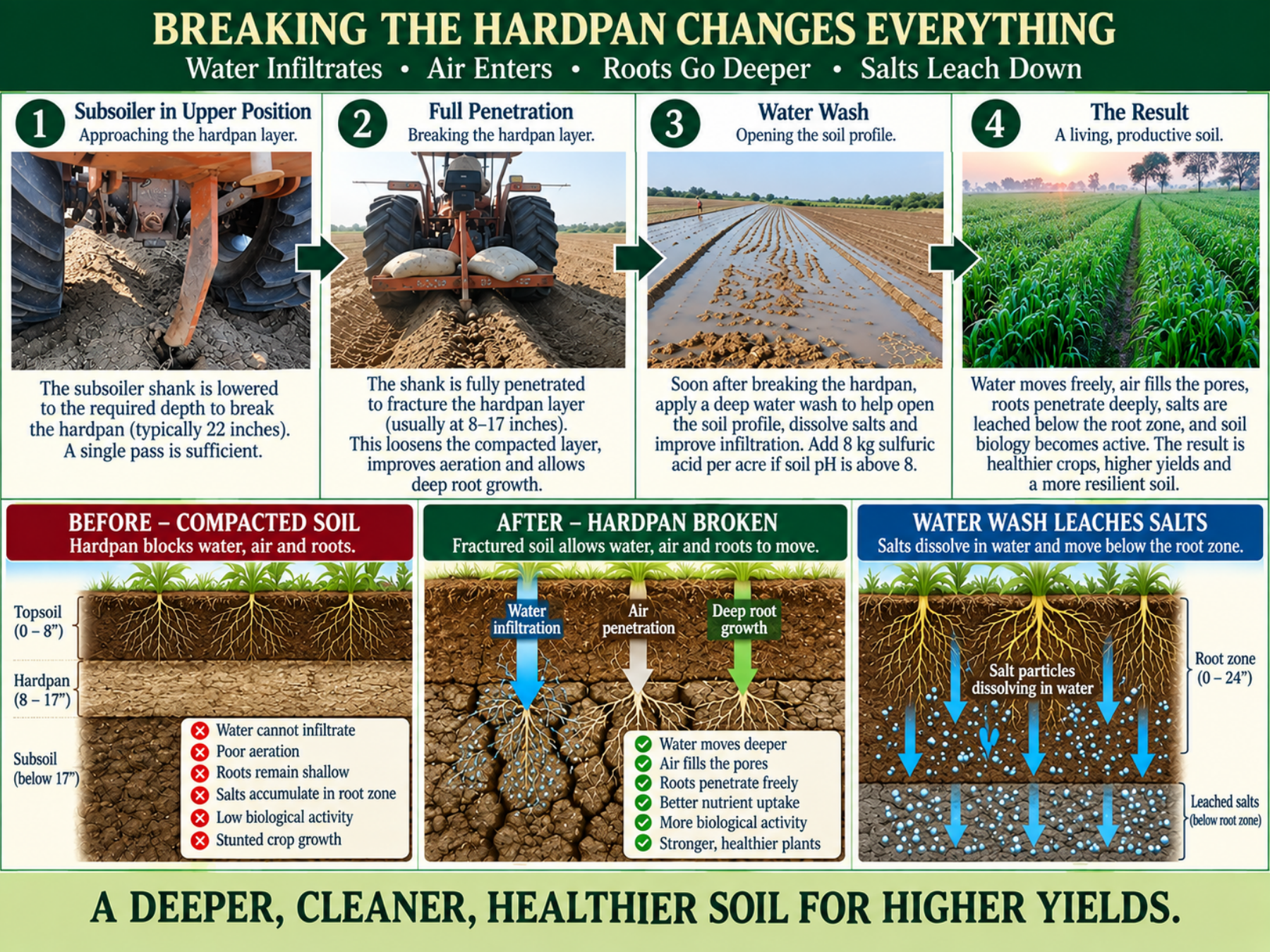
The subsoiler used in PQNK is not a generic deep-tillage implement. It is specified and calibrated to shatter the hardpan layer at the correct depth for the specific soil conditions of the field being transitioned, without inverting or mixing the soil profile above and below that layer. Soil inversion is the fundamental error of conventional tillage: it brings subsoil to the surface, buries topsoil biologically active layers, disrupts the vertical stratification of the soil ecosystem, and creates a homogenized profile that takes years to restratify biologically. The PQNK subsoiler is designed specifically to fracture the compacted layer horizontally (creating vertical fissures through which water and roots can penetrate) without disturbing the profile above and below.
After hardpan shattering, the physical architecture of possibility changes permanently for that field. Water that previously ponded on the surface or ran off now infiltrates. Roots that previously reached eight to twelve inches of depth and stopped now penetrate twenty-four, thirty-two, forty inches and beyond. The soil oxygen profile deepens. Biological activity expands vertically through a profile that was previously divided by an impermeable ceiling. The transition from industrial field to living ecosystem becomes physically possible at the moment the subsoiler completes its single pass.
The subsoiler is used once in the transition. It is not used again. The biological activity of the established PQNK ecosystem (the root growth, the organic matter decomposition, the microbial production of soil-aggregating substances, the physical expansion of fungal hyphae through the soil mass) maintains the soil’s porosity and structural integrity from that point forward without mechanical assistance. The machine opens the door. Biology keeps it open.
THE RAISED BED SHAPER: CREATING THE PERMANENT ARCHITECTURE
The raised bed shaper creates the physical architecture upon which all PQNK production operates. This machine is specified to produce the PQNK standard bed profile exactly: forty-two inches of bed top, eighteen inches of furrow top, eight inches of furrow base, eight inches of total depth from bed top to furrow bottom, and a bed-to-bed centreline of sixty inches. These are not arbitrary dimensions. They are the product of decades of field observation, biological measurement, and agronomic refinement. Every dimension serves a specific ecological function.
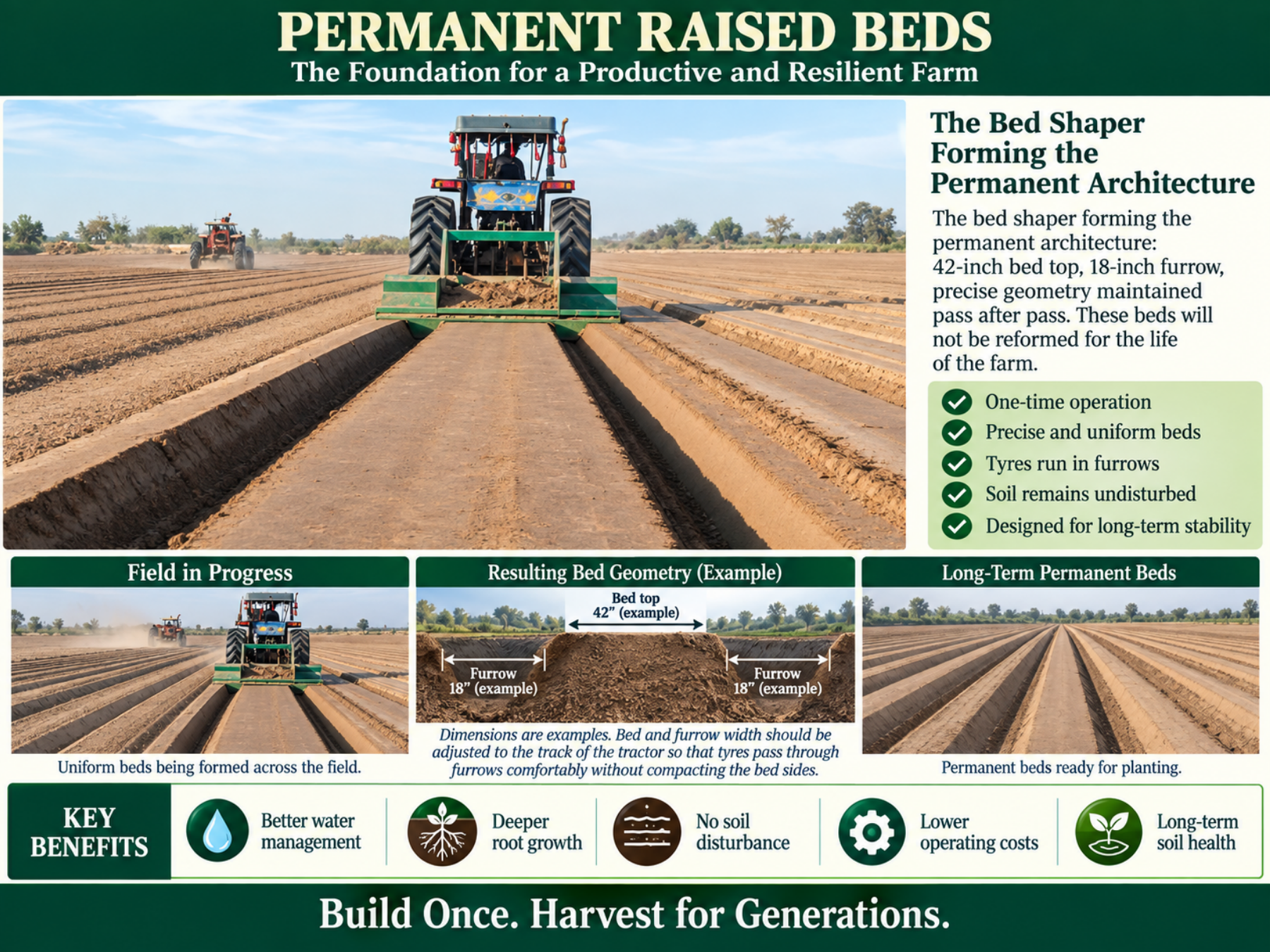
The forty-two-inch bed top accommodates the PQNK standard planting configurations for all major crops: five rows of wheat or rice, two rows of cotton, three or four rows of maize, single-row high-density vegetables. The sixty-inch centreline allows tractor wheels to travel in the furrows without ever compressing the bed surface where the biological activity and root architecture of the crop are concentrated. This permanent separation of traffic lanes from production zones is one of the most important structural principles in the entire system: it eliminates the compaction cycle that conventional agriculture cannot escape.
The bed shaper is used once to form the permanent bed geometry of the field. Thereafter, the beds are maintained without reshaping. Season after season, crop after crop, the beds retain their architecture because the biological system within them (the root networks, the organic matter matrix, the fungal web, the water-stable aggregates created by biological activity) physically maintains the structure. The bed does not collapse between crops because living systems are continuously reinforcing its architecture.
Like the subsoiler, the bed shaper is fundamentally a transition machine. After the first formation, it is needed only if an exceptional circumstance (a flood event, a severe compaction episode, or a field modification) requires restoration of the bed geometry.
THE SIPP PLANTER: PLANTING WITHOUT DISTURBING THE ECOSYSTEM
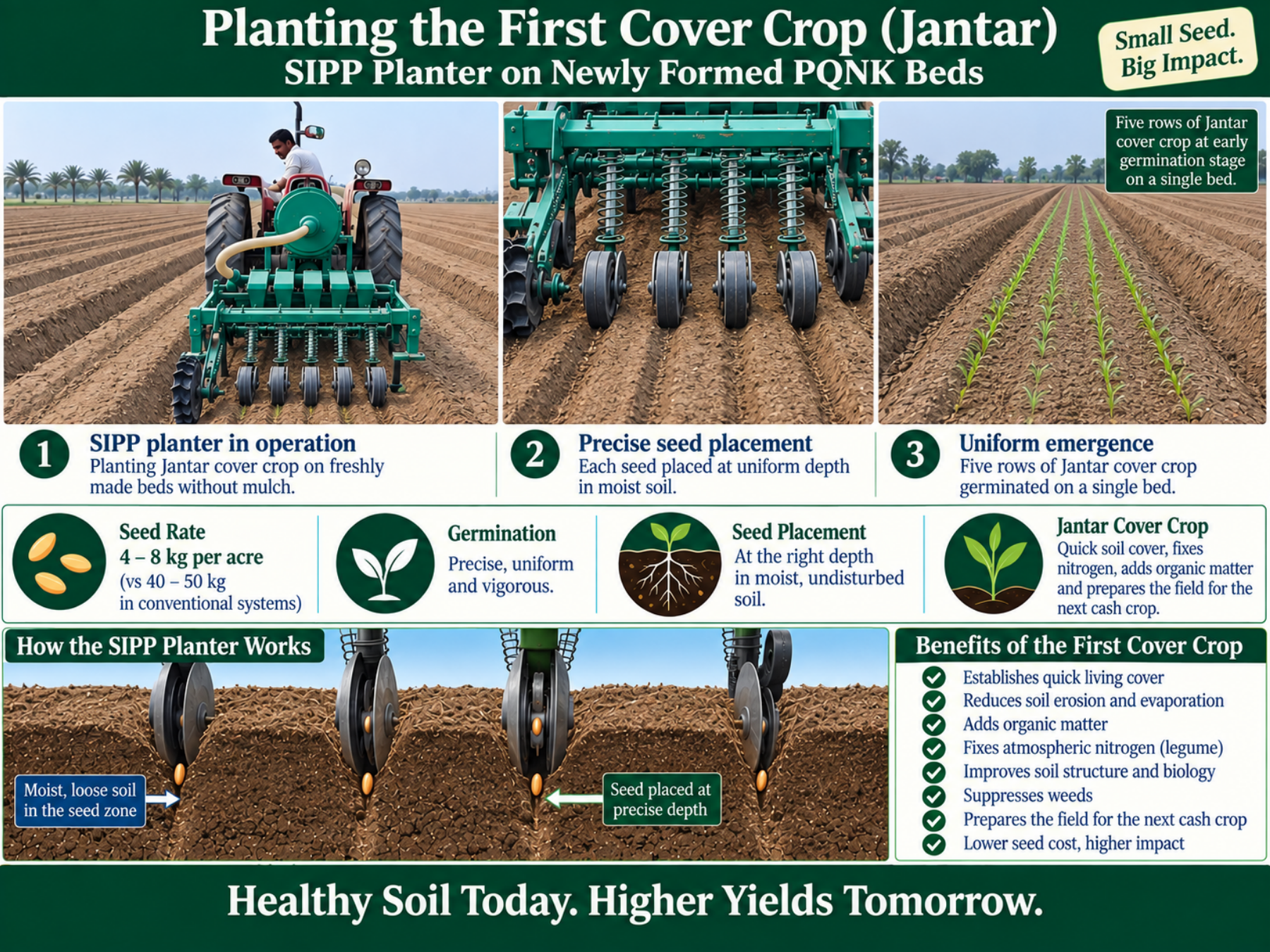
The SIPP (Slit Insertion Precision Planter) is the primary maintenance machine of the PQNK system. It is the machine that places each seed into the established PQNK bed with precision, without disturbing the biological architecture of the soil or the protective mulch layer on the bed surface.
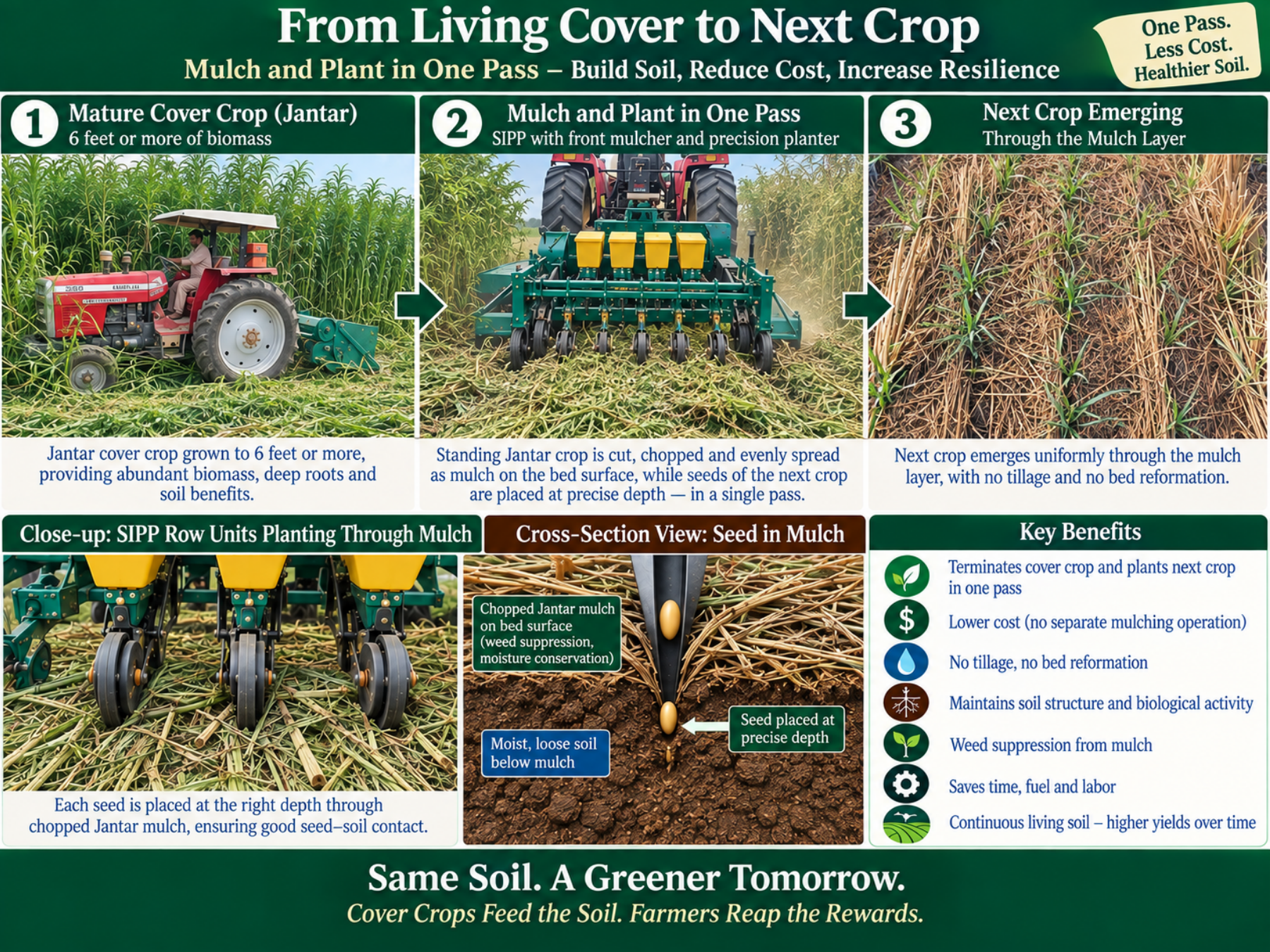
The fundamental design challenge of the SIPP planter is that conventional seed drills and planters are designed for tilled, bare soil: they rely on loose, disturbed soil to open a furrow, deposit the seed, and cover it. A PQNK bed covered by three inches of organic mulch and populated by a continuous root and biological network cannot be planted by a conventional drill without destroying the mulch layer and the biology beneath it. The SIPP planter penetrates the mulch with a narrow, precisely calibrated cutting element that opens a channel of minimum width through the mulch and into the soil, deposits the seed at exactly the correct depth, and closes the channel without disturbing the surrounding mulch or soil matrix.
The result is a crop that is precisely planted at the correct depth for optimal germination, into a soil that is biologically active, moisture-retentive, and structurally intact. The plant emerges into a field where the ecosystem has already been established and is ready to support it. The first root hair of the establishing seedling touches living soil from its first moment of growth. Compare this to the seedling in a conventionally tilled field, which emerges into a disturbed, temporarily aerated, biologically disrupted soil that is already beginning the process of re-compaction from the first rain event after tillage.
The SIPP planter’s precision in seed spacing and depth is equally important. PQNK plants at population densities calibrated by plant count per acre, not by seed weight per unit area. The planter must deliver each seed individually, at the prescribed spacing, at the prescribed depth, every time. Variability in seed placement (the cause of uneven emergence, competition between plants, and incomplete canopy closure) is not tolerated by the system. The machine must perform to the specification, and the specification is derived from the biological requirements of the crop in an ecosystem setting, not from the operational convenience of a tractor operator managing a large area quickly.
THE VIPP PLANTER: VERTICAL INSERTION AS A NEW PLANTING PRINCIPLE
The VIPP (Vertical Insertion Precision Planter) represents a development beyond the SIPP for specific crops and conditions. Where the SIPP opens a narrow horizontal channel through the mulch to place the seed at depth, the VIPP delivers the seed through a vertical insertion mechanism that penetrates the mulch and soil to the required depth with minimal lateral disturbance. This distinction matters for crops where lateral soil disturbance at planting time, even the small amount created by the SIPP channel-opening element, can disrupt the established root network of a companion crop or the biological structure of a particularly dense mulch layer.
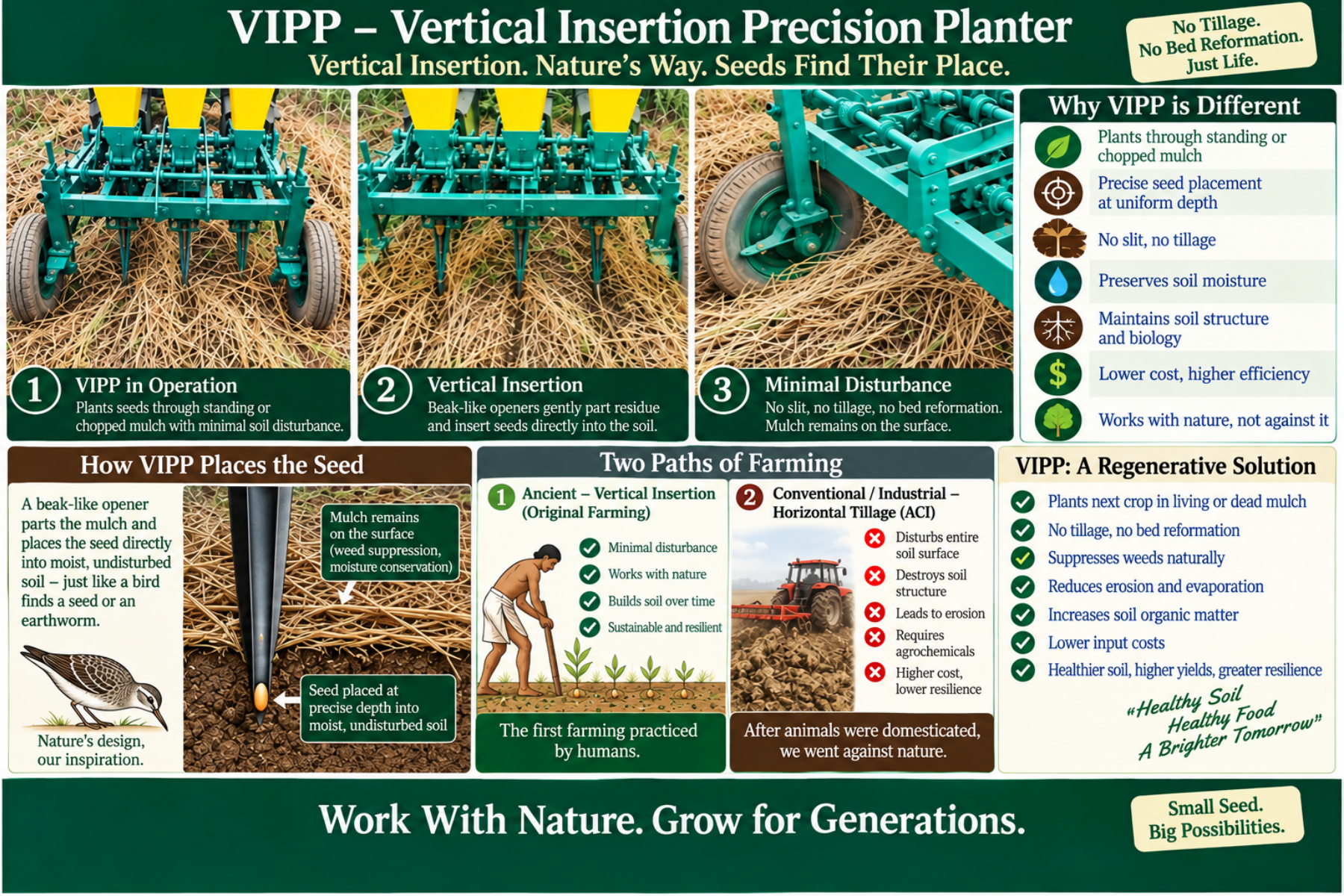
The VIPP is particularly valuable for planting in standing crops; that is crop-in-crop operations, for planting into established PQNK beds with dense mulch accumulation from multiple previous crop cycles, and for situations where the PQNK bed is supporting a companion planting protocol. Its design principle is consistent with the foundational engineering philosophy of all PQNK maintenance machinery: introduce the new crop into the living system with the minimum physical disruption that precise seed placement requires.
THE MULCHER: RETURNING ORGANIC MATTER TO ITS NATURAL FUNCTION
The mulcher is the machine that converts the standing residue of a harvested crop into the mulch layer that protects the bed surface, moderates soil temperature and moisture, and feeds the decomposition biology of the PQNK soil. It is not a complicated machine in engineering terms, but its function in the PQNK system is essential.
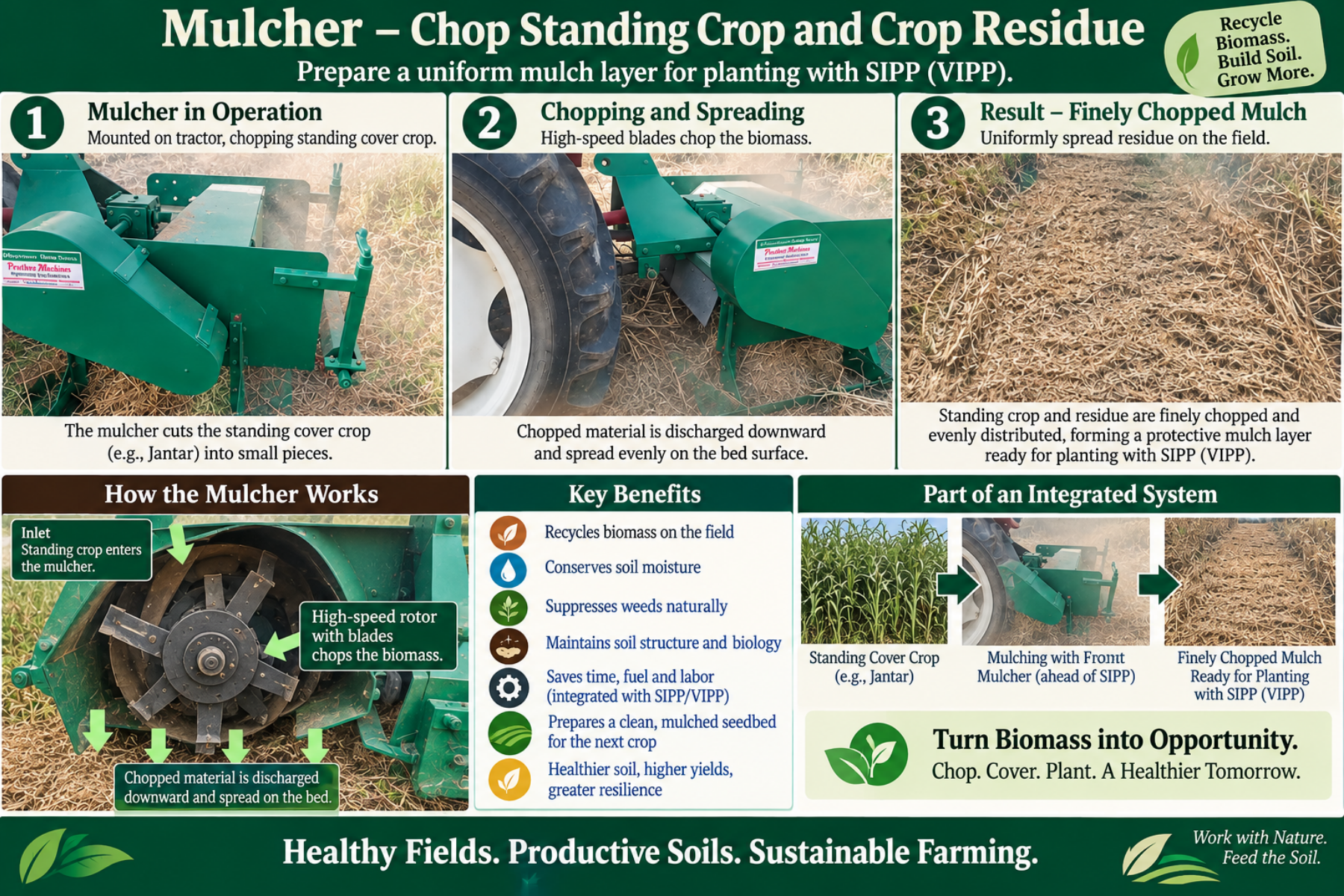
The principle is simple: after harvest, the above-ground residue of the crop remains on the bed. The mulcher chops this residue into fragments of a size that decomposes at the rate the PQNK system requires: fine enough to allow rapid biological colonization, coarse enough to maintain the physical structure of the mulch layer as a moisture-retaining blanket over the bed surface. The residue is not removed, baled, burned, or composted. It is returned directly to the surface of the bed from which it grew, where the biology of that specific field decomposes it efficiently and incorporates its nutrients into the root zone.
This is not composting. Composting removes organic material from the field, subjects it to an external biological process, and returns it as a processed amendment. PQNK mulching returns organic material to the field in situ, where the specific biology of that field’s ecosystem processes it in direct contact with the root zone of the next crop. The biological outcome is different, the ecological logic is different, and the result for soil health is substantially superior to any external organic amendment.
The mulcher also plays a critical role in weed management. A well-mulched PQNK bed, with three inches of chopped crop residue covering the surface, creates conditions under which most weed seeds cannot germinate or establish, not because the mulch is chemically active, but because it deprives emerging weed seedlings of the light they need in the first critical days of establishment. The mulch layer is therefore simultaneously a fertility system, a moisture system, and a weed management system. Three functions, one machine, no inputs.
BED RENOVATION AND FURROW CLEANING
Two additional maintenance tools complete the PQNK machinery set: the precision weeder and the bed renovator.
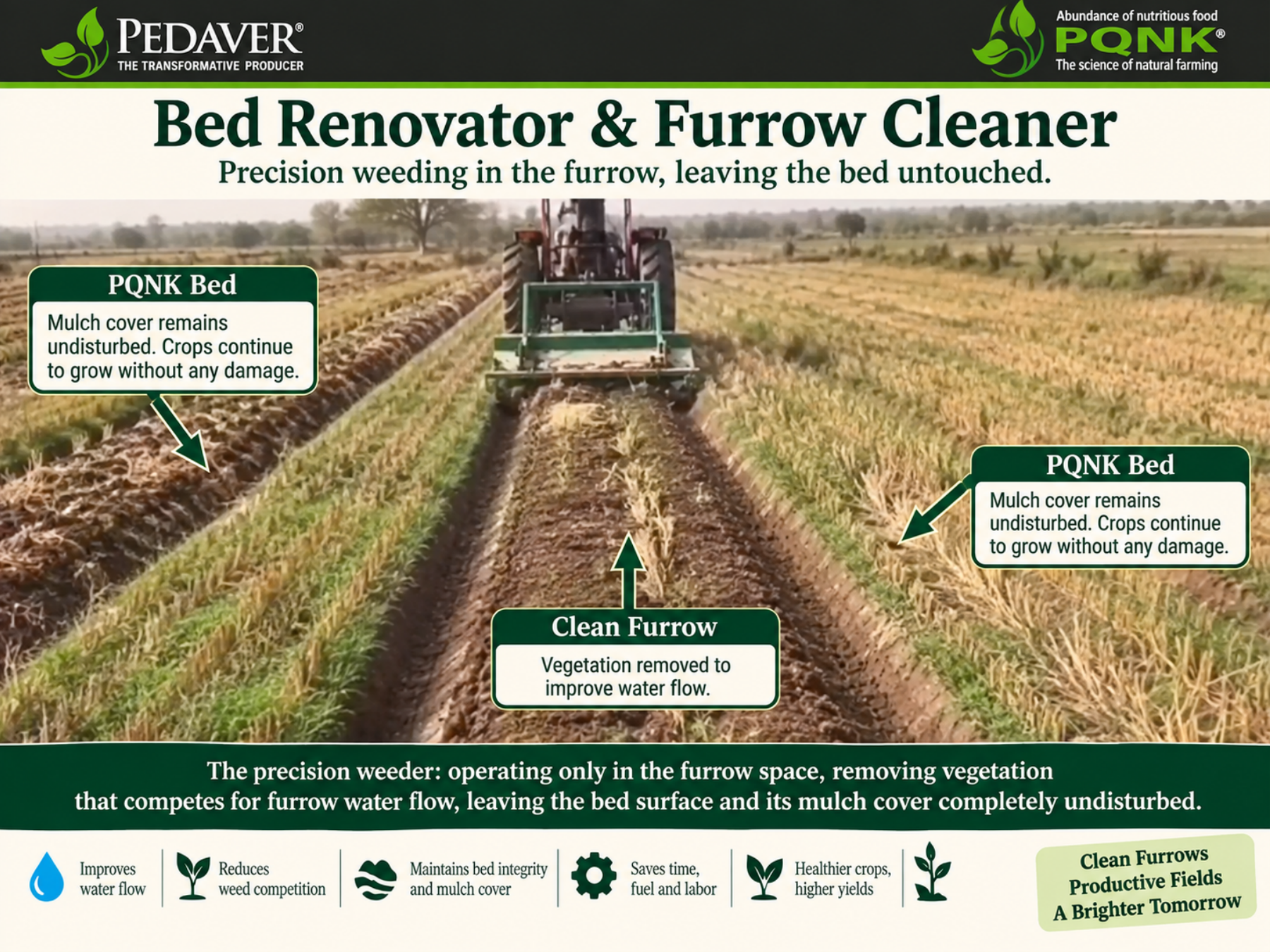
The precision weeder operates within the furrow space between PQNK beds, removing any vegetation that establishes in the traffic zone without entering or disturbing the bed surface or the biological activity it protects. The weeder is calibrated to operate between the beds without contacting the bed edges, and it does not penetrate the bed surface at any point. Its function is to maintain the furrow as a clean operational space for water management and tractor access, not to manage the ecology of the bed.
The bed renovator is used in the exceptional circumstance where a specific area of the bed surface has been disturbed (by a localized compaction event, by an unusual soil movement, or by any other physical disruption to the standard bed profile). It reshapes the affected section of the bed to the standard PQNK profile without disturbing the surrounding areas. Like all PQNK maintenance machinery, its design objective is minimum disruption to the maximum ecological area, targeted precisely at the specific area requiring intervention.
WHAT THIS CHAPTER HAS ESTABLISHED
This chapter has described the complete PQNK machinery system as an integrated set of tools designed to serve ecological function rather than compensate for ecological collapse. The transition machines (the hardpan breaker and the bed shaper) perform their foundational work once and are then removed from the regular operational cycle of the farm. The maintenance machines (the SIPP and VIPP planters, the mulcher, the precision weeder, and the bed renovator) operate within the established ecological architecture with minimum disturbance and maximum precision.
The engineering philosophy that governs every PQNK machine is consistent: the ecosystem performs the essential functions of fertility, water management, pest regulation, and structural maintenance. The machines create the conditions for those functions to operate, and then move aside. They are servants of the living system, not replacements for it. This is the inversion of the conventional relationship between machinery and agriculture that Chapter Nine described. The industrial machine expanded as the ecosystem weakened. The PQNK machine creates the conditions for the ecosystem to strengthen, and then, progressively, is needed less.
The next chapter looks more closely at the SIPP and VIPP planters introduced here: the field calibration, planting sequence and adoption economics that make precision no-till seeding practical at commercial scale.
Chapter Twenty-Nine: SIPP and Precision Planting