
Industrial Devastation To Natural Abundance
Extended Knowledge · Chapter 50
Re-Mothering Agriculture
Dharti Maan
Release 1.0 · 2026-10-24
If you use “Listen”, the text of the page may be sent to your browser or operating system’s speech provider, such as Apple, Google or Microsoft, depending on the voice your device uses. Pedaver does not process, transmit or store any audio.
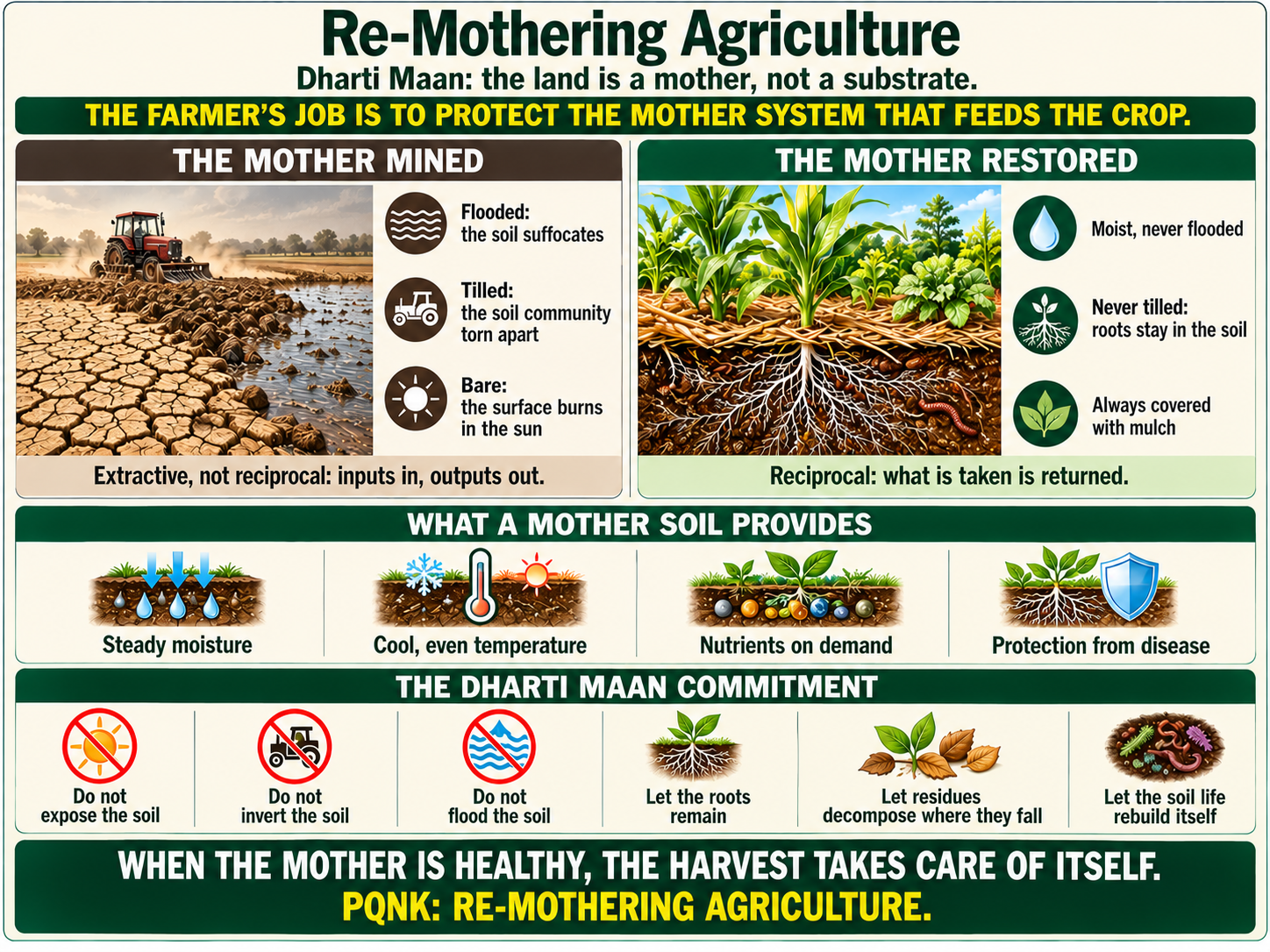
Re-Mothering Agriculture: when the mother is healthy, the harvest takes care of itself.
There is a phrase that encapsulates an entire agricultural philosophy in two words: Dharti Maan, the land is mother. It is not a metaphor invented for convenience. It is a recognition of a biological reality that traditional farming cultures understood intuitively before the language of agronomy existed: the soil is not a growing medium. It is a living organism that nourishes everything that grows within it, and that must be nourished in return.
Modern industrial agriculture has severed this relationship. It treats the soil as a substrate into which inputs are injected and from which outputs are extracted. The relationship is extractive, not reciprocal. The result, played out over more than sixty years of the Green Revolution, is visible in every salinised field, every compacted subsoil, every aquifer drawn down below recovery level. The mother has been mined, not cared for. And like any organism that is continuously depleted without renewal, she is failing.
PQNK is the act of re-mothering: restoring the reciprocal relationship, returning to the soil what is taken from it, and allowing the biological systems that constitute soil health to reassert themselves. This is not romanticism. It is ecology. And it has a precise, operational meaning.
WHAT MOTHERING MEANS BIOLOGICALLY
A mother does not merely provide food. She provides a precisely calibrated environment, temperature regulated, moisture maintained, pathogens managed, nutrients supplied in the right proportions at the right developmental stages. This is exactly what a functioning soil system does for plant roots.
The microbial community in a healthy soil is not a passive collection of decomposers. It is an active, responsive system that monitors root exudate signals, manufactures plant-available nutrient forms on demand, suppresses pathogens through competitive exclusion, and builds soil structure to maintain the physical conditions roots require. The plant does not simply absorb what the soil contains. The plant and the soil engage in a continuous dialogue, exudate-for-nutrient, signal-for-service, that is the biological basis of all natural fertility.
When tillage inverts the soil, this community is disrupted. When flood irrigation creates anaerobic conditions, it is killed. When bare soil is exposed to a hot summer sun, its surface temperature approaches 60 to 70 degrees Celsius, conditions lethal to the organisms that power the system. These three practices of ACI (Ancient Conventional Industrial) agriculture, flooding the soil, tilling it and leaving it bare, are not merely suboptimal management choices. They are acts of violence against the mother system.
THE TECHNOLOGICAL DISPLACEMENT PROBLEM
The narrative of modern agricultural development has consistently framed the problem of food security as a technology problem: insufficient seeds, insufficient chemistry, insufficient machinery. The solution has always been more technology, newer varieties, more potent chemicals, larger machines.
PQNK challenges this framing directly. The technology problem is not that farms lack inputs, it is that the underlying biological system has been damaged to the point where it requires inputs to produce anything at all. The farmer is not managing a farm; they are managing a dependency. Every year, the soil degrades further. Every year, the input requirement increases. Every year, the margin narrows. This is not productivity, it is biological debt, accumulating with compound interest.
The GMO debate exemplifies this displacement. Genetically modified crops are offered as a solution to pest pressure, nutrient deficiency, and drought. But these are symptoms of soil system failure, not causes of crop vulnerability. A plant rooted in a functioning PQNK soil system does not require Bt insertion to resist insects, because the pest pressure that GMO crops are engineered to survive arises precisely in the degraded, minerally imbalanced soils that PQNK restores. The GMO is an engineering solution to a problem created by engineering.
MACHINERY AND THE TWO-PASS PRINCIPLE
Mechanisation in conventional agriculture requires multiple passes per crop cycle: ploughing, harrowing, bed-forming, sowing, inter-row cultivation, harvesting. Each pass compacts the traffic lanes, disturbs the soil profile, disrupts mycorrhizal networks, and consumes fossil fuel.
PQNK needs only two soil-working passes in the entire productive life of the field, both made once, at conversion: one subsoiling operation to fracture the hardpan, and one bed-forming operation to establish the permanent growing geometry (Chapter Twenty-Three). After that, the soil is never tilled again: the planter places each crop's seed through the mulch with minimal disturbance, and the beds stay as they are, crop after crop. The machinery economy is not merely financial, it is energetic. Every diesel litre saved is carbon not released, soil not compacted, and farming not contingent on fuel price volatility.
POLICY IMPLICATIONS: WHAT DHARTI MAAN DEMANDS
Re-mothering agriculture at scale requires more than farmer adoption. It requires policy alignment. Agricultural support structures in most countries, developed and developing alike, Pakistan among them, are built around the input-dependent model: subsidised fertiliser, subsidised pesticide, extension services trained to recommend chemical interventions. These structures actively discourage the transition to PQNK by making the degrading inputs cheaper than the regenerating practices.
A re-mothering agricultural policy would look different. It would value soil organic matter as a national asset, with extension services trained to measure and increase it. It would subsidise the one-time subsoiling and bed-forming operations that establish PQNK fields. It would price water at its true replacement cost, making PQNK’s 77 to 92 percent water savings economically decisive. It would reward farmers for sequestered carbon through verified carbon finance mechanisms that are already technically available.
Most fundamentally, it would recognise that the farmer who maintains a functioning soil system is performing an ecosystem service for the entire nation, producing food without depleting aquifers, without salinising land, without releasing carbon, without polluting waterways. This service has value that the market currently does not price. Until it does, the policy framework itself subsidises soil destruction.
THE DHARTI MAAN COMMITMENT
The Dharti Maan commitment is simple to state and profound in its implications: return to the soil everything that is taken from it, in forms the soil can use. Do not expose the soil. Do not invert the soil. Do not flood the soil. Let the roots remain. Let the residues decompose where they fall. Let the biological community rebuild itself from the conditions it requires.
This is not a sacrifice. It is the recognition that the fertility of the farm is not purchased from an input dealer, it is created by the soil itself, provided the conditions for its creation are present. The farmer's job is not to feed the crop. The farmer's job is to protect the mother system that feeds the crop. When the mother is healthy, the harvest takes care of itself.
Chapter Fifty-One: Okra Under PQNK, Fruiting Management and the Non-Intervention Principle