
Industrial Devastation To Natural Abundance
The Transformation · Chapter 49
PQNK as the Farmacy
The Root of the Chronic Disease Epidemic, and Its Cure
Release 1.0 · 2026-10-24
If you use “Listen”, the text of the page may be sent to your browser or operating system’s speech provider, such as Apple, Google or Microsoft, depending on the voice your device uses. Pedaver does not process, transmit or store any audio.
PQNK as the Farmacy: the hospital is downstream of the farm.
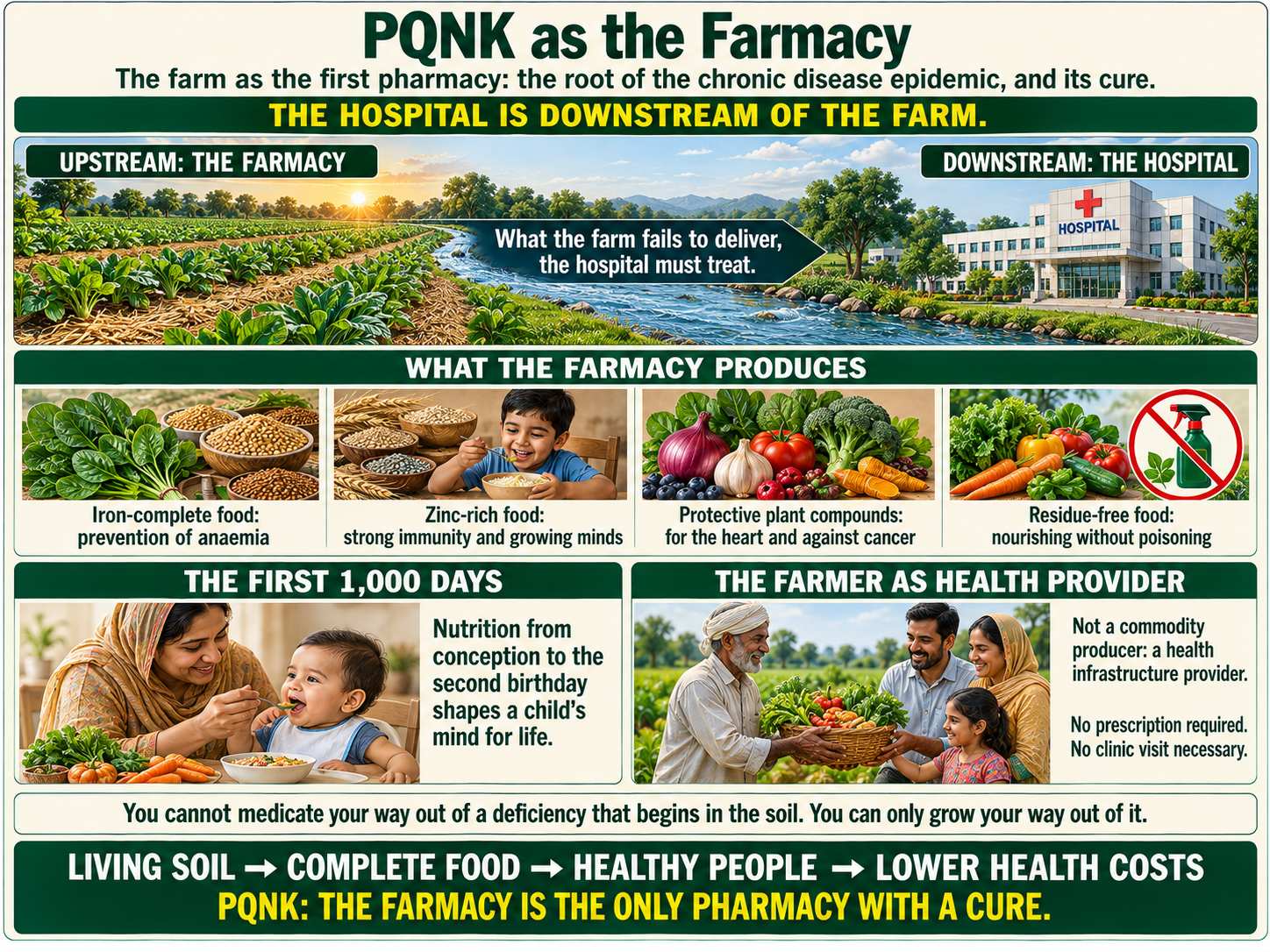
“The hospital is downstream of the farm. Every patient in a hospital whose condition is rooted in nutritional deficiency is there because a farm somewhere failed to deliver what the food chain was designed to provide. You cannot medicate your way out of a deficiency that begins in the soil. You can only grow your way out of it. The farmacy is the only pharmacy with a cure.”
Asif Sharif, Lahore, 2024
The word farmacy is deliberate. It is the farm as pharmacy: not metaphorically, not as an aspiration, but as a biological description of what a PQNK farm does for the community that eats from it. A pharmacy dispenses compounds that correct biological deficiencies and support the body’s own healing capacity. A PQNK farm produces food whose nutritional completeness prevents the deficiencies that the pharmacy treats. Prevention and cure are the same biology. The farm is where they begin.
THE CHRONIC DISEASE EPIDEMIC: ITS AGRICULTURAL ROOT
The global epidemic of chronic non-communicable disease, type 2 diabetes, cardiovascular disease, metabolic syndrome, obesity, certain cancers, autoimmune conditions, and the expanding spectrum of neurological and psychiatric disorders, is the defining public health crisis of the twenty-first century. It affects every country, every income level, and every demographic group that has adopted the industrial food system. It is not primarily a genetic crisis. It is an environmental one: the human body encountering, for the first time in evolutionary history, a food supply that is calorically abundant but nutritionally incomplete.
The agricultural root of this crisis is the bio-potentiation chain disruption documented in Chapter Forty-Eight: the severing of the mycorrhizal delivery system, the simplification of plant nutrition to NPK, the reduction in micronutrient density, secondary metabolite richness, and phytonutrient complexity of the food supply that the industrial farming system produces. The body that evolved over hundreds of thousands of years on food from biologically active soil is now eating food from biologically depleted soil and experiencing the consequences of that mismatch in its tissues, its metabolism, and its longevity.
The economic consequence of this agricultural-origin chronic disease is vast. In the United States alone, diet-related chronic disease is estimated to cost $1.2 trillion a year, and every health system in the world carries the same burden in its own measure. This cost is borne primarily by healthcare systems that treat the symptoms of deficiencies whose roots are in the farm, not the clinic. The medication bill for type 2 diabetes management alone is measured in hundreds of billions of dollars annually, for a disease that is largely preventable through the mineral and phytonutrient completeness of a food supply grown in biologically active soil.
WHAT THE FARMACY PRODUCES
The PQNK farmacy does not produce medicine. It produces food. The distinction matters. Medicine is a response to disease. Food is the condition in which disease does or does not arise. The farmacy’s product, nutritionally complete food from a biologically active soil, is the condition in which the chronic diseases of nutritional deficiency do not arise, in which the immune system functions as it was designed to, in which the metabolic system regulates itself without pharmaceutical assistance, and in which the human body experiences the biological expression that adequate nutrition enables across a lifetime.
Iron-complete food for anaemia prevention. Anaemia, much of it from iron deficiency, affects about a third of the world’s women of reproductive age (WHO), and Pakistan’s rate is among the highest in Asia. PQNK leafy vegetables, pulses and grain crops draw on the full mineral spectrum of a living soil and are grown to carry more iron than their conventionally grown counterparts. The iron in PQNK food is embedded in the food matrix of a biologically complete plant with the co-factors, vitamin C, copper, folate, that maximise its absorption. Iron supplementation tablets are an expensive and poorly absorbed response to a deficiency whose root is in the soil. Iron-complete food from the PQNK farmacy is its prevention.
Zinc-rich food for immune function. Zinc deficiency impairs immune function, wound healing, and the cognitive development of children whose zinc status during the critical early years determines their neurological architecture. PQNK crops reach the zinc of the subsoil through their mycorrhizal network, which NPK-grown crops in the same district cannot. The child who grows up eating from a PQNK farmacy is fed the zinc that a growing body needs.
Secondary metabolites for cancer and cardiovascular protection. The flavonoids of PQNK onion, the glucosinolates of PQNK brassicas, the lycopene of PQNK tomato, the allicin of PQNK garlic, each produced in full by a plant that has the complete mineral spectrum it needs, are the phytochemicals whose intake correlates most strongly with reduced cancer risk and cardiovascular protection in the epidemiological literature. The farmacy’s phytonutrient spectrum is the biological expression of what a functioning soil delivers to the human body through the food chain.
Residue-free food for immune and endocrine protection. PQNK food carries none of the synthetic pesticide residues that accumulate in conventionally grown food and that the growing epidemiological literature associates with endocrine disruption, neurological effects in children, and immune dysregulation. The absence of these residues is not a negative quality. It is the presence of the immune and endocrine system’s original operating conditions: a food supply that is not simultaneously nourishing and poisoning.
The farmer who grows PQNK food is providing their community with the most evidence-based preventive medicine available: iron for anaemia prevention, zinc for immune development, flavonoids for cancer protection, clean food for endocrine safety. No prescription required. No clinic visit necessary. Just food from living soil doing what food was always designed to do.
THE FARMACY IN THE COMMUNITY: HOW PQNK HEALTH BENEFITS SCALE
The individual health benefits of eating PQNK food compound at the community level when PQNK adoption reaches a significant proportion of local food supply. A community whose food supply is predominantly PQNK-grown has a different nutritional environment than one whose food supply is predominantly conventional: higher average micronutrient status, lower chronic disease prevalence, lower healthcare expenditure, and the compounding developmental advantages of children whose first 1,000 days of nutrition came from a biologically complete food supply.
The most significant community-level benefit is in child development. The first 1,000 days, from conception to the second birthday, are the period during which the human brain is most actively developing its neurological architecture. Micronutrient adequacy during this period, iron for myelination, zinc for synaptic development, iodine for thyroid function, omega-3 fatty acids for membrane integrity, determines the cognitive capacity that the developing person will carry for the rest of their life. A community whose pregnant mothers and young children eat from PQNK farms is a community investing in the cognitive endowment of its next generation at zero additional cost.
This developmental investment compounds across generations. A generation of children who grew up eating from PQNK farmacies will have higher average cognitive capacity, better average health outcomes, lower average healthcare costs, and greater average economic productivity than a generation that grew up eating from conventional farms. The returns to PQNK adoption at community scale are not limited to the farm or the food. They extend to the full human capital of the communities that eat from it.
HEALTHCARE SYSTEMS AND THE FARMACY: THE COST REVERSAL
Healthcare systems globally are overwhelmed by the cost of treating diet-related chronic diseases whose origin is nutritional. Type 2 diabetes management, cardiovascular disease treatment, cancer care, inflammatory condition management, these are the largest and fastest-growing categories of healthcare expenditure in both developed and developing countries. They are also, from the bio-potentiation perspective, the most preventable: diseases whose drivers include micronutrient deficiency, phytonutrient inadequacy, chemical residue toxicity, and gut microbiome disruption, all consequences of the industrial food system’s bio-potentiation chain failures.
A healthcare system that supports the transition of its population’s food supply to PQNK production is making the most cost-effective healthcare investment available. The prevention of one case of type 2 diabetes saves the healthcare system the lifetime treatment cost of managing that condition, estimated at tens of thousands of dollars per case in managed healthcare systems. PQNK food’s contribution to diabetes prevention, through its mineral-complete, phytonutrient-rich, residue-free nutritional profile, is the prevention that no pharmaceutical intervention can replicate at population scale.
THE FARMACY AS A VISION FOR PQNK’S FUTURE
The farmacy vision is where the PQNK argument reaches its fullest expression: not just better farming, not just a better economy, not just a better climate, but a different relationship between the land, the food it produces, and the health of the people who eat from it. A relationship in which the farm is the primary health infrastructure of the community it serves, and the farmer is understood as a health provider alongside being a food producer.
This vision changes what farming means and who the farmer is. The PQNK farmer who understands that their wheat is grown to carry more iron than the wheat from the neighbouring conventional farm, their garlic more allicin, their vegetables more zinc, that their food carries no pesticide residue, this farmer is not a commodity grain producer. They are a health infrastructure provider for their community, producing a service that the healthcare system cannot replicate and cannot afford to do without.
The premium market for PQNK food that Chapter Thirty-Nine described as an emerging reality in Pakistan’s urban markets is the beginning of the economic recognition of this health infrastructure value. When consumers pay a premium for chemical-free, biologically grown food, they are paying for the prevention that the conventional system does not provide. When healthcare systems begin to recognise and fund the preventive value of PQNK food production, the farmacy will have its full economic expression: the farm paid not only for the food it produces but for the healthcare costs it prevents.
WHAT THIS CHAPTER HAS ESTABLISHED
PQNK as the farmacy is the argument that the farm is the original and most effective health infrastructure of any community: the source of the mineral-complete, phytonutrient-rich, residue-free food that prevents the nutritional deficiencies whose consequences fill hospitals and consume healthcare budgets. The chronic disease epidemic has an agricultural root, and an agricultural cure. The cure is not a new medication or a new supplement or a new dietary protocol. It is a new farming system that produces the food the human body was designed to eat from the soil that was designed to grow it.
This chapter closes Part Six, The Transformation. Part Seven, Extended Knowledge, goes deeper into the practice behind everything Part Six has described, beginning with the idea at its heart: the soil as mother, Maaee Zameen.
Chapter Fifty: Re-Mothering Agriculture, Maaee Zameen