
Industrial Devastation To Natural Abundance
The Transformation · Chapter 48
Bio-potentiation
From Soil to Soul: The Food Chain as Fountain of Life
Release 1.0 · 2026-10-24
If you use “Listen”, the text of the page may be sent to your browser or operating system’s speech provider, such as Apple, Google or Microsoft, depending on the voice your device uses. Pedaver does not process, transmit or store any audio.
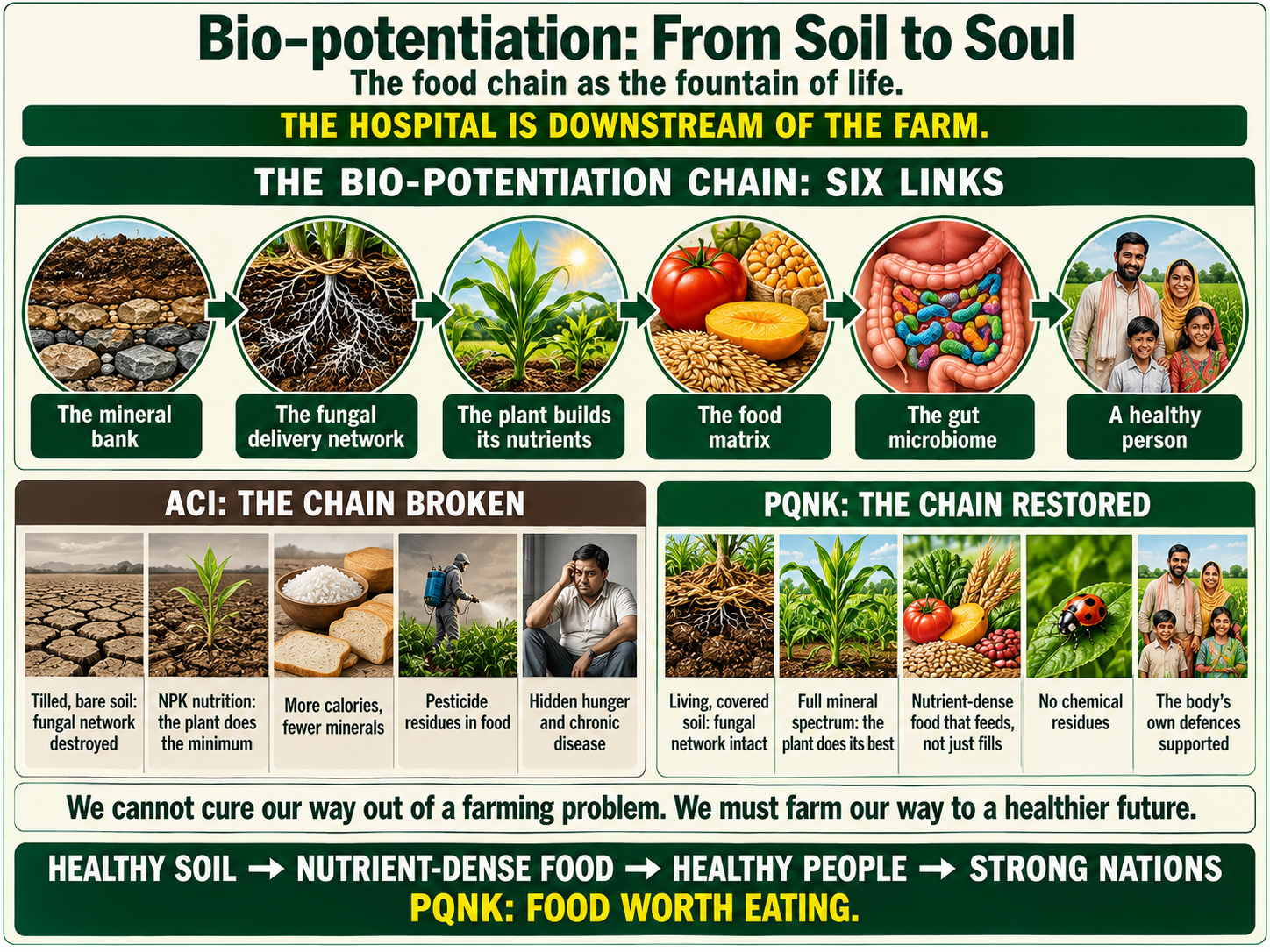
Bio-potentiation: From Soil to Soul. The six links of the chain, broken by ACI and restored by PQNK.
“We have been so focused on quantity that we forgot to ask what the food we produce actually does to the body that eats it. The answer from conventional agriculture is: less than it should. The answer from PQNK agriculture is: what it was always designed to do. The difference is not in the calories. It is in everything that the calories carry.”
Asif Sharif, Lahore, 2023
Bio-potentiation is the concept at the heart of PQNK’s deepest claim: that the restoration of soil biological function does not merely improve agricultural productivity and environmental outcomes but restores the nutritional chain from geology to plant to animal to human that sustains the full expression of human biological potential. It is the claim that food grown in living soil is not just more nutritious by some measure but is a qualitatively different food from food grown in dead soil, and that the difference is visible in the health of the populations that eat from each.
This chapter develops the bio-potentiation concept in full: the biological chain from soil to soul, the specific nutrients and metabolites that PQNK food contains that conventionally grown food does not, the documented effects on plant quality that the preceding chapters have described in crop-specific terms, and the growing evidence that these quality differences produce measurable health outcomes for the people who eat PQNK food over time.
THE BIO-POTENTIATION CHAIN: SIX LINKS
Bio-potentiation operates through a six-link biological chain from the geological mineral bank to the human cell that benefits from it. Each link must be intact for the chain to deliver its full nutritional potential.
Link One: The geological mineral bank. As Chapter Three established, the geological mineral bank beneath every agricultural field contains the full periodic table of elements in quantities that could sustain billions of harvests at current yield rates without depletion. The minerals are not the constraint. Access to them is.
Link Two: The mycorrhizal delivery system. The mycorrhizal fungal network that extends from plant roots into the geological mineral bank is the biological pipe through which minerals move from where they are abundant to where they are needed. Without the mycorrhizal network, destroyed by tillage and fungicide in conventionally managed soils, the geological bank is inaccessible and the plant relies on the simplified NPK nutrition that purchased fertiliser provides.
Link Three: The plant biosynthesis. A plant receiving the complete mineral spectrum through the mycorrhizal delivery system can synthesise the full range of vitamins, secondary metabolites, and phytonutrients that its genetic programme requires. Iron supports chlorophyll and haemoglobin synthesis. Zinc supports enzyme production and immune function. Selenium drives the antioxidant pathways that protect cellular integrity. Magnesium activates hundreds of enzymatic reactions. A plant with the full mineral spectrum is doing all of this at full capacity. A plant on NPK nutrition is doing the minimum.
Link Four: The food matrix. Minerals and vitamins in food are not free-floating chemicals. They are embedded in the biological matrix of the plant tissue: complexed with proteins, incorporated into cell structures, associated with other nutrients that affect their absorption. The bioavailability of iron from PQNK spinach, iron embedded in the full mineral matrix of a biologically produced plant, differs from the bioavailability of iron from fortified conventional food because the food matrix determines how much of the mineral the human digestive system can access.
Link Five: The human gut microbiome. The human gut microbiome is the digestive equivalent of the soil food web: a community of microorganisms that mediates the relationship between what is eaten and what the body can absorb. PQNK food, produced by a biologically complex system and carrying a diverse array of prebiotics, fermentable fibres, and complex phytonutrients, feeds a more diverse and more functional gut microbiome than the simplified nutritional profile of conventionally produced food. A more functional gut microbiome absorbs more of the nutrients available, produces more of the metabolites that support immune function and mental health, and provides more effective barrier protection against pathogens.
Link Six: Human biological expression. At the end of the chain, a person consuming PQNK food over time receives a richer supply of the minerals, vitamins, secondary metabolites, and phytonutrients that their cells require for the full expression of their biological potential: immune function, cognitive clarity, physical energy, emotional stability, the prevention of the chronic diseases that mineral deficiency and oxidative stress drive across a lifetime. This is bio-potentiation: the soil’s biological potential potentiating the human biological potential through the food chain that connects them.
WHAT PQNK FOOD CONTAINS THAT CONVENTIONAL FOOD DOES NOT
The nutritional differences between PQNK and conventionally grown food have been documented in a range of specific comparisons across the crops of Part Five. This section synthesises those differences into the categories that matter most for human health.
Micronutrient density. A PQNK crop draws on the full mineral spectrum through its mycorrhizal network, so it is grown to carry more of the iron, zinc, magnesium, selenium and trace minerals than the same crop species on NPK-fertilised soil. These are the minerals whose deficiency drives the most prevalent nutritional disorders worldwide, Pakistan’s among them, and a chronic disease burden that in the United States alone is estimated to cost $1.2 trillion a year.
Secondary metabolite richness. Secondary metabolites, the phytonutrients, flavonoids, carotenoids, glucosinolates, terpenes, and phenolic compounds that plants produce as part of their biological defence, communication, and ecological function, are produced at higher concentrations in PQNK plants that have the full mineral spectrum required for their biosynthesis. These compounds are the phytochemicals whose intake correlates most strongly with cancer risk reduction, cardiovascular health, neurological protection, and the prevention of the chronic diseases that conventional food’s simplified nutritional profile fails to prevent.
Lower water content, higher dry matter. PQNK food grows in a moist, aerated soil under Soil Moisture Management, never in a flooded one, and PQNK growers find their produce denser, more flavourful and longer-keeping. Where it has been measured, the difference is real: Kinnow from a PQNK orchard has shown 15 to 20 percent higher Brix than conventional fruit from the same orchard (Chapter Forty). As Chapter Twenty-Six explains, such gains come from the living soil and the whole plant, not simply from less water in the fruit.
Absence of synthetic chemical residues. PQNK food, grown without synthetic pesticide, herbicide, or fertiliser, contains none of the residues that accumulate in conventionally grown food and for which the FAO/WHO Codex Alimentarius Commission sets maximum residue limits. The absence of these residues removes from PQNK food the low-level chronic toxic load that accumulates across a lifetime of eating conventionally produced food and that epidemiological studies increasingly associate with endocrine disruption, neurological effects, and immune dysfunction.
THE CORRECT MEASURE: USEABLE BIOLOGICAL ENERGY PER PLANT AND PER UNIT OF LAND
The measure that the industrial agricultural system uses to evaluate crop performance, yield as volume, expressed in tonnes per acre or kilograms per hectare, is not a measure of agricultural success. It is a measure of industrial output, and it has been used for sixty years to conceal one of the most significant nutritional catastrophes in human history. Volume of harvest and quality of harvest are not the same thing. A wheat crop that produces more tonnes per acre of grain carrying less protein, fewer minerals and less of the biological activity of the grain it replaced has not outperformed its predecessor. It has produced more of less. The documented decline in the nutritional content of staple food crops since the introduction of Green Revolution varieties and ACI (Ancient Conventional Industrial) management practices, documented across multiple long-term datasets spanning six decades, falls broadly in the 20 to 40 percent range for many crops and nutrients, with some crop-nutrient combinations showing considerably larger losses (Chapter Eleven). Volume increased. Nourishment declined. The industrial system measured the wrong thing and called the result progress.
The correct measure, the one that nature has always used in designing productive ecosystems, is useable biological energy produced per plant and per unit of land. A plant that is fully mineralised, physiologically complete, biologically active, and grown without chemical interference delivers to the person who eats it a fundamentally different nutritional experience from a plant that was force-fed soluble nitrogen, protected by systemic chemistry, and harvested at maximum bulk before biological maturity was complete. PQNK food is consistently richer in Brix value, mineral density, enzyme activity, and secondary metabolite complexity: the compounds that are invisible to a weighbridge but are the actual substance of human health. This is not a marginal difference. It is the difference between food that feeds and food that fills. PQNK does not optimise for volume. It optimises for maximum useable biological energy from every plant and every unit of land, which is precisely the objective that nature encoded into every living ecosystem long before the first agricultural field was formed.
It must also be understood that field performance in PQNK is not a fixed number that can be read from a single season or a single location. A field in its first season of transition performs differently from a field in its third season, and a field in its fifth year differently again from its third. The biological capital of the soil compounds with each undisturbed season: deeper root archives, denser mycorrhizal networks, richer microbial communities, greater water-holding capacity. The nutritional quality of the crop reflects this biological maturity. Adaptation accuracy, seed variety, local soil history, climatic conditions, and the precision of the transition protocol all influence what any given field produces in any given season. This is not a weakness of the system. It is what it means to work with a living ecosystem rather than a managed industrial process. The ecosystem responds to where it is, what has been done to it, and how carefully it has been managed. Given time and correct management, it converges toward the same destination: maximum useable biological energy from every plant and every unit of land, produced entirely from within the resources that nature has already placed there.
Yield as volume was the metric that allowed sixty years of nutritional decline to be recorded as agricultural progress. PQNK does not optimise for volume. It optimises for life: in the soil, in the plant, and in the person who eats what the plant produces.
THE CALORIE ILLUSION: WHY MORE FOOD IS NOT BETTER NUTRITION
The fundamental fallacy of the food security framework that measures success in calories is that it treats all calories as equivalent. A calorie of conventionally grown wheat is not the same as a calorie of PQNK wheat in its nutritional content, its micronutrient profile, its secondary metabolite richness, or its effects on the human body that eats it. The calorie is a unit of energy. It tells nothing about the mineral content, the vitamin profile, the phytonutrient complexity, or the absence of synthetic residues of the food that contains it.
Chapter Thirteen described the nutritional bankruptcy of ACI agriculture, and Chapter Eleven the documented decline in the mineral, vitamin and phytonutrient content of staple crops: broadly 20 to 40 percent for many crops and nutrients, and more for some. This chapter provides the biological explanation for that decline and the biological route to its reversal: restore the mycorrhizal delivery system and the plant will restore its mineral uptake, its vitamin synthesis, and its secondary metabolite production to the levels that its genetic programme has always been capable of. The food that results is not a nutritional supplement. It is food doing what food was always supposed to do.
We feed our population more than ever and they are less healthy than ever. The calories are there. The nutrition is not. The nutritional bankruptcy of ACI agriculture is not visible on the plate. It is visible in the blood work of the population that eats from it and in the healthcare system that treats what the food is causing.
BIO-POTENTIATION AND THE CHRONIC DISEASE EPIDEMIC
The global epidemic of chronic non-communicable disease, type 2 diabetes, cardiovascular disease, metabolic syndrome, obesity, inflammatory conditions, and a range of neurological disorders, has risen in direct correlation with the adoption of the industrial food system and its characteristic nutritional profile. The correlation is documented and consistent across geographies and demographic groups. The biological argument from the bio-potentiation chain is clear: chronic diseases whose drivers include mineral deficiency, chronic inflammation from pesticide residues, oxidative stress from inadequate antioxidant nutrition, and gut microbiome disruption from simplified and chemically treated food, these diseases are precisely what the restoration of the bio-potentiation chain through PQNK food production addresses at its biological root.
PQNK’s claim is not that eating PQNK food cures chronic disease. It is that growing food in a biologically active soil with the full mycorrhizal mineral delivery chain produces food that provides the nutritional environment in which the human body can function as it was designed to function: regulating its own inflammation, maintaining its own immune balance, sustaining its own metabolic efficiency, and protecting its own cellular integrity through the antioxidant chemistry that adequate mineral and phytonutrient intake enables. The food chain was always designed to be the body’s primary defence. The industrial food system has dismantled that defence. PQNK restores it.
THE PQNK FARMACY: FOOD AS THE FIRST MEDICINE
The Hippocratic aphorism ‘Let food be thy medicine and medicine be thy food’ is not a nutritional idealisation. It is a biological description of how human health worked for the entirety of human evolution before the industrial food system separated food from nutrition and nutrition from health.
PQNK’s vision of the farm as a farmacy, a farm that produces food of sufficient nutritional density to function as preventive medicine for the family and community it feeds, is developed in Chapter Forty-Nine. This chapter establishes the biological foundation for that vision: the bio-potentiation chain that connects the geological mineral bank to human health through six links, each of which PQNK restores and conventional agriculture has severed.
The farmer who implements PQNK is not just a food producer. They are a health infrastructure provider for the community that eats their food. The land they farm is not just an agricultural asset. It is a biological system that, when managed correctly, produces the most sophisticated and most cost-effective health intervention available to any society: nutritionally complete food from a biologically active soil that sustains the human body’s own healing capacity.
The farm that produces PQNK food is producing preventive medicine for every person who eats from it. The farmer is not a food producer. They are a health infrastructure provider. The land is not an agricultural asset. It is a biological pharmacy operating at zero cost for the community it serves.
WHAT THIS CHAPTER HAS ESTABLISHED
Bio-potentiation is the deepest argument for PQNK: not the yield argument, not the economics argument, not the climate argument, but the human health argument. The food chain from a biologically active soil to a biologically complete human body is the original design of the relationship between the geological mineral bank, the living soil, the plant, and the person who depends on all three. PQNK restores this design. The industrial food system has dismantled it. The chronic disease epidemic is the cost of the dismantling. The bio-potentiation chain is the cost of the restoration, and the restoration is free.
The next chapter is the shortest and the most direct: PQNK as the Farmacy, the vision of the farm as the primary health infrastructure of the community it feeds.
Chapter Forty-Nine: PQNK as the Farmacy, The Root of the Chronic Disease Epidemic, and Its Cure