
Industrial Devastation To Natural Abundance
The Evidence · Chapter 38
Potato, Circular Production
Permanent Beds, Thermal Protection, Lower Seed Requirement and Year-Round Production Potential
Release 1.2 · 2026-10-05
If you use “Listen”, the text of the page may be sent to your browser or operating system’s speech provider, such as Apple, Google or Microsoft, depending on the voice your device uses. Pedaver does not process, transmit or store any audio.
“The conventional potato farmer spends heavily on seed and grows one crop a year. The PQNK potato farmer plants a fraction of that seed, grows crop after crop on the same permanent bed, and meets the market more than once a year. The circular system is not a farming technique. It is a business model.”
Asif Sharif, Lahore, 2022
Circular production is possible only when the potato’s biological requirements are separated from the conventional seasonal calendar. Air temperature, night temperature, day length and humidity affect the canopy; soil temperature governs the environment in which stolons and tubers actually develop.
Potato is normally treated as a seasonal crop because conventional production exposes the crop directly to seasonal soil conditions and rebuilds the field for each planting. PQNK changes that production architecture. Permanent raised beds, retained biological structure, surface or shallow seed placement, a substantial organic mulch layer and Soil Moisture Management create a protected root and tuber environment that can differ sharply from the temperature of bare soil.
This distinction is central to circular production. A summer afternoon may expose bare soil to extreme solar heating even when the air temperature is much lower. Under a sufficiently thick organic mulch, the soil and tuber zone can remain dramatically cooler. In winter the same mulch reduces rapid heat loss and moderates daily temperature swings. The farmer therefore manages two climates at once: the atmosphere above the crop and the protected biological environment beneath the mulch.
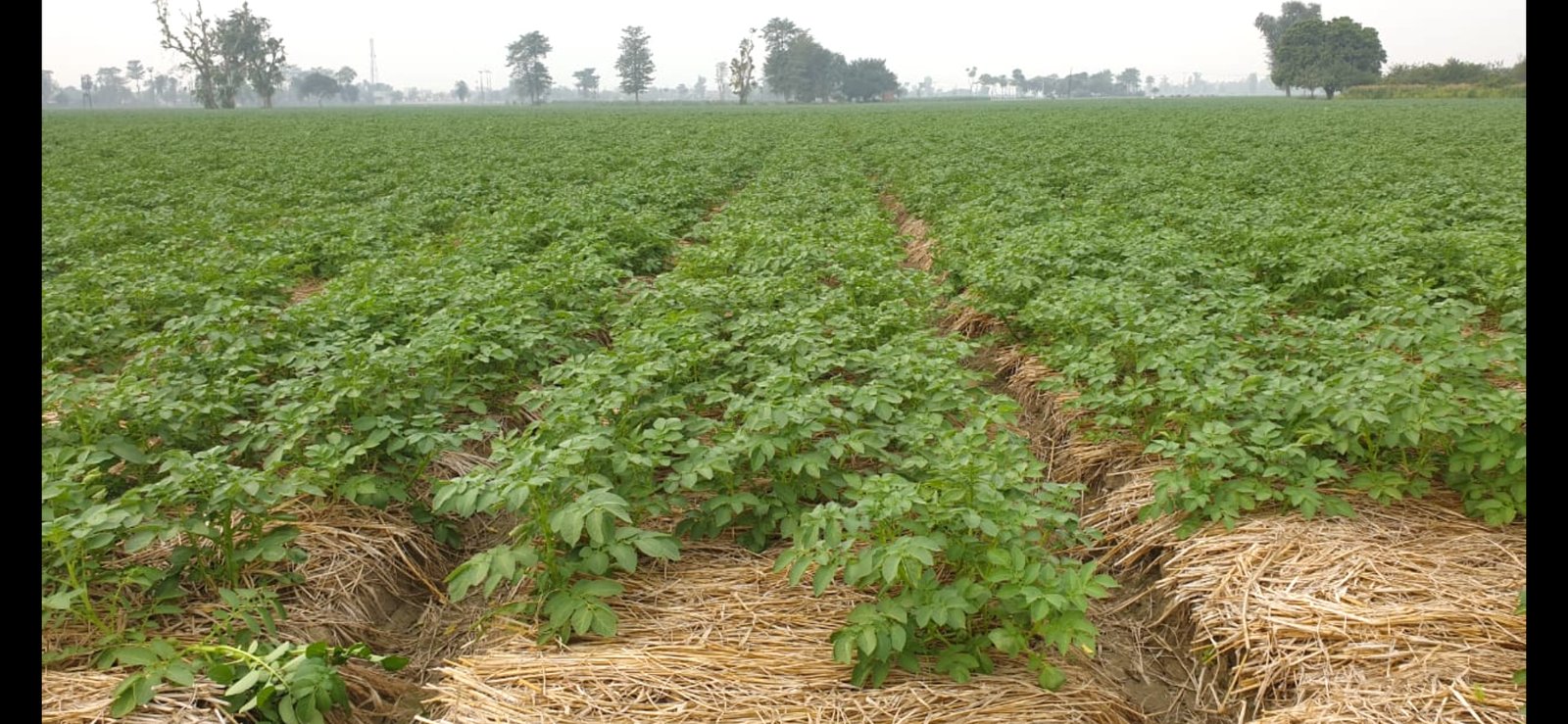
PQNK potatoes on permanent raised beds, with organic mulch protecting the tuber zone
THE TEMPERATURE QUESTION: AIR AND SOIL ARE NOT THE SAME
Established potato physiology supports this distinction. FAO guidance gives an optimum soil temperature of about 15–18°C for tuber growth, while reporting favourable daytime air temperatures of about 25–32°C and night temperatures of about 12–18°C. High temperature can promote vegetative growth while progressively suppressing tuber initiation and bulking. Experimental work separating air and soil temperature found that hot soil could largely prevent tuber development even when the air was comparatively cool. This is why a potato calendar cannot be judged from maximum air temperature alone.
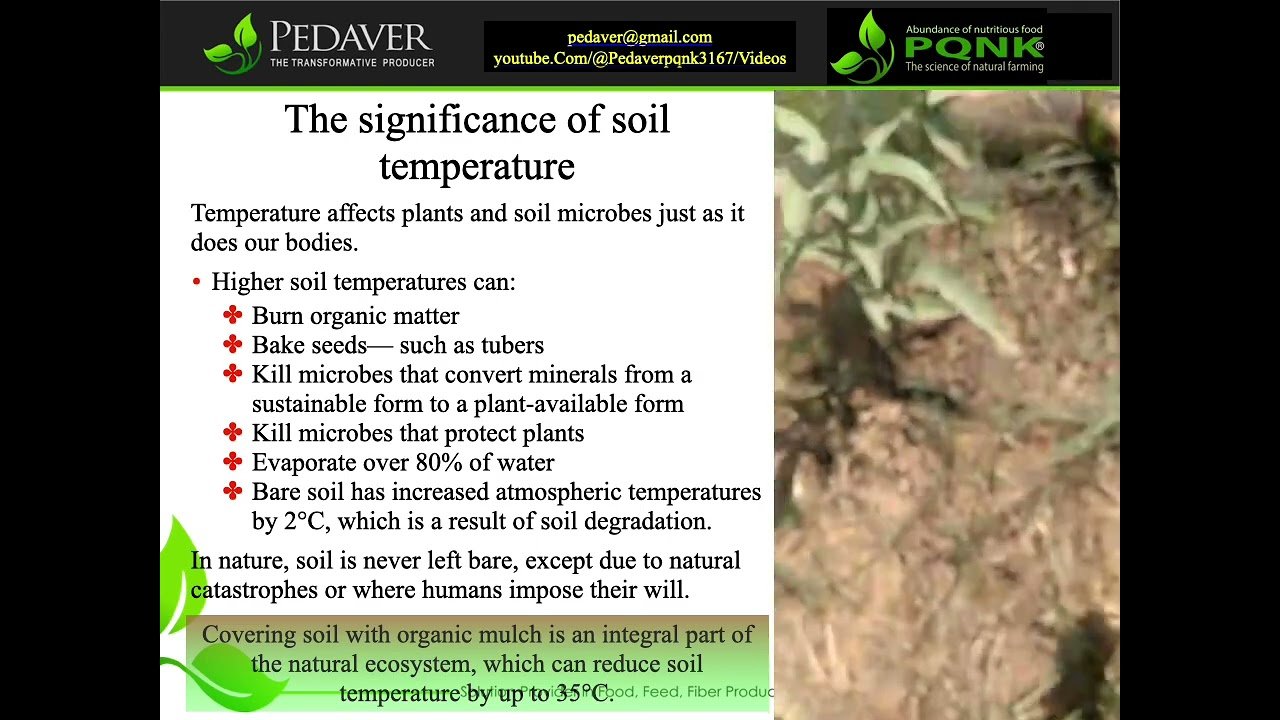
PQNK field observation adds the management dimension. The accompanying Pedaver soil-temperature video, and the infographic below, show the large thermal contrast that organic surface cover creates. In hot summer, naked soil exposed to direct sun passes 70 °C and the top of a dead mulch layer reaches about 66 °C, while the soil beneath dead or living mulch stays at about 30–33 °C: roughly 40 °C cooler. In winter, mulched soil in the production zone commonly remains around 10–20 °C even while ambient temperatures range much more widely.
PUNJAB CLIMATE: WHAT THE POTATO CANOPY EXPERIENCES THROUGH THE YEAR
The table below uses Lahore as a representative central-Punjab reference. Day and night temperatures and relative humidity are 1992–2021 Lahore Airport climate averages reported by Timeanddate.com. Day length is approximate astronomical daylight near the middle of each month at Lahore latitude. These are climatic averages, not daily limits: individual days can be substantially hotter or colder, including occasional winter frost and extreme summer heat.
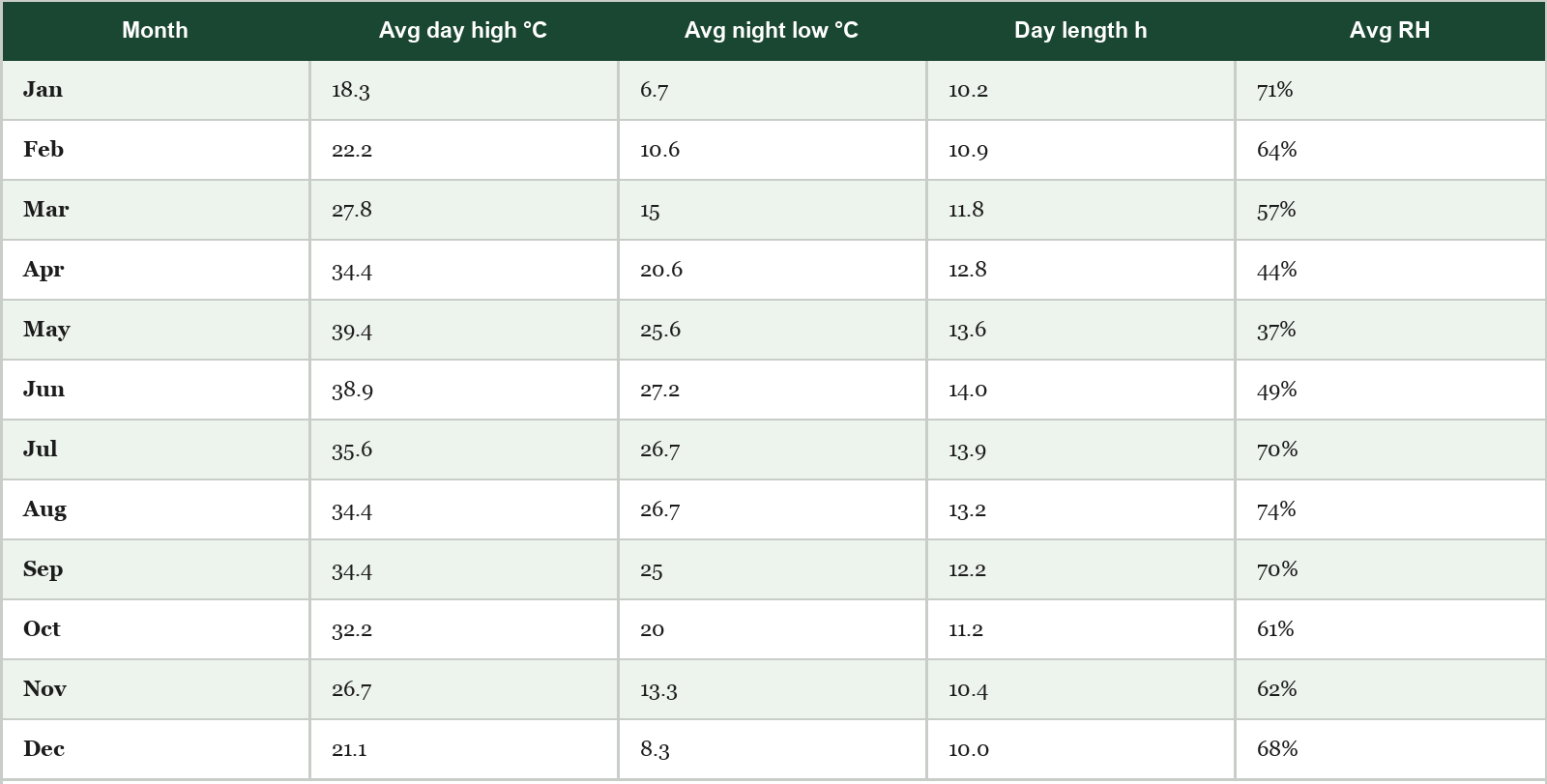
| Month | Avg day high °C | Avg night low °C | Day length h | Avg RH |
|---|---|---|---|---|
| Jan | 18.3 | 6.7 | 10.2 | 71% |
| Feb | 22.2 | 10.6 | 10.9 | 64% |
| Mar | 27.8 | 15 | 11.8 | 57% |
| Apr | 34.4 | 20.6 | 12.8 | 44% |
| May | 39.4 | 25.6 | 13.6 | 37% |
| Jun | 38.9 | 27.2 | 14.0 | 49% |
| Jul | 35.6 | 26.7 | 13.9 | 70% |
| Aug | 34.4 | 26.7 | 13.2 | 74% |
| Sep | 34.4 | 25 | 12.2 | 70% |
| Oct | 32.2 | 20 | 11.2 | 61% |
| Nov | 26.7 | 13.3 | 10.4 | 62% |
| Dec | 21.1 | 8.3 | 10.0 | 68% |
The circular-production question is not: “Is summer air too hot for potato?” It is: “Can the canopy survive the atmospheric conditions while the tuber zone is kept within a biologically workable thermal and moisture environment?”
WHAT THE CLIMATE TABLE MEANS FOR CIRCULAR PRODUCTION
From November through March, central Punjab naturally provides the most favourable combination of cool nights, moderate daytime temperature and shorter days. April and October are transition months. From May through September, atmospheric heat becomes the major constraint, especially during establishment, flowering, canopy maintenance and tuber bulking. High night temperature is particularly important because it increases respiration and can reduce tuber bulking and dry-matter accumulation.
PQNK does not make the potato plant independent of atmospheric temperature. Leaves still experience the air, solar radiation, humidity and vapour-pressure demand. Mulch therefore cannot be used to claim that any variety will automatically produce normally at any date. What PQNK changes most directly is the soil and tuber environment. This expands the production window and makes additional cycles biologically plausible where variety, canopy survival, mulch depth, soil moisture, planting date and local microclimate are managed together.
For this reason, circular production is not a promise of three to four cycles in any “moderate” climate. It is an engineered sequence whose timing must be matched to the local climate and cultivar. Three cycles can be designed as the working target in suitable Punjab conditions; any fourth cycle should be treated as location- and variety-dependent rather than as a universal annual promise.
THE PQNK THERMAL SHIELD
Conventional ridged potato places the tuber inside a mass of cultivated mineral soil. As the ridge heats, the developing tuber is surrounded by that heated medium. PQNK changes the geometry: seed potato is placed on or near the surface of the permanent biological bed and covered by approximately 4–6 inches of organic mulch. The mulch intercepts solar radiation, reduces direct heating, reduces evaporation, buffers rapid temperature change and maintains a biologically active, aerated moisture environment around the developing stolons and tubers.
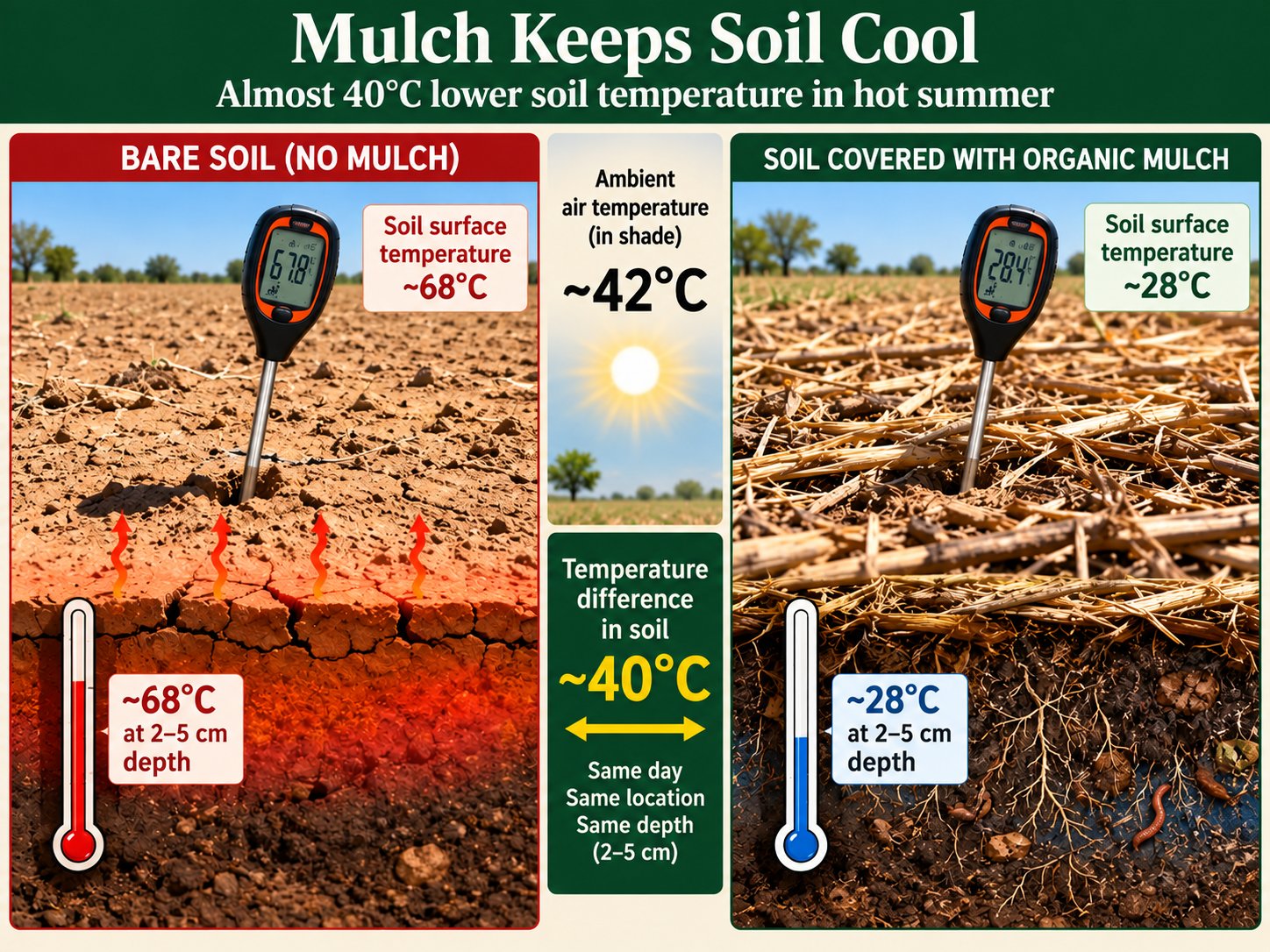
Mulch keeps soil cool: bare soil and soil under organic mulch in hot summer (PQNK field readings)
The thermal effect depends on mulch type and thickness. Coarse, dry, airy residues generally insulate differently from compact, wet or decomposed material. The practical PQNK rule is therefore not merely ‘apply mulch’. It is to maintain enough organic cover to keep the tuber zone protected throughout the crop and to observe soil temperature as part of crop management, particularly during hot-season cycles.
THE SEED-COST PARADOX
Potato is unusual because its planting material is itself a marketable tuber. Conventional systems commonly plant whole small seed tubers or larger tubers cut into pieces, so hundreds of kilograms of saleable product can be returned to each acre as planting material. Conventional Punjab practice commonly plants 600–800 kg of seed potato per acre; the established PQNK protocol uses 150–200 kg/acre. This is a 75% reduction at the midpoint and is one of the strongest immediate economic advantages of precision placement.
PQNK uses selected seed pieces with a viable eye, placed individually at the required plant population rather than using seed weight as a substitute for placement accuracy. The exact seed-piece size and spacing must remain subordinate to variety, desired plant population and planter calibration. The principle is precision: plant the number of viable propagules required, not unnecessary kilograms of tuber.
Each cut seed piece should carry one sprouting eye, and its cut surfaces should be coated with pure cement to keep the moisture inside the seed.
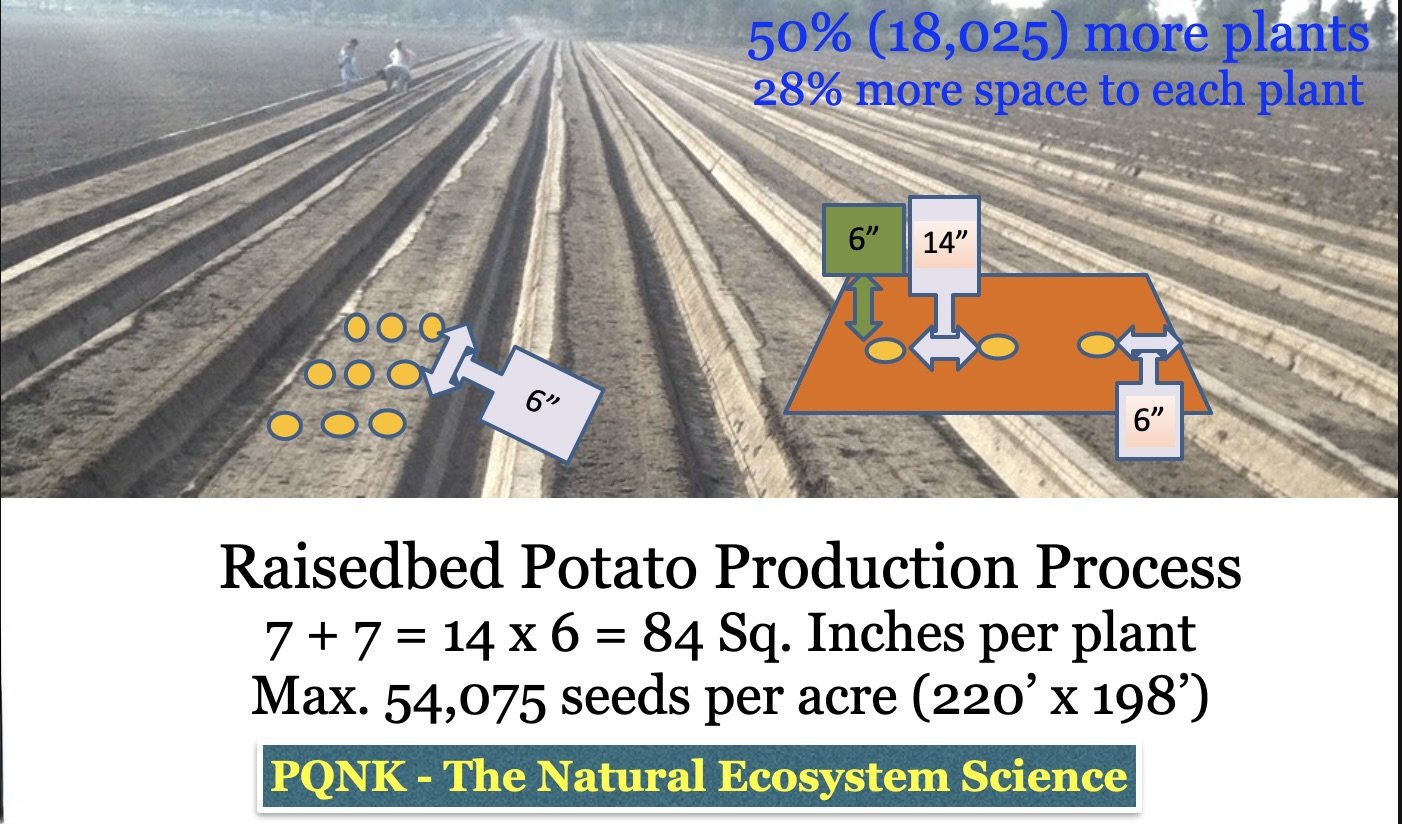
PQNK raised-bed potato planting layout
Farmers normally replace their seed with imported seed after a few crops, because seed-borne disease spreads and yield drops. In conventional production this disease is carried from plant to plant by sucking insects. In PQNK, biological control keeps sucking insects from building up, so if a few plants are affected by disease carried in the seed from the previous generation, it does not spread. Such plants should be pulled out and buried in soil away from the field. With this practice, farmers do not need to buy expensive seed every few years.
ACI VERSUS PQNK POTATO: THE PRODUCTION ARCHITECTURE
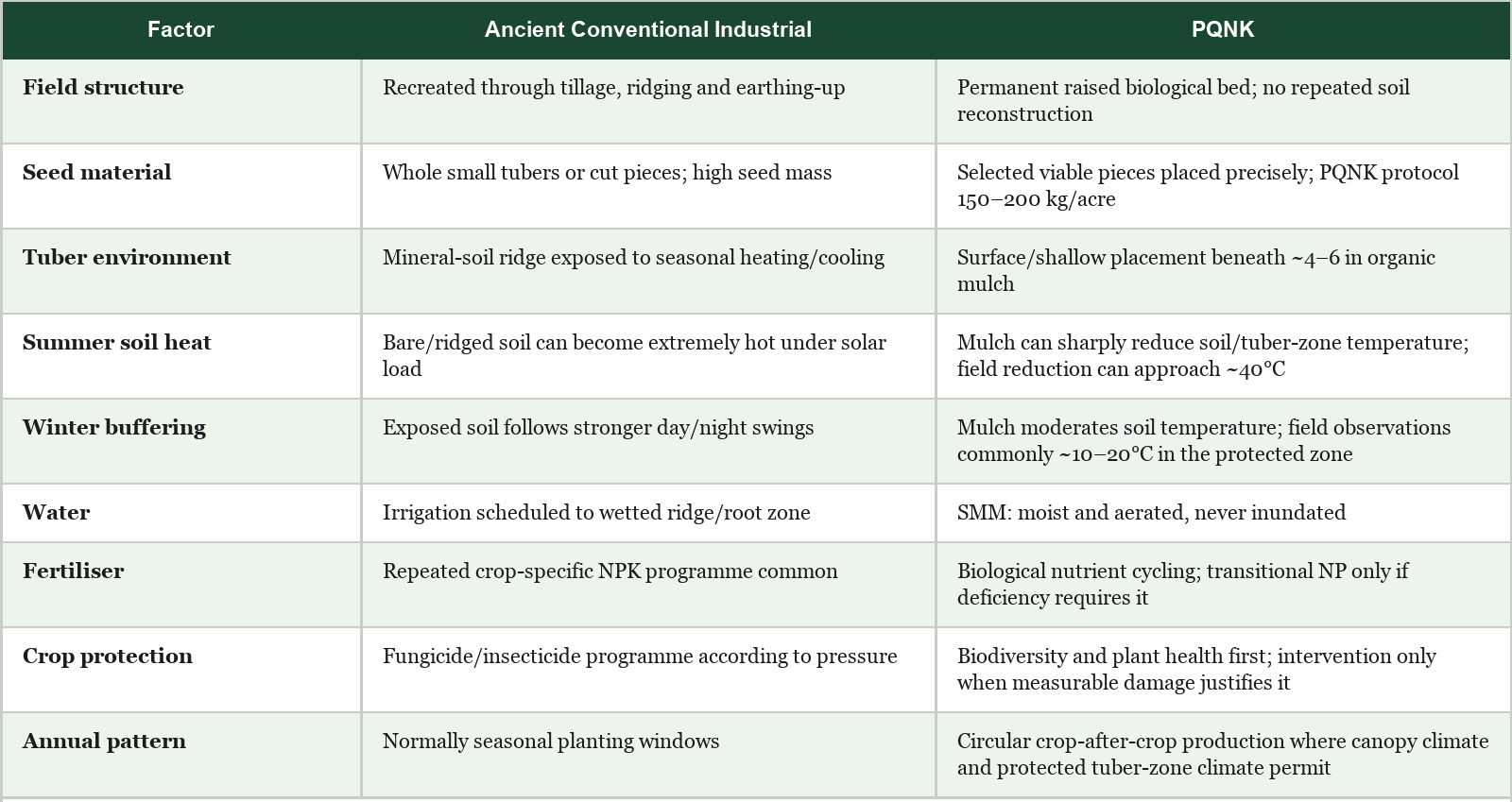
| Factor | Ancient Conventional Industrial | PQNK |
|---|---|---|
| Field structure | Recreated through tillage, ridging and earthing-up | Permanent raised biological bed; no repeated soil reconstruction |
| Seed material | Whole small tubers or cut pieces; high seed mass | Selected viable pieces placed precisely; PQNK protocol 150–200 kg/acre |
| Tuber environment | Mineral-soil ridge exposed to seasonal heating/cooling | Surface/shallow placement beneath ~4–6 in organic mulch |
| Summer soil heat | Bare/ridged soil can become extremely hot under solar load | Mulch can sharply reduce soil/tuber-zone temperature; field reduction can approach ~40°C |
| Winter buffering | Exposed soil follows stronger day/night swings | Mulch moderates soil temperature; field observations commonly ~10–20°C in the protected zone |
| Water | Irrigation scheduled to wetted ridge/root zone | SMM: moist and aerated, never inundated |
| Fertiliser | Repeated crop-specific NPK programme common | Biological nutrient cycling; transitional NP only if deficiency requires it |
| Crop protection | Fungicide/insecticide programme according to pressure | Biodiversity and plant health first; intervention only when measurable damage justifies it |
| Annual pattern | Normally seasonal planting windows | Circular crop-after-crop production where canopy climate and protected tuber-zone climate permit |
CIRCULAR PRODUCTION: THE SEQUENCE, NOT A FIXED CALENDAR
PQNK does not tie potato to one fixed planting calendar for every region. The principle is a rolling sequence: harvest the mature crop without disturbing the permanent bed, select healthy tubers for the next planting, restore the mulch cover, and plant the next crop within days when the coming canopy climate is acceptable for the chosen variety.
This is circular production in the PQNK sense. The bed is not destroyed between crops. Roots and biological structure remain. Residues continue as cover. Seed can be selected from the previous harvest. The next crop enters an already functioning production environment instead of waiting for ploughing, seedbed preparation and ridge reconstruction.
In the coolest part of the year, ambient conditions and protected soil conditions both favour potato. Through spring, mulch becomes increasingly important as soil protection. During the hottest months, soil cooling alone is not sufficient if the canopy cannot tolerate the prevailing day and night air temperatures. Variety choice, planting date, canopy establishment, humidity, irrigation timing and local shading or companion-crop effects therefore determine whether a summer cycle is practical. As autumn returns, both atmospheric and soil conditions again move toward the potato optimum. To manage extreme temperatures, a 2% solution of food-grade ethanol may be sprayed once every 4–5 days.
SOIL MOISTURE MANAGEMENT UNDER MULCH
Temperature and moisture cannot be separated. Dry bare soil heats rapidly. Saturated soil excludes air. PQNK aims for the middle condition: a continuously moist but aerated biological bed beneath permanent cover. Furrow water moves laterally into the bed, and water is given only when the soil-ball test shows a need, never by flooding the root zone; on mature beds where annual rainfall is 400 mm or more, rain, dew, humidity and capillary rise carry the crop and furrow water remains a supplementary option. Mulch reduces evaporative loss and protects the moisture gradient.
This is especially important for potato because stolon initiation and tuber bulking are sensitive to both heat and water stress. The objective is not to force the crop with excessive irrigation. It is to maintain the water-air balance that allows roots, microbes and developing tubers to function continuously.
TUBER QUALITY
PQNK fields produce a higher proportion of marketable A-grade tubers, more uniform tubers, firmer texture, better flavour and longer keeping quality. This follows from the uniform spacing, steady moisture and protected tuber zone that PQNK creates; the size of the gain depends on the variety, on how far the soil has progressed from the regenerative to the sustained state, and on planting accuracy.
The same holds for nutritional quality. PQNK’s biological nutrient pathway and mycorrhizal associations supply the crop with minerals in balance with its own needs, and that is reflected in the nutrient density of the tubers.
LATE BLIGHT: BIODIVERSITY DOES NOT ABOLISH DISEASE BIOLOGY
Late blight, caused by Phytophthora infestans, remains a serious potato disease where temperature, humidity, leaf wetness, inoculum and susceptible varieties align. A biologically active PQNK field can support microbial antagonists and can avoid some of the nutritional and moisture imbalances that predispose plants to disease. That is a meaningful ecological advantage, but it should not be written as a guarantee that late blight cannot occur.
The PQNK rule is observation before intervention. Maintain biodiversity, aeration, balanced moisture and healthy plant nutrition; monitor the crop; distinguish pathogen presence from economically significant disease; and intervene only when actual risk or damage requires it. During transition, when the biological system is still recovering, protective intervention may be necessary once disease pressure crosses the PQNK threshold of about 10 percent. The objective is progressive biological regulation, not denial of disease pressure.
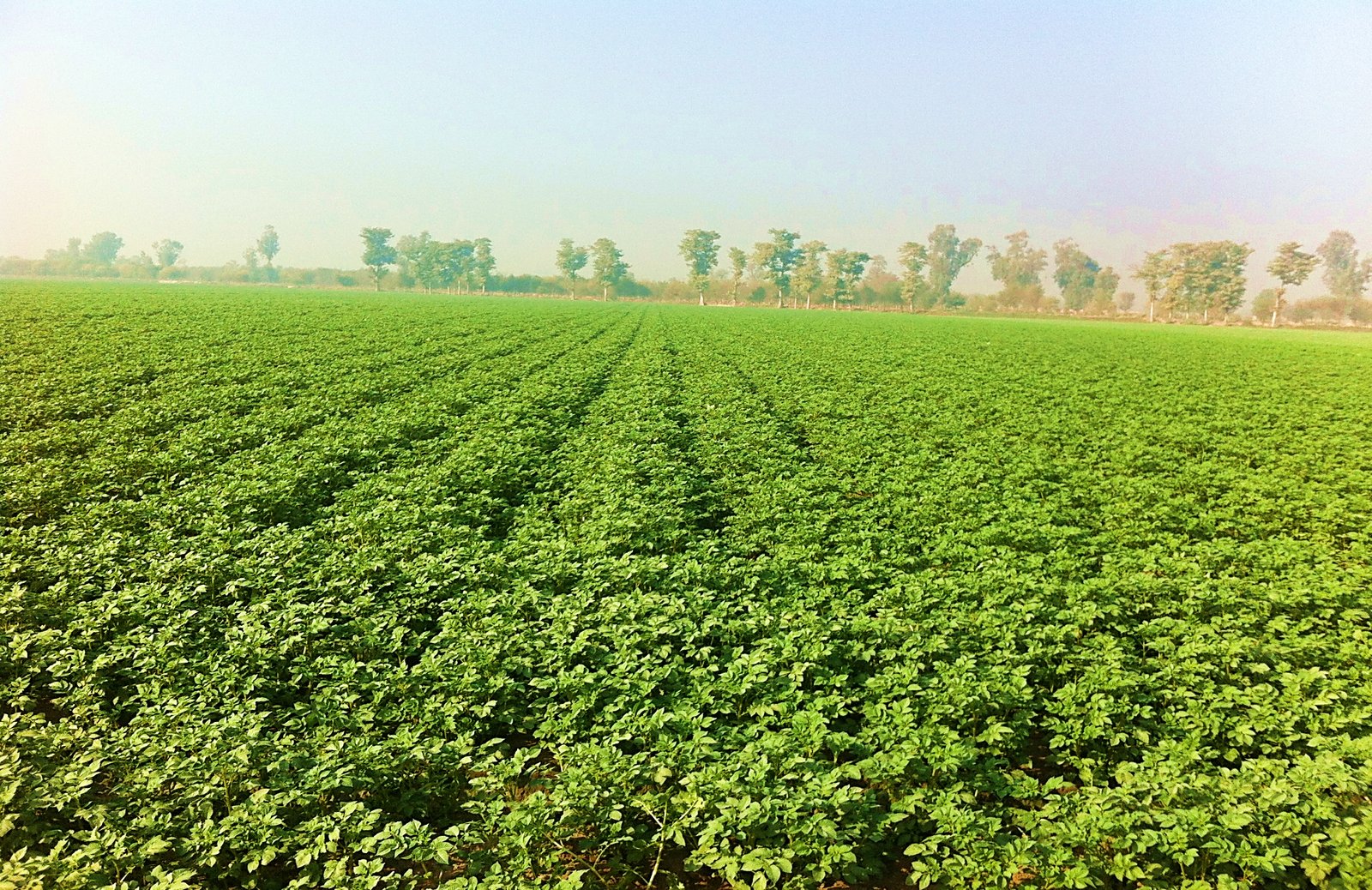
A healthy PQNK potato crop on permanent raised beds
THE ECONOMICS OF CIRCULAR PRODUCTION
The strongest economic change is structural rather than a single yield claim. Seed requirement falls through precision placement. Repeated tillage and ridge reconstruction disappear. Permanent mulch conserves moisture and moderates soil temperature. The farmer can retain seed from a suitable harvest. Most importantly, the same bed can move rapidly from one crop cycle into the next, allowing production to be timed across more than one market window.
That does not mean every acre will deliver the same number of crops or the same annual income. Market price, variety, harvest maturity, disease pressure and summer canopy survival remain real variables. The business advantage of circular production is that the farmer is no longer structurally restricted to rebuilding the field for a single conventional seasonal crop.
A PRACTICAL CLIMATE RULE FOR THE PRODUCTION MANAGER
Before each new potato cycle, check four environments: (1) expected daytime air temperature, (2) expected night temperature, (3) day length and humidity, and (4) actual temperature and moisture beneath the mulch. Planting decisions should be based on all four, not on the calendar alone.
The Production Manager therefore reads the tuber zone directly: the temperature under the mulch at the hottest part of the day and again before sunrise, the mulch type and thickness, and the soil moisture by the ball test, and plans each planting from those readings.
WHAT THIS CHAPTER HAS ESTABLISHED
Potato reveals why PQNK circular production is more than multiple cropping. Conventional seasonality partly reflects the exposed soil environment and the repeated need to reconstruct the field. PQNK preserves the bed and uses organic cover to create a moderated tuber-zone climate inside a much wider atmospheric climate.
The potato plant still experiences the season above ground. It still responds to day and night temperature, day length, humidity and variety. But the developing tuber no longer has to experience the same thermal extremes as naked soil. That separation between atmospheric climate and protected soil climate is the key that makes a longer annual production window possible.
Circular production therefore means crop-after-crop on the same permanent bed, with the next planting governed by biology rather than tillage. The system reduces seed requirement through precision, protects the tuber zone with mulch, maintains moisture and aeration through SMM, retains the living soil architecture, and allows the Production Manager to exploit suitable planting windows throughout the year.
Potato under PQNK: the same permanent bed, a protected tuber zone, precise seed and biological soil, with the next crop planted when the four climate conditions align.
SOURCES AND EVIDENCE NOTE
• FAO. Crop Yield Response to Water, Potato chapter: soil and air temperature requirements, frost/heat stress and potato water sensitivity.
• Reynolds, M.P. & Ewing, E.E. (1989). Effects of high air and soil temperature stress on growth and tuberization in Solanum tuberosum. Annals of Botany. (Indexed by FAO AGRIS.)
• International Potato Center (CIP). Global Potato Research for a Changing World: high-temperature effects on tuber initiation, bulking and dry matter.
• Timeanddate.com. Lahore climate averages, Lahore Airport, 1992–2021: monthly average high, low and relative humidity.
• Pedaver field video: The Significance of Soil Temperature. Used here as PQNK field evidence of the thermal buffering created by organic mulch.
• PQNK field records and protocols: permanent raised beds, 4–6 inch mulch for potato, Soil Moisture Management, precision seed placement and circular crop-after-crop production.
The next chapter turns to garlic, onion and vegetables, where the same permanent bed is designed for diversity and high value from a single acre.
Chapter Thirty-Nine: Garlic, Onion, and Vegetables