

Industrial Devastation To Natural Abundance
The Evidence · Chapter 36
Maize, Up to Four Crops a Year
More Productive Days from the Same Permanent Bed
Release 1.0 · 2026-09-30
If you use “Listen”, the text of the page may be sent to your browser or operating system’s speech provider, such as Apple, Google or Microsoft, depending on the voice your device uses. Pedaver does not process, transmit or store any audio.
“The economic strength of PQNK maize is not one extraordinary harvest. It is the ability to shorten the interval between crops, retain the biological infrastructure, and use more of the year productively. Where climate, variety and management permit, the same permanent bed can carry successive maize crops with progressively lower dependence on purchased inputs.”
Asif Sharif, Lahore, 2020
Maize is a strategically important crop in Pakistan because it links crop farming with poultry, livestock, starch and food-processing industries. It is also well suited to demonstrate one of PQNK’s most important economic principles: the permanent production system can reduce the unproductive interval between harvest and the next establishment. The benefit comes from cropping frequency and continuity, not from a promise that every farm will harvest four maize crops every year.
Conventional maize calendars vary across Pakistan. Farmers may grow spring maize, autumn maize or maize within a wheat–maize rotation, depending on temperature, irrigation, variety and market. Each crop normally occupies about 90 to 120 days, but grain drying, harvest logistics and preparation for the following crop can extend the effective field cycle. On a mature PQNK field, permanent beds, retained roots, surface mulch and precision no-till planting can allow the next crop to be established rapidly. In Punjab and Sindh this supports up to four silage crops, or three seed-corn crops, from one acre in a year, grown crop after crop; farmers in other regions adjust to their own climate. The field calendar, not a slogan, must determine what is agronomically and economically sound.
WHY PQNK SHORTENS THE INTERVAL BETWEEN CROPS
The principal limitation in sequential conventional cropping is not maize biology alone; it is the time and cost required to rebuild the field after every harvest. Residue removal or burning, repeated tillage, reshaping, fertiliser application and irrigation preparation consume working days, disturb soil structure and expose the surface. When these operations are repeated, each crop begins by reconstructing conditions that the previous crop had already created.
PQNK retains that infrastructure. The raised beds and furrows remain in place. Living and decaying roots preserve channels for air, water and future roots. Crop residue remains on the surface as mulch. The next crop is placed through this cover with the SIPP or another suitable no-till precision planter, while tractor traffic remains in the furrow lanes. The transition between crops therefore becomes an establishment operation rather than a complete reconstruction of the field.
Where harvest method, residue condition, soil moisture and the seasonal temperature window are suitable, planting can follow harvest within a day. Germination time still depends on seed quality, temperature and moisture, and the next crop should never be forced into an unsuitable season merely to achieve a numerical target. Maize cannot be grown crop-in-crop: once a standing crop is taller than about two feet and its stems cannot bend, planting machinery cannot pass through it without breaking the plants. Maize is therefore grown crop after crop, and the saving comes from losing no days between harvest and the next planting.
THE FOUR-CROP CALENDAR
Four crops fit into the Punjab and Sindh year only because there is no gap between them: each crop is harvested and the next is planted through the mulch the following day. Newer varieties are ready for silage in about 75 to 90 days and for seed in about 105 days, which places four silage crops, or three seed-corn crops, between late January and mid-December, before the frost returns:

| Crop | Silage 4 crops a year | Seed corn 3 crops a year |
|---|---|---|
| 1st crop | End January to end April About 90 days | End January to mid May About 105 days |
| 2nd crop | End April to mid July About 75–80 days | Mid May to end August About 105 days |
| 3rd crop | Mid July to end September About 75–80 days | End August to mid December About 105 days |
| 4th crop | End September to mid December About 80 days | Only where early frost is no threat |
• Circular production: maize is well suited to crop-after-crop production, especially for silage, which is ready for harvest 15 to 30 days sooner than a grain crop of the same variety (about 100 to 110 days).
• No lost days: planting on mature beds with the SIPP or VIPP leaves no more than a one-day gap between the harvest of one crop and the planting of the next.
• Frost and heat: in Punjab, frost nights normally fall between the end of December and the end of January. Pollination must not coincide with frost or a heat wave, so the silage dates in the table can be moved by about two weeks either way to keep pollination clear of both; farmers in other regions adjust the sowing dates to their own climate zone.
• Crop combinations: one acre can give four silage crops or three seed-corn crops in a year, or two silage crops and two grain crops. Four short-duration seed-corn crops are possible in regions where frost is not a threat.
THE CORE EVIDENCE: A PROGRESSION, NOT A GUARANTEE
• Conventional maize frequency: commonly one or two crops within the local annual rotation.
• PQNK maize frequency: up to four silage crops, or three seed-corn crops, a year in Punjab and Sindh, crop after crop; other regions adjust to their climate.
• Plant population: about 40,000 plants per acre for varieties with erect leaves; the planter is set by seed count, not by seed weight.
• Water: maize grows fast and needs more water than most crops, above all in the summer heat before the monsoon; supplementary furrow irrigation, with no more than a 4-inch head, is applied whenever the root-zone ball test fails.
• Purchased fertiliser: zero is a mature-system target, not a first-crop assumption; transition correction is based on observed deficiency.
• Yield: measured crop by crop against the local conventional baseline; plant population, grain moisture and harvested area must be recorded.
• Net return: calculated from measured production and gross sales minus seed, machinery, labour, water, transition corrections, harvest, drying and marketing costs.
The following table presents the expected direction of change. It is a management framework rather than a guaranteed four-season formula. Each farm should replace these descriptions with its own measured records.
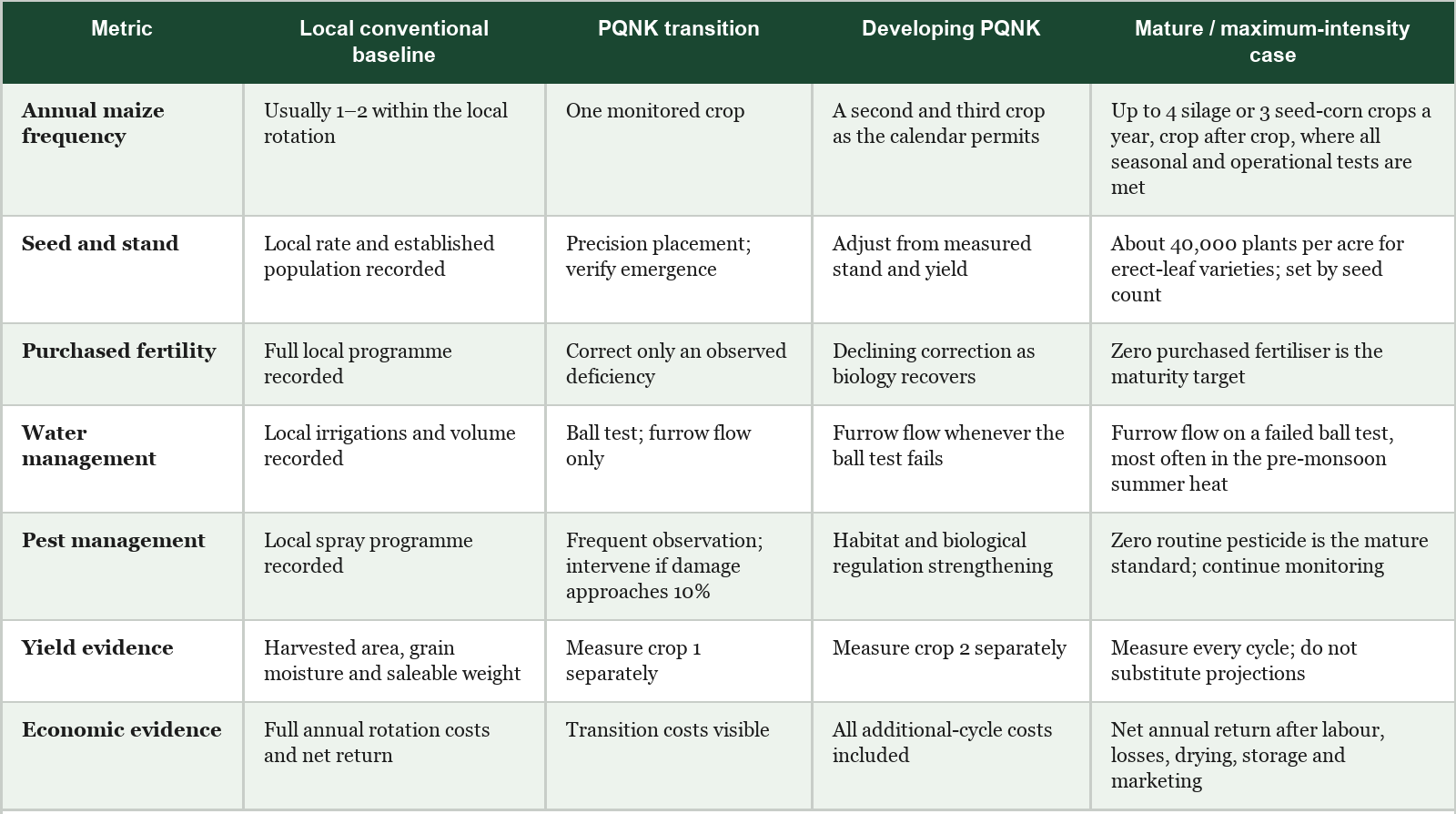
| Metric | Local conventional baseline | PQNK transition | Developing PQNK | Mature / maximum-intensity case |
|---|---|---|---|---|
| Annual maize frequency | Usually 1–2 within the local rotation | One monitored crop | A second and third crop as the calendar permits | Up to 4 silage or 3 seed-corn crops a year, crop after crop, where all seasonal and operational tests are met |
| Seed and stand | Local rate and established population recorded | Precision placement; verify emergence | Adjust from measured stand and yield | About 40,000 plants per acre for erect-leaf varieties; set by seed count |
| Purchased fertility | Full local programme recorded | Correct only an observed deficiency | Declining correction as biology recovers | Zero purchased fertiliser is the maturity target |
| Water management | Local irrigations and volume recorded | Ball test; furrow flow only | Furrow flow whenever the ball test fails | Furrow flow on a failed ball test, most often in the pre-monsoon summer heat |
| Pest management | Local spray programme recorded | Frequent observation; intervene if damage approaches 10% | Habitat and biological regulation strengthening | Zero routine pesticide is the mature standard; continue monitoring |
| Yield evidence | Harvested area, grain moisture and saleable weight | Measure crop 1 separately | Measure crop 2 separately | Measure every cycle; do not substitute projections |
| Economic evidence | Full annual rotation costs and net return | Transition costs visible | All additional-cycle costs included | Net annual return after labour, losses, drying, storage and marketing |
THE PQNK MAIZE PROTOCOL
Variety selection: PQNK is not tied to a particular maize variety. Select legally available, locally adapted seed for the intended season, maturity window, end use and disease environment. Hybrid seed may provide useful performance, but saved hybrid seed does not reproduce uniformly and should not be described as genetically improved merely because it was grown under PQNK. The soil system influences plant expression and resilience; it does not replace sound varietal selection or create genetic resistance.
Plant population and placement: There is no universal maize spacing for every variety and season. Calibrate the SIPP/VIPP or other precision planter to seed size, tested germination, expected emergence, bed geometry, light interception and the target plant population. Place one viable seed per station where germination permits, maintain consistent depth in moist soil, and keep machinery on the permanent furrow lanes. PQNK recommends about 40,000 plants per acre where the variety has erect leaves. Set the planter by seed count, not by seed weight, because the weight of 40,000 seeds varies with variety and grading.
Companion cropping: Maize allows no ordinary companion crop, because it grows quickly and soon shades any lower plant beneath it. The only option is to sacrifice the central maize row on the bed and plant soybean in its place in the summer crop, where the maize canopy protects the soybean from extreme heat, which it does not tolerate. This works only where the beds and crop rows run north to south, so that the soybean still receives enough light.
Between-cycle transition: Leave the maize roots in the soil. The SIPP manages the standing crop residue and plants the next crop through it in a single pass, so no separate residue or mulching operation is needed; the stalks and leaves become surface mulch on the bed. There is no incorporation, burning or removal of residue, and the permanent beds and furrows stay intact.
Fourth-cycle maize: A fourth crop is possible where the varieties can complete every cycle between late January and mid-December, with no gap between harvest and the next planting, and where no pollination coincides with frost or a heat wave. On a mature PQNK soil, maize can follow maize crop after crop, with no rotation and no external inputs, because the soil system holds everything the crop needs. Nature is the proof: the same species grow in the same place for thousands of years without rotation, without a gap and without losing yield.
THE ECONOMICS OF SEQUENTIAL CROPPING
The economic case for PQNK maize rests on productive use of time, lower repeated field-preparation costs and declining dependence on purchased inputs as the soil system matures. It should not be reduced to a claim that four crops automatically create four times the income. Additional cycles also require seed, planting, supervision, harvest, drying, storage and marketing, and they expose the farmer to additional weather and price risk.
Circular production for silage and fresh fodder: where silage or green fodder is used, processed or sold every day, planting follows the same daily rhythm as the harvest. If the herd or the market needs one acre harvested every day, one acre is planted every day. When the first acre is harvested, the next acre is ready the following day, because it was planted a day later, and each harvested acre is planted again through its mulch. Planting and harvesting become daily routines, and the supply neither runs out nor piles up. The rhythm can be adjusted for convenience: for example, two acres can be planted on one day and two acres harvested on another.
For each crop, record the measured area, seed and establishment cost, machinery and operator cost, water and energy, any transition correction, labour, harvest and post-harvest losses, grain moisture, saleable production and actual selling price. Gross sales are not income. Net return is the value remaining after all paid costs and the treatment of household labour have been stated.
The annual comparison should then be made between complete systems: the local conventional rotation and the PQNK sequence that actually occupied the same land during the same twelve months. This captures the value of reduced turnaround time without hiding the contribution of another crop, omitting transition costs or assuming that a mature zero-purchased-input condition exists from the first season.
For smallholders, risk capacity is as important as theoretical profitability. An additional maize crop should be planted only when suitable seed, machinery, water, harvest capacity and a credible market are available. Sequential cropping is powerful because PQNK keeps the production platform ready; disciplined management determines whether that opportunity becomes profit.
MAIZE, FEED AND THE LIVESTOCK CHAIN
Maize is a major energy ingredient in poultry and livestock feed, so reliable local production affects feed cost and food-system stability. More than one harvest window can also reduce dependence on a single seasonal supply peak, provided grain is dried, stored and marketed safely.
This wider benefit should be demonstrated with records rather than assumed. PQNK farms supplying feed markets should document harvest timing, grain moisture, grade, storage losses, price and delivery consistency. Direct relationships with processors or livestock producers can improve market certainty, but they are a business arrangement, not an automatic result of the production system.
Nutritional superiority must likewise be measured. A biologically active soil can improve the conditions for balanced nutrient acquisition, yet claims about higher zinc, manganese, selenium or reduced mineral premix require representative laboratory analysis of grain and properly controlled feed trials. Until such evidence is available, the defensible PQNK claim is that the system restores the soil processes capable of supporting balanced plant nutrition.
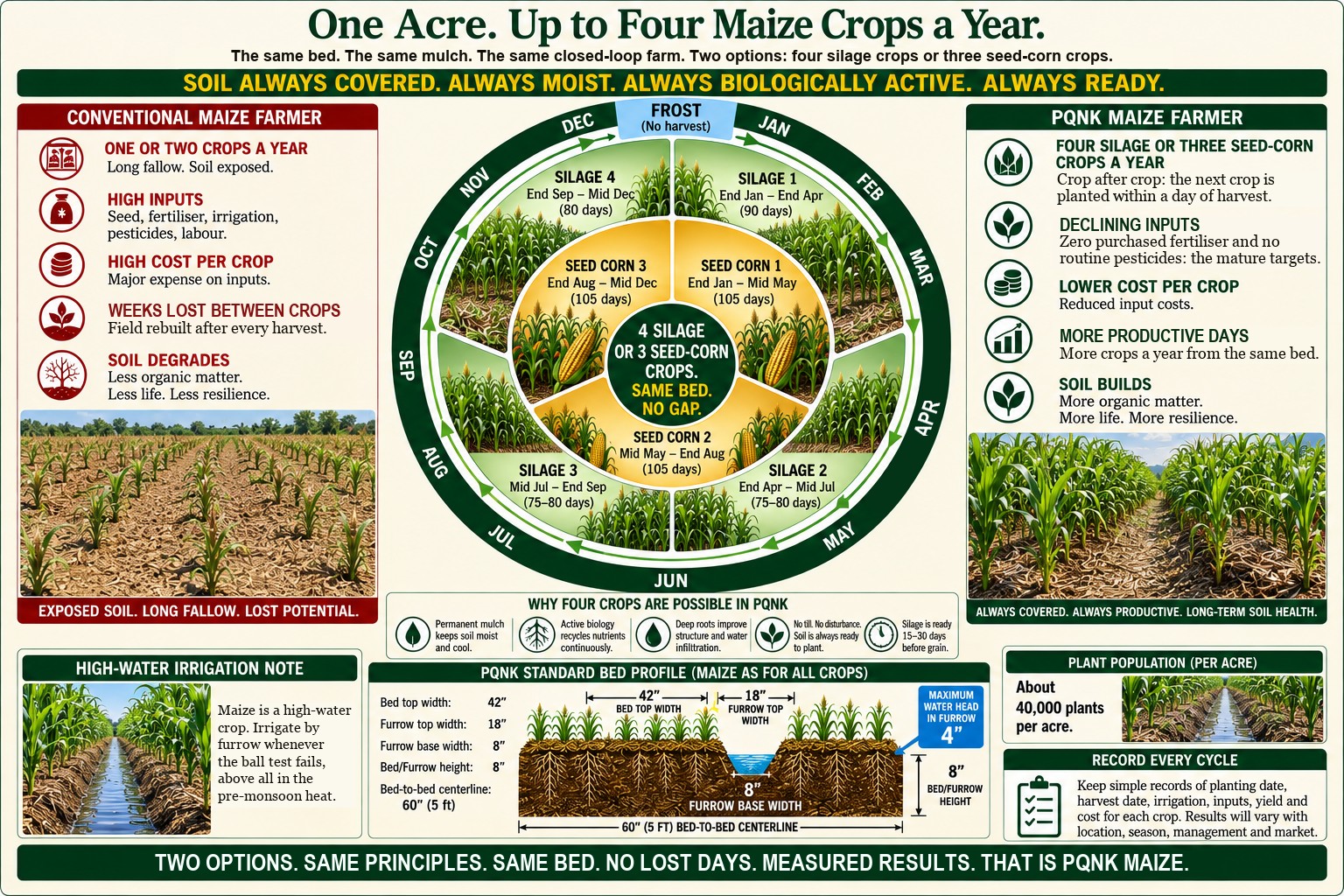
One Acre, Up to Four Maize Crops a Year: four silage or three seed-corn crops, crop after crop, with no lost days between harvest and planting
MAIZE IN THE ONE ACRE PROSPERITY MODEL
Maize is a versatile component of the One Acre Prosperity model because its relatively short duration, market demand and high biomass can serve both income and soil-cover objectives. During orchard establishment, maize or another compatible annual crop may occupy selected alleys where tree roots, shade, machinery movement and water competition are carefully managed. The crop plan must protect the permanent system rather than maximise one crop at the expense of the whole farm.
Maize grain can supply the market or farm livestock; stalks and leaves become surface mulch; and retained roots preserve pores and biological habitat. These functions make maize valuable in a circular production design. The best sequence is the one that keeps soil covered and biologically active while producing a measured net return with manageable risk.
WHAT THIS CHAPTER HAS ESTABLISHED
Maize demonstrates the frequency dimension of PQNK. Permanent beds, retained roots, continuous surface mulch, controlled traffic and no-till precision establishment can compress the interval between crops and increase the number of productive days in a year. Up to four silage crops, or three seed-corn crops, a year are feasible in Punjab and Sindh, crop after crop, but this is not a universal PQNK standard. Each cycle must satisfy the local climate, crop-duration, machinery, water, market and risk tests, and its result must be recorded separately.
The next chapter turns to sugarcane, a long-duration crop that tests PQNK through perennial rooting, ratoon continuity, residue management and precise soil-moisture control.
Chapter Thirty-Seven: Sugarcane, The Bamboo Principle