Industrial Devastation To Natural Abundance
The Evidence · Chapter 43
Livestock and Fodder
From 70% to 20% Feeding Cost, Soil to Soul
Release 1.0 · 2026-10-20
If you use “Listen”, the text of the page may be sent to your browser or operating system’s speech provider, such as Apple, Google or Microsoft, depending on the voice your device uses. Pedaver does not process, transmit or store any audio.
“The conventional dairy farmer spends seventy percent of his income on purchased feed. He is a feed purchaser who happens to own cows. The PQNK farmer grows his feed from his land, feeds it to his animals, lets their dung return to the land where it falls, and receives milk from a biological circle that costs him almost nothing. He is a farmer. There is a difference.”
Asif Sharif, Lahore, 2022
Livestock is the element of the PQNK system that closes the biological circle most completely. The PQNK farm produces fodder from its own living soil, feeds that fodder to its own animals, lets their dung return to the land where it falls, and keeps the organic matter cycle in a state that requires nothing from outside. Livestock is not an addition to the PQNK system. It is the biological completion of it.
The title of this chapter names the most immediate economic transformation that PQNK livestock integration produces: the reduction of feeding cost from as much as 72 percent of the value of the milk to the 22 to 30 percent that PQNK targets (Knowledge Paper KP-080). This reduction is not achieved by feeding animals less or by substituting inferior nutrition. It is achieved by growing the feed from the farm’s own soil at near-zero input cost rather than purchasing it from markets at prices determined by fertiliser costs, transport costs, and middleman margins. And the fodder that the PQNK farm produces is measurably more nutritious than the commercially purchased feed it replaces, with consequences for animal health, milk quality, and human nutrition that trace directly from the soil to the table.
WHY LIVESTOCK BELONG IN THE PQNK SYSTEM
The integration of livestock into PQNK farming is not merely an economic convenience. It is a biological necessity for the most complete version of the closed loop. Three biological functions make livestock essential to the PQNK circular system:
Manure stays where it falls. On a PQNK farm, animal manure is not a fertiliser to be bought, carted or spread. The soil’s recovery comes from within the field itself: Jantar roots and mulch feed the soil food web, and the geological mineral bank supplies the minerals, so a mature PQNK field needs neither synthetic fertiliser nor imported manure. When animals graze or are housed on the farm, their dung simply stays on the same land, in small amounts, scattered as it falls. Returned this way, it is part of the farm’s own closed cycle, never a dose of nutrients. Dung that is surplus to that cycle is better used for biogas or fuel than piled onto beds, where heavy loads create a nutrient spike that unbalances the soil biology the system depends on.
Weeds as fodder, not a cost. Under PQNK, weeds are not enemies to be removed. They are soil physicians and living mulch, and in a living soil they do the crop no harm. What grows along the field margins, the boundaries and the furrows can be cut as green fodder and carried to the animals, while the roots are left in the soil to keep feeding it. The animals are kept off the permanent beds, which are never trodden or compacted. The farmer who keeps goats, sheep or dairy animals turns this green growth into meat and milk, with no cost of weed control at all.
Insect protein as poultry feed. The biologically diverse PQNK farm produces insect populations in its mulch layer, under-canopy diversity, and between-row inter-crops that represent a significant protein-rich feed resource. Poultry allowed access to the inter-row areas of PQNK beds harvest this insect resource directly, supplementing their grain diet with a protein source that significantly improves egg yolk density and colour and reduces purchased protein supplement costs.
PQNK FODDER: THE MINERAL-RICH FEED CHAIN
The quality difference between PQNK-grown fodder and conventionally grown purchased feed follows the same biological logic as the quality difference between PQNK food crops and their conventional counterparts: the mycorrhizal mineral delivery system provides a complete mineral spectrum that NPK fertilisation does not.
For dairy cattle and buffalo, this mineral completeness in fodder produces measurably higher butterfat content and superior mineral density in milk. The calcium, phosphorus, magnesium, selenium, and zinc profile of PQNK-grown alfalfa, Rhodes grass, sorghum and maize is substantially richer than the same fodder species grown on NPK-fertilised conventional soil. The animal that eats this fodder does not require the same level of mineral supplement in its ration as the conventionally fed animal, reducing purchased feed costs further beyond the savings from growing fodder on-farm.
The most visible quality consequence of PQNK fodder for dairy production is richer milk, higher in butterfat. This matters to farmers who supply dairy processors that pay on the basis of fat content rather than volume alone.
THE PQNK FODDER SYSTEM: WHAT TO GROW AND WHEN
Alfalfa (lucerne): PQNK recommends alfalfa, not berseem, as the protein fodder for dairy animals. Alfalfa carries more than 20 percent crude protein in its dry matter, the richest protein fodder the farm can grow. It is a deep-rooted perennial: planted once on the permanent beds, it is cut again and again over several years without replanting, and where the stand thins, new seed is placed between the old plants with the VIPP without disturbing the soil. After each cut the roots stay in the bed, the living soil carries the regrowth, and water is given only in the furrow when the soil-ball test shows a need.
Sorghum (Sudan grass and forage varieties): The primary kharif fodder, sorghum produces large biomass volumes rapidly in Pakistan’s summer conditions. PQNK sorghum grown on permanent beds with the biological mineral delivery produces higher protein concentration and lower nitrate accumulation (which is a safety risk in conventional nitrogen-heavy sorghum) than conventionally managed sorghum. The deep root system of sorghum in PQNK soil also contributes significantly to the subsoil mineral cycling that the following crop benefits from.
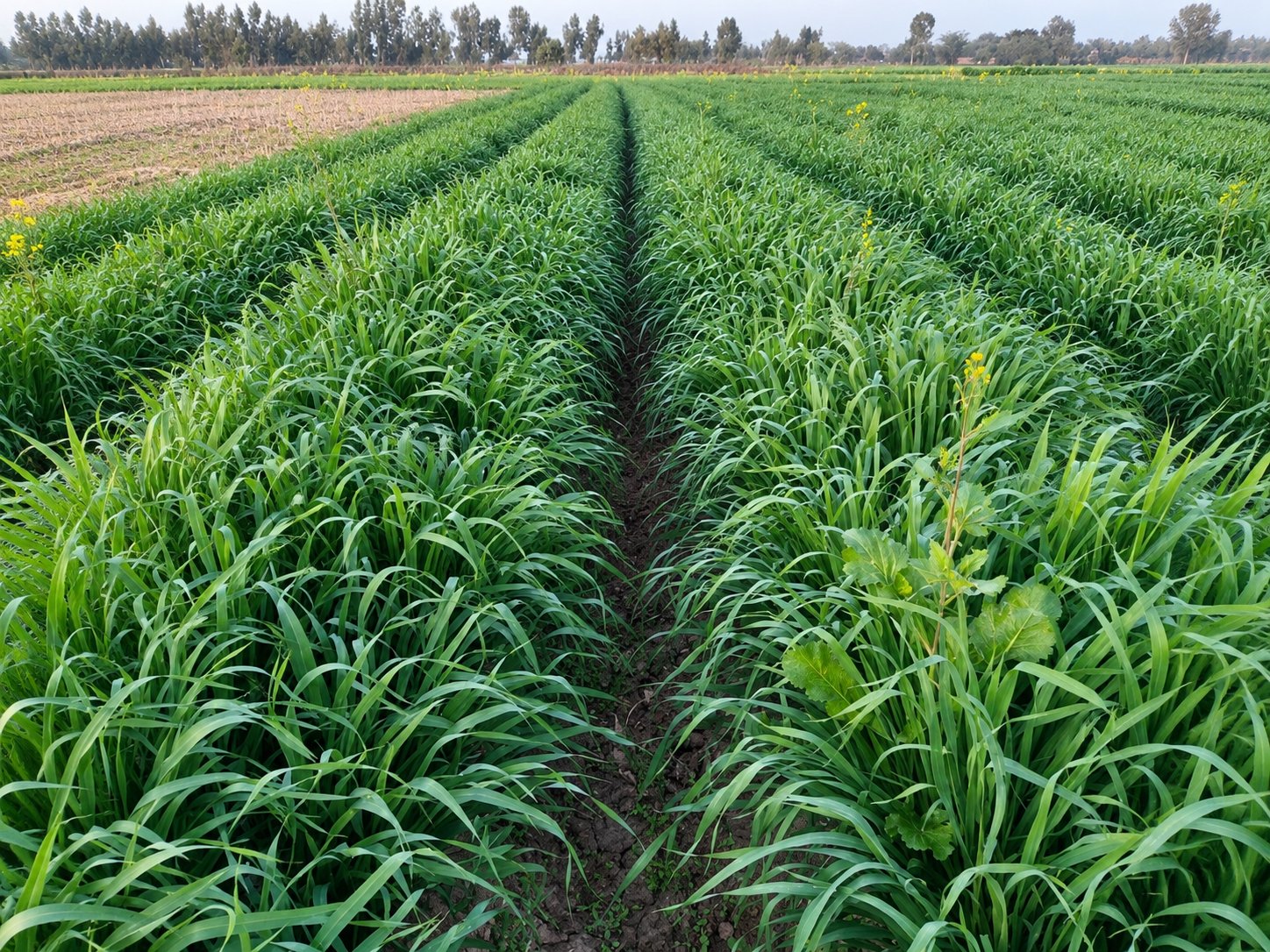
Rhodes grass (Chloris gayana): The most productive fodder crop a PQNK farm can grow, with 10 to 12 percent crude protein in its dry matter, higher than sorghum fodder (Knowledge Paper KP-014). Rhodes grass is a perennial, deep-rooted grass of warm climates, at its best between 25 and 35 °C and resting through the cool months, and it tolerates the salinity and moderate alkalinity common in Punjab soils. It is planted once on the permanent beds and never replanted. The first cut comes 60 to 75 days after sowing, and through the growing season it is cut again every four to six weeks, always leaving 10 to 15 cm of stubble so the crown regrows and the roots keep feeding the soil. Its dense, deep roots open the soil and hold it together, and the farm can keep its own seed from a plot left to flower. With water given only in the furrow when the soil-ball test shows a need, Rhodes grass supplies green fodder cut after cut through the warm months, and hay for the winter, at almost no cost.
Maize for fodder and silage: Maize grown on PQNK permanent beds gives the livestock enterprise a high-energy feed from the same land that grows the cash crop. Grown for silage, the whole crop is cut above the ground at the right stage, the roots stay in the bed, and the next crop is planted through the mulch within a day; on one acre this allows up to four silage crops a year (Chapter Thirty-Six). Grown for grain, the grain goes to market or is kept as the concentrate for the farm’s own animals, while the stalks are chopped and left on the bed as mulch, because in PQNK the residue belongs to the soil. Either way, the crop that feeds the market and the crop that feeds the animals come from the same beds, and the soil is never left bare.
Fodder from inter-crops and margins: Crops grown between the main crops on the same beds are also high-quality livestock fodder when cut green or dried and stored. What is cut for the animals is cut, never pulled: the roots stay in the bed to feed the soil. The residues of the cash crops are not carted away; they stay on the beds as mulch, because in PQNK the residue belongs to the soil. PQNK does not sow any crop for its nitrogen; the free-living organisms of a living bed supply what the crop needs.
THE FEED COST REDUCTION: THE NUMBERS
The fall in feed cost from as much as 72 percent of milk value to the 22 to 30 percent that PQNK targets is the central economic claim of this chapter, and it deserves a precise account of how it is achieved.
The conventional dairy farmer in Pakistan’s smallholder sector typically keeps 2 to 4 dairy animals, buffaloes or cows, on 1 to 3 acres of land that is primarily under crop production. The animals are fed purchased feed: commercial rations, cottonseed cake, wheat bran, and purchased fodder from the market or from a small rented berseem plot. Feed can take as much as 72 percent of the value of the milk the animals produce (Knowledge Paper KP-080). The milk revenue is often barely adequate to cover the feed cost, leaving little net income from the animal enterprise itself.
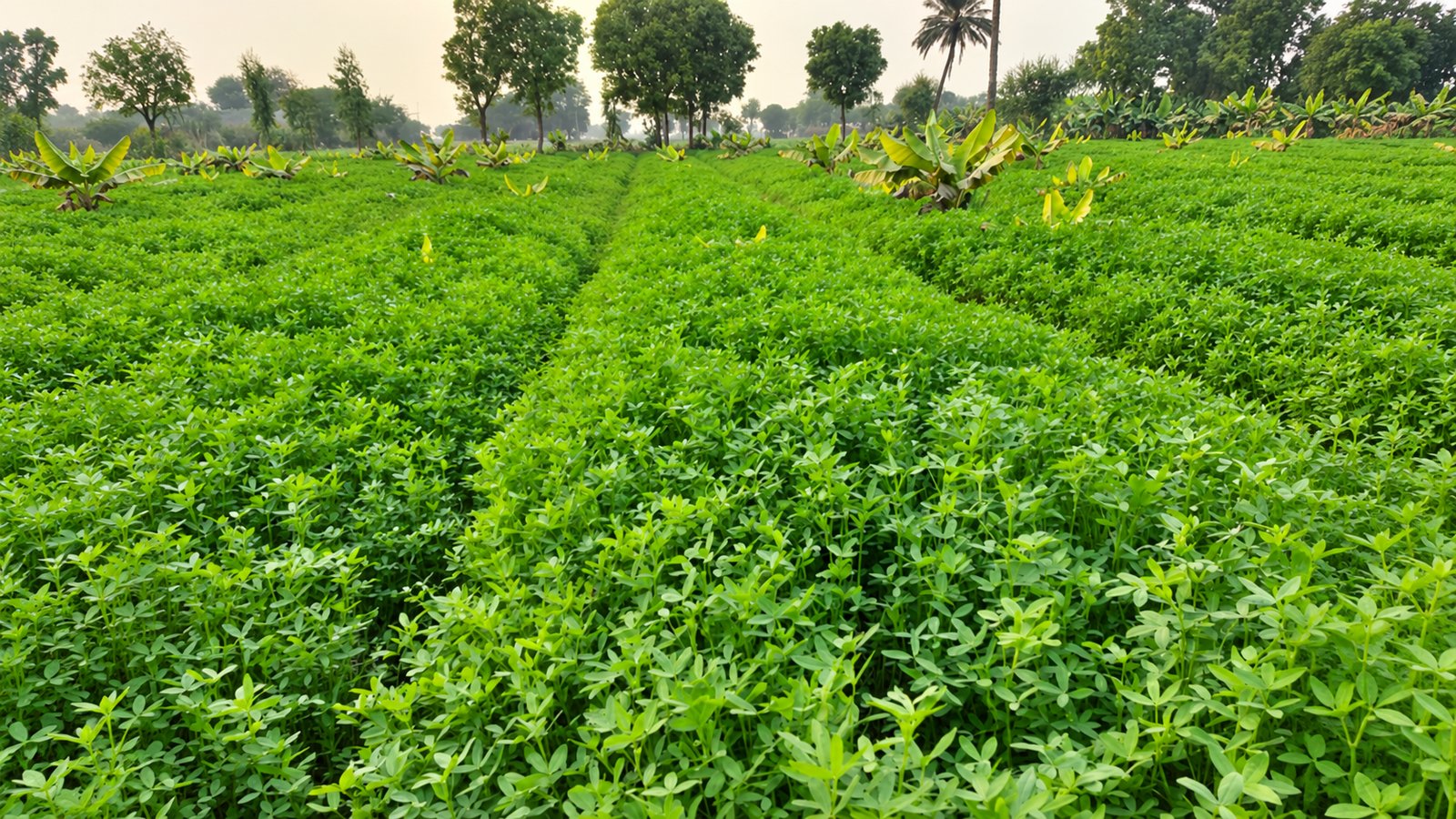
The PQNK integrated farmer grows alfalfa on the permanent beds and cuts it through the year, grows sorghum in summer, and cuts Rhodes grass again and again through the warm months, with hay for the winter. Maize for silage is grown crop after crop on the same beds. Inter-crops and green growth from the field margins provide additional fodder, and orchard prunings provide browse. The only purchased feed is the grain concentrate given during peak lactation, and even that can come from the farm’s own PQNK maize. Feed cost then falls to the 22 to 30 percent of milk value that PQNK sets as its target (Knowledge Paper KP-080), turning the dairy from a break-even enterprise into one of the farm’s most profitable components.
Feed is to livestock what fertiliser is to crops: a purchased substitute for what the biological system can produce for free. The PQNK farm needs no fertiliser: its living soil and mycorrhizal network feed the crop. It grows its own feed on the same permanent beds. The two circles overlap: the animals eat from the farm, and their dung returns to the land where it falls. This is what closed loop means.
COW DUNG AND URINE: WHAT THE SCIENCE ACTUALLY SUPPORTS
A separate correction concerns cow dung and cow urine, widely promoted in South Asian “natural” and “organic” farming circles, often as fermented preparations such as jeevamrutha or panchagavya, as if a living soil depended on them. PQNK does not share that belief.
A living PQNK soil already carries its own vast and diverse microbial community. Once the hardpan is broken, the beds are permanent, the soil is never tilled or left bare, and roots and mulch are retained, that community recovers and multiplies on its own. It does not need to be seeded with dung or urine, and dung is not a nutrient that the soil lacks.
Nor can dung and urine supply a crop’s needs. At any rate a smallholder can produce and apply they are dilute, and treating them as fertility inputs only repeats the input mindset of conventional farming with different materials. Applied fresh, they also carry the enteric pathogens of any raw animal waste, a risk that passes to any crop eaten fresh from the field.
Within PQNK, the dung of the farm’s own animals stays where it falls, in small amounts, as part of the farm’s closed cycle. It is not bought, sold, fermented into preparations or spread on the beds, and any surplus is better used for biogas or as fuel. The biological system this book describes, the hardpan broken once, permanent beds, mulch and retained roots, does the fertility work on its own.
SOIL TO SOUL: THE NUTRITIONAL CHAIN FROM BIOLOGICAL SOIL TO HUMAN HEALTH
The final dimension of the livestock chapter is the one that connects the soil biology argument of Part One to the human health that Part Six takes up through the specific, traceable mechanism of the mineral chain from soil to animal to person.
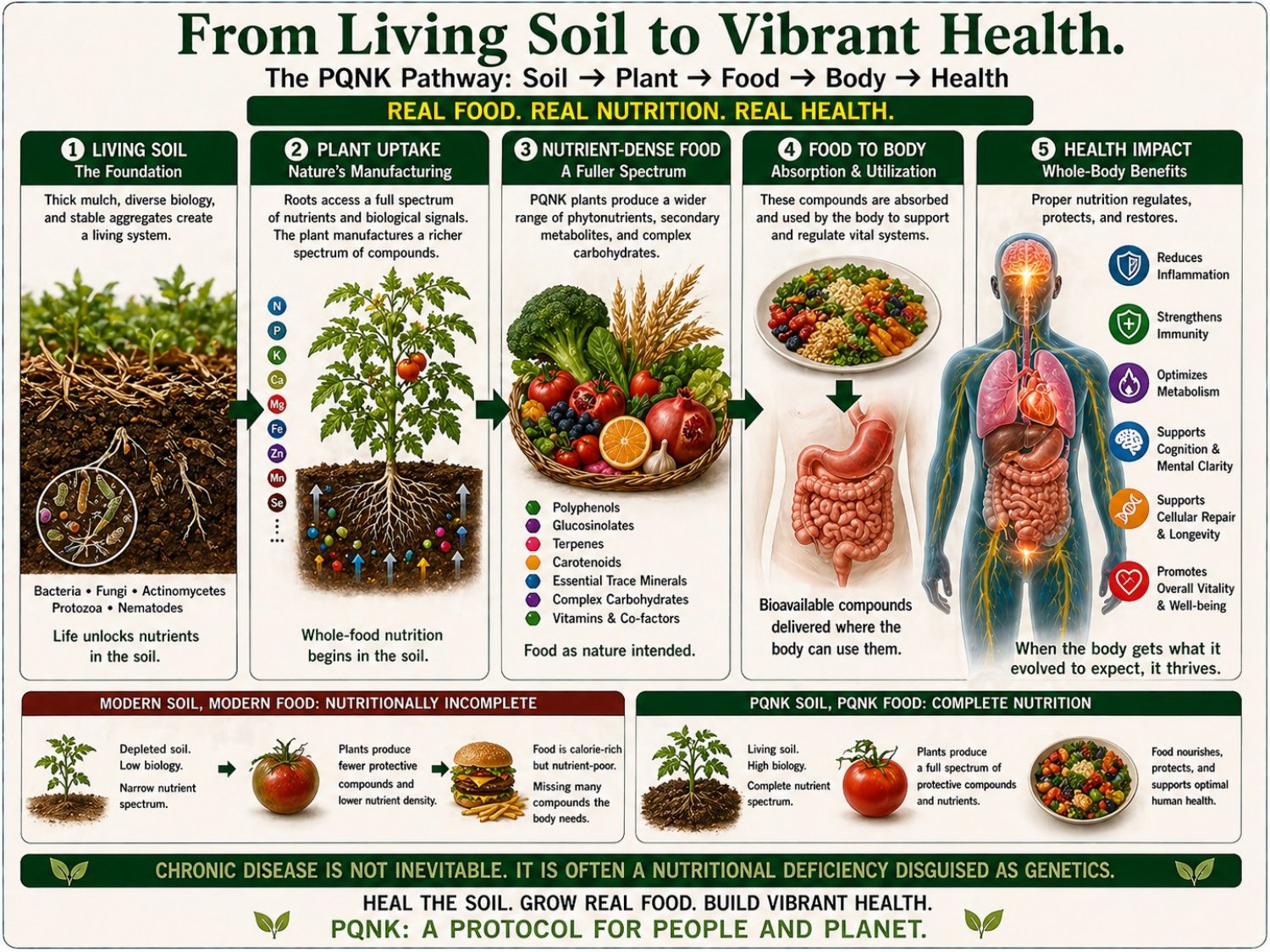
From Living Soil to Vibrant Health: The PQNK Pathway, Geology → Soil → Microbe → Root → Plant → Food → Body → Health
The bio-potentiation chain is as follows. A PQNK soil with a functioning mycorrhizal network delivers a complete mineral spectrum to the fodder crops that grow in it. The dairy animal that eats this fodder absorbs a complete mineral spectrum from its feed. The milk that animal produces contains a higher concentration of calcium, magnesium, selenium, zinc, and the full range of trace minerals than milk from an animal fed on conventionally grown fodder or purchased commercial rations. The person who drinks this milk receives that mineral spectrum in the form most bioavailable to human metabolism: food-matrix minerals from a biologically active source.
This chain is not theoretical. The difference between the milk of a PQNK-fodder-fed dairy animal and a conventionally fed animal shows in its mineral content, butterfat and protein profile. Better mineral nutrition through the food chain produces better health for the people who eat from it.
Soil to soul is not a metaphor. It is a biological chain with precisely traceable links. The PQNK farmer who restores their soil restores the mineral chain from geology to mycorrhiza to fodder to animal to milk to human. Every link in the chain is healthier than its conventional counterpart. The health benefit at the end is the sum of all the biological improvements at every link.
WHAT THIS CHAPTER, AND PART FIVE, HAS ESTABLISHED
Livestock and fodder complete the biological circle of the PQNK system. The fodder that the PQNK soil grows is more nutritious than what the market sells. The animals that eat it are healthier and produce richer milk. Their dung returns to the land where it falls, and the living soil grows the next fodder season. The circle closes. The cost approaches zero. The quality approaches the maximum that the biological system is capable of producing.
Part Five has presented the evidence: eleven chapters, eleven crop or production categories, from the peer-reviewed rice result through the NARC wheat trial, the 200-boll cotton plant, up to four maize crops a year from one acre, sugarcane planted once and harvested for years, the potato circular model, garlic, onion and vegetables, the Toba Tek Singh citrus data, the tropical and frontier crops, to the livestock feed cost revolution. In every case, the mechanism is the same: restore the soil biology and the biological system does what it was always designed to do. The evidence is complete. The case is closed.
Part Six describes what the world looks like when this evidence is acted on at scale: the transformation of the farm, the farmer, the rural community, the water system, the climate, the national economy, and the health of every person who eats from a PQNK farm.
Part Six: The Transformation, From Farm to Future