Industrial Devastation To Natural Abundance
The Transformation · Chapter 44
One Acre Prosperity
The Smallholder's Path to Dignity
Release 1.0 · 2026-10-22
If you use “Listen”, the text of the page may be sent to your browser or operating system’s speech provider, such as Apple, Google or Microsoft, depending on the voice your device uses. Pedaver does not process, transmit or store any audio.
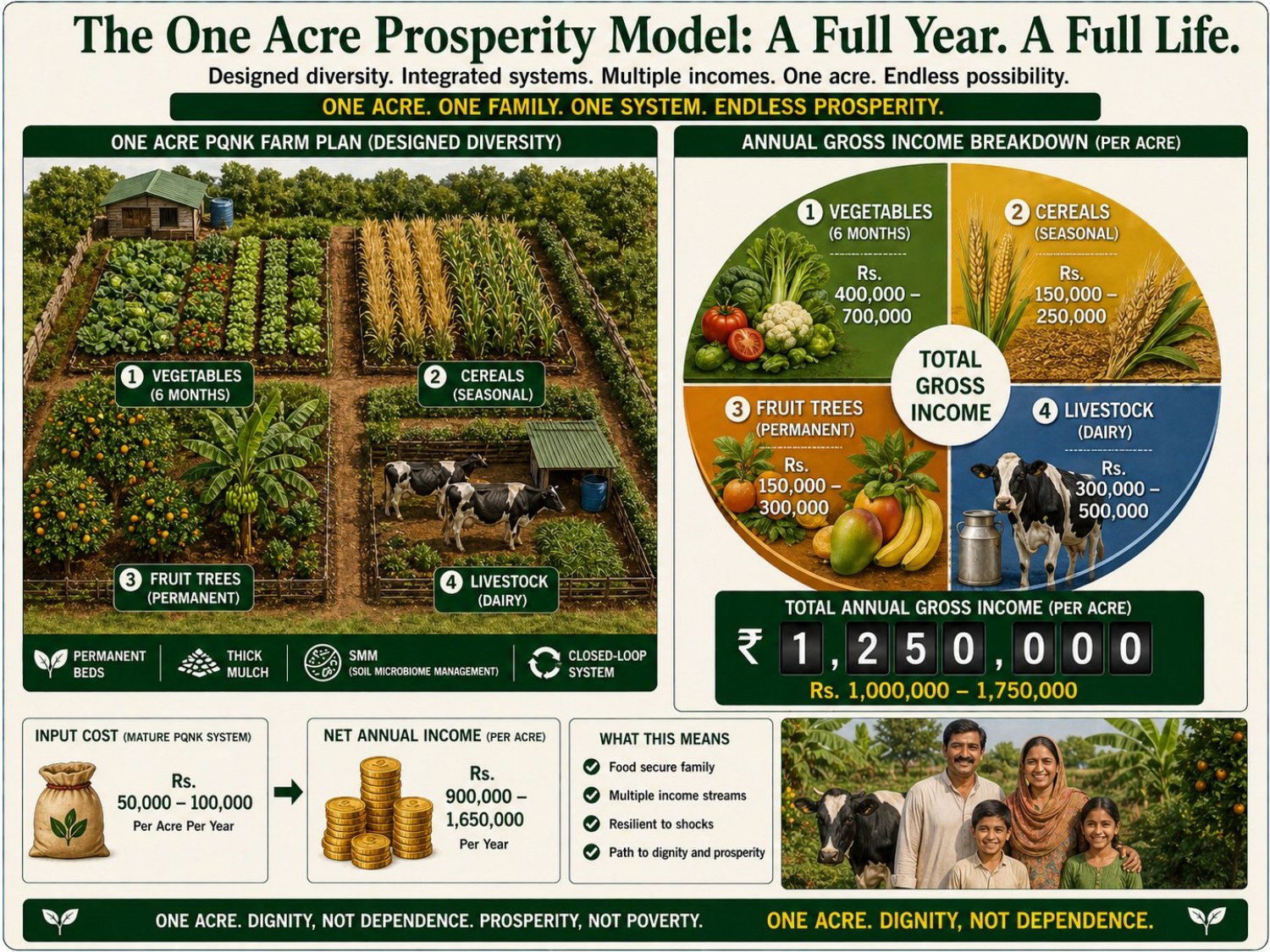
The One Acre Prosperity Model: One Acre, One Family, One System, Rs. 1,000,000–1,750,000 Annual Gross Income
“The smallholder with one acre has been told that one acre is not enough. He has been told to consolidate, to migrate, to seek non-farm income, to accept that small farming is subsistence farming and subsistence farming is poverty. He has been told this by people who were measuring the output of one acre of dead soil. One acre of PQNK soil is not subsistence. It is prosperity.”
Asif Sharif, Lahore, 2023
A NOTE ON PART SIX
The chapters that follow in Part Six are extended knowledge papers. They are designed to stand independently of the main text and may be read separately, shared with specific audiences, or used as reference material alongside the preceding parts of this book. Readers who have moved through Parts One to Five will find familiar ground here, treated in greater depth and with additional technical detail. The repetition is intentional: each knowledge paper is complete in itself, written to be understood without requiring the reader to have first read the whole book. Part Six is a reference appendix with full standalone value.
Part Six is the transformation section of this book. Where Part Five documented what PQNK produces crop by crop, Part Six documents what it transforms, the farm, the farmer, the rural household, the rural community, the water system, the atmosphere, the national economy, and the health of every person who eats from a PQNK farm. Part Six is not a projection. It is a description of what is already happening on the farms that have implemented PQNK, extrapolated to what the world looks like when it is implemented at scale.
Chapter Forty-Four begins with the smallest scale: a single acre and the family that farms it. Because the transformation of the world begins with the transformation of the farm, and the transformation of the farm begins with the farmer’s decision to follow eight steps on the land they already have.
THE PROBLEM PQNK SOLVES AT THE HOUSEHOLD LEVEL
Pakistan’s smallholder farming household, the family with 1 to 5 acres of agricultural land, is the most important economic unit in the country’s rural economy. Most of Pakistan’s farming families work holdings of this size. They produce the majority of Pakistan’s food, employ a large proportion of its rural labour force, and hold most of its agricultural land in productive cultivation. They are also, by almost every measure of economic welfare, among the most financially precarious households in the country.
The financial precariousness of the smallholder is not a natural condition or an inevitable consequence of small scale. It is the product of the Ancient Conventional Industrial (ACI) system’s cost structure applied to small land holdings: the same input costs per acre that a large commercial farm can absorb into a diversified cost base consume the entire revenue of a one-acre farm in a bad year and most of it in a good one. The conventional smallholder is not farming at a disadvantage because of his scale. He is farming at a disadvantage because the system he is using was designed for a scale that most Pakistani farmers do not have.
PQNK inverts this relationship. The PQNK system’s most important economic feature for the smallholder is not that it produces more per acre. It is that, once the soil matures, it produces with zero purchased inputs. When purchased inputs are zero, every acre is profitable regardless of scale. The smallholder is not disadvantaged by PQNK. He is advantaged: the same zero purchased-input cost that a 100-acre PQNK farm achieves is available to the one-acre PQNK farmer as the soil matures, often around the third crop cycle.
THE OAP DESIGN: ONE ACRE, FOUR COMPONENTS, TWELVE MONTHS
The One Acre Prosperity model is a specific, implementable design for maximising biological diversity, nutritional self-sufficiency, and market income from a single acre under PQNK management. It is built on the PQNK field practice set out in Chapter Thirty-One, where One Acre Prosperity, Alley Cropping and Circular Production were first described together.
The four components are designed to work together: the fruit trees provide the permanent income structure, the field crops provide the food security base, the vegetables provide the weekly cash income, and the livestock close the biological circle while providing additional income streams. Together they ensure that the farm is never dependent on a single crop price, never without income in any month, and never without food security for the family. The share of the acre given to each component is set by the household’s needs, the market and the growth of the tree canopy, not by a fixed formula.
The OAP design aims at a gross income of Rs. 1,000,000 or more from one acre each year, with zero purchased inputs once the soil matures, and with all twelve months of the year generating revenue from at least one income stream. At Pakistan’s current urban wage rates, this income from one acre is competitive with middle-class urban employment and is available without the social disruption, housing cost, and quality-of-life reduction of rural-to-urban migration.
ONE HOUSEHOLD, MANY CROPS: INCOME FROM THE FIRST SEASON
The OAP model does not ask the farmer to wait for the trees. In the first year, once the Jantar cover crop has opened the soil and been laid on the beds as mulch, high-value, low-volume crops are planted through that mulch on the beds between the young trees of the high-density orchard. These are crops that earn a high price for a small quantity, so the household can harvest, carry and sell them itself. The crop is chosen by the buyer, not by habit: what the nearest market, shop or buyer will take, in the quantity the family can deliver. The young trees are planted first, and the other crops are sown after them.
Garlic shows what this means. On one acre of permanent beds, garlic is planted in nine rows 4 inches apart on the 42-inch bed top, with the cloves 4 inches apart in each row: 235,224 plants on one acre. If every bulb weighs only 20 grams, the acre yields 4,704 kg, about 118 maunds, and at the lowest wholesale price of Rs. 100 per kg it earns Rs. 470,448 in about six months. If the bulbs reach 50 grams, the same acre yields 11,761 kg, about 294 maunds, worth Rs. 1,176,120. Onion planted at the same spacing follows the same arithmetic.
And that is only half the year. The remaining six months carry further crops on the same beds, each one planted into the standing crop before it is harvested, crop-in-crop, so the beds are never empty and the income never stops.
This is the heart of the OAP philosophy: one household, engaged throughout the year in producing many crops on one acre. The work is planned so that the family’s own hands can manage it, sowing, tending, harvesting and selling a little at a time, without hired labour and without purchased inputs. The acre earns from its first season, and every season after that adds a further layer: the trees, the crops between them, and the livestock.
ONION & GARLIC PLANTS AND YIELD

| Row to row & plant to plant distance | Plants/acre | Bulb weight (g) | Bulbs in 1 kg | Kg/acre | Maunds/acre | Price per kg (Rs.) | Income Rs./acre |
|---|---|---|---|---|---|---|---|
| 4" × 4": 9 rows on a 42" bed top | 235,224 | 20 | 50 | 4,704 | 118 | 100 | 470,448 |
| 4" × 4": 9 rows on a 42" bed top | 235,224 | 50 | 20 | 11,761 | 294 | 100 | 1,176,120 |
Spacing 4 × 4 inches, nine rows on a 42-inch bed top (60-inch bed centres). 1 maund = 40 kg. Income at Rs. 100 per kg, the lowest wholesale price.
THE THREE-YEAR JOURNEY: WHAT CHANGES AND WHEN
The OAP model reaches its full level in about three years, but it earns from its first season. Understanding what changes in each year helps the farmer manage their expectations and recognise the signs of successful progress at each stage of the journey.
Year One: The infrastructure year. The field is designed, the hardpan is broken once with a subsoiler, the soil is washed where required, and the permanent beds are formed. Jantar is then grown on the beds as the first cover crop: its deep roots open pores through the soil for infiltration and aeration, and when it is cut, the roots stay in the soil as food for the microbes while the cut Jantar is laid on the beds as mulch. The young high-density orchard is planted in its permanent positions, and high-value, low-volume crops such as garlic and onion are planted through the mulch on the beds between the young trees. Input costs are already substantially lower than the conventional baseline. The farm looks different: beds visible, mulch covering the surface, young trees in rows with crops growing between them. The trees are not yet bearing, but the crops between them bring in a substantial income from the first season, crop after crop, from the household’s own labour.
Year Two: The acceleration year. Soil biology is visibly recovering. Water is given in the furrows only when the ball test shows a need, and the need falls as the beds mature. Pest pressure is declining without spray. Under the mulch few weeds emerge, and those that do are left to work for the soil or cut as fodder, with no herbicide. Vegetable production is at full designed-diversity output. The trees are beginning to produce their first significant fruit. Livestock are producing on PQNK fodder. Income rises further as the first fruit is added to the crops between the trees. The farmer is confident. The farm is demonstrably different from every conventional farm in the district.
Year Three: The harvest year. The closed loop is established. Zero purchased inputs across all components. Trees are in full early production with rapidly improving grade. Field crops produce at PQNK performance levels at zero input cost. Vegetables produce continuously throughout the year. Livestock produce on entirely on-farm fodder. Total income reaches the OAP target. The farm has achieved what the system promised. The farmer’s relationship with debt, with the input dealer, and with the economic precariousness of the conventional system is over.
Year One: the crops between the young trees pay you while you build the system. Year Two: the trees begin to add their fruit. Year Three: the system is working for you and you owe no one anything. Three years to financial independence from the input industry that has owned Pakistani farmers for sixty years. That is the timeline on a correctly managed farm, and the field, not the calendar, confirms each stage.
FOOD SECURITY FIRST: THE OAP MODEL’S NON-NEGOTIABLE
Before income, before market positioning, before any commercial consideration, the OAP model requires the food security of the farming household. This is not a social policy aspiration. It is a biological design principle: the farm that produces the family’s food from its own soil is the farm that is most resilient to market price volatility, supply chain disruption, and the income shocks that affect every farming household.
In the OAP design, food security is achieved through five parallel channels that together cover the full nutritional requirement of a Pakistani rural household. The wheat grown among the field crops covers the family’s staple grain requirement. The vegetable beds provide fresh vegetables throughout the year. The fruit trees provide seasonal fruit. The dairy and livestock components provide milk, eggs, and periodic meat. And the pulses grown on the farm provide the protein that the cereal cannot. A household eating from an established OAP farm is nutritionally complete without purchasing a single food item from outside the farm.
This food security foundation is what allows the cash crop income to be directed toward savings, education, and investment rather than food purchase. The conventional smallholder who grows one cash crop and purchases food from the market is converting agricultural revenue into food expenditure at market prices rather than at biological cost.
The OAP farmer grows the food at near-zero cost and sells everything else. The difference in economic position is structural, not marginal.
WHY ONE ACRE IS ENOUGH
The claim that one acre of PQNK-managed land can provide financial prosperity for a Pakistani farming household is the most politically important claim in this chapter because it directly contradicts the dominant narrative of Pakistan’s agricultural policy: that farm size must increase for agriculture to be viable, that smallholders are inherently inefficient, and that the future of Pakistani agriculture lies in consolidation, mechanisation, and commercial-scale production.
This narrative, which drives the economic and policy pressure on smallholder farmers to sell their land and seek urban employment, is based on the economics of the ACI farming system applied to small land holdings. It is correct in its diagnosis of the ACI system: one acre of conventionally managed land cannot support a family in dignity. It is wrong in its prescription: the problem is not the size of the land but the system that is farming it.
One acre of PQNK land, designed according to the OAP model, generates an annual income comparable to the salary of a university-educated Pakistani in a government or private sector position. It does so without commuting, without rent, without the social costs of urban living, and with a quality of life that the urban alternative cannot provide to the families who have experienced both. The PQNK one-acre farmer does not need to migrate to the city. The city’s income is available from their land.
OAP AND RURAL-TO-URBAN MIGRATION: REVERSING THE FLOW
Pakistan’s cities are growing at rates that their infrastructure and economy cannot sustain. Karachi, Lahore, and Faisalabad are receiving rural migrants at a pace that produces overcrowding, unemployment, housing stress, and the social dislocation that Chapter Thirteen described as social bankruptcy. The cause of this migration is not a natural preference for urban life. It is the economic impossibility of rural farming life under the ACI system.
The OAP model offers a structural alternative: an income from one acre that makes rural life economically preferable to the marginal urban employment that most rural migrants achieve. The young person who calculates that their one-acre PQNK farm will generate Rs. 1,000,000 or more a year once the soil has matured and the fruit trees come into full production, has no economic reason to migrate. The pull of the city becomes insufficient when the land provides more.
The reversal of rural-to-urban migration that PQNK could enable is not merely an agricultural outcome. It is a social and economic one: the repopulation of rural communities with productive young households who have the biological and economic tools to rebuild what the ACI system has dismantled. Rural regeneration through biological farming is not a romantic aspiration. It is an economic calculation that favours the land when the land is PQNK land.
WHAT THIS CHAPTER HAS ESTABLISHED
The One Acre Prosperity model is the economic proof that PQNK is not only an ecological system but a rural prosperity engine. A gross income of Rs. 1,000,000 or more from one acre each year, with zero purchased inputs once the soil matures, in twelve-month income distribution that eliminates the single-crop dependency and the seasonal income gaps of the conventional system, this is what the OAP farm is built to deliver and the answer to the conventional narrative that one acre cannot sustain a family.
The next chapter scales the OAP model to its environmental dimension: what happens to the water system when millions of OAP farms are infiltrating rainfall instead of running it off, recharging aquifers instead of depleting them, and managing floods instead of creating them.
Chapter Forty-Five: Water, Floods, and Aquifer Replenishment, PQNK as Hydrological Solution