
Industrial Devastation To Natural Abundance
The Destruction · Chapter 15
Human Civilisation and the Politics of Food
Agriculture, Power, and the Future of Autonomy
Release 1.0 · 2026-09-12
If you use “Listen”, the text of the page may be sent to your browser or operating system’s speech provider, such as Apple, Google or Microsoft, depending on the voice your device uses. Pedaver does not process, transmit or store any audio.
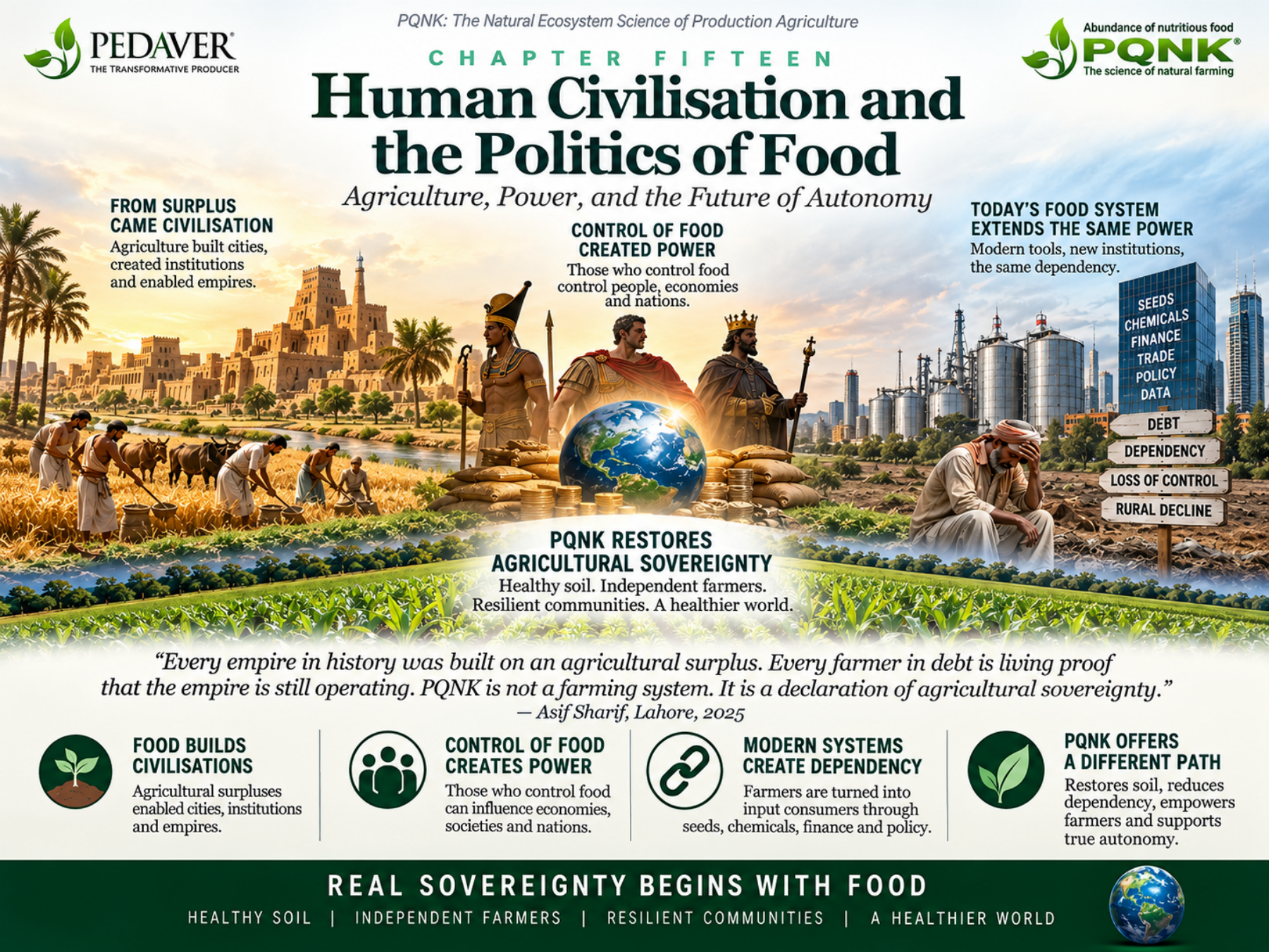
From surplus came civilisation; control of food created power; today's food system extends the same power through seeds, chemicals, finance, trade, policy and data. PQNK restores agricultural sovereignty: healthy soil, independent farmers, resilient communities, a healthier world.
“Every empire in history was built on an agricultural surplus. Every farmer in debt is living proof that the empire is still operating. PQNK is not a farming system. It is a declaration of agricultural sovereignty.”
Asif Sharif, Lahore, 2025
The preceding fourteen chapters of this book have made two interlocking arguments. The first is scientific: that nature maintains soil fertility, water ecology, pest regulation, and vegetation abundance through a set of biological principles that conventional agriculture has systematically dismantled. The second is economic: that the dismantling imposes real, documented costs, measured in the trillions of dollars once the accounting set out in Chapter Fourteen is applied, while delivering declining soil health, declining nutritional quality, and declining farmer welfare. Both arguments are correct and both are important. But they are incomplete without a third argument, which this chapter makes.
The crisis of conventional agriculture is not primarily a scientific error. Scientists who asked the right questions were dismissed, defunded, or ignored. It is not primarily an economic failure. Farmers who understood the true cost-benefit of the system they were in could not exit it without destroying themselves financially in the short term. The crisis of conventional agriculture is, at its deepest level, a political phenomenon: the outcome of a ten-thousand-year relationship between food and power that has never been honestly named and therefore never been honestly addressed.
This chapter names it.
SURPLUS, CIVILISATION, AND THE BIRTH OF POWER
For most of human history, food was not merely a means of survival. It was the foundation upon which every social structure was built. Long before modern governments, financial institutions, industrial corporations, universities, armies, or political systems existed, there was food. Every civilisation, regardless of geography or culture, depended upon its ability to convert sunlight, water, soil, and biological activity into a dependable food supply.
When agricultural systems began producing surpluses beyond immediate household needs, an important transformation occurred. For the first time, not every member of society needed to participate directly in food production. Some individuals became builders. Others became soldiers. Others became administrators, priests, traders, craftsmen, scholars, and rulers. Cities emerged. Governments emerged. Institutions emerged. Civilisation itself became possible because agriculture produced more food than the producers themselves required.
Yet surplus also created something beyond civilisation. It created power.
A family producing only enough food for its own survival possesses little influence beyond its immediate surroundings. A group controlling the food supply of thousands possesses a different kind of authority. The ability to direct food flows gradually became the ability to direct labour, wealth, trade, military organisation, and political decision-making. Throughout human history, control of food repeatedly translated into control of society.
Empires did not emerge solely through military strength. Armies themselves depended upon agricultural surpluses. Administrative systems depended upon agricultural surpluses. The capacity to organise and distribute food often determined the capacity to organise and govern populations. Behind every palace stood a grain-producing landscape. Behind every bureaucracy stood a farming population. Behind every army stood an agricultural surplus.
Food remained the invisible foundation of political authority.
This relationship persists today, although it appears in less visible forms. Modern populations rarely interact directly with agricultural production. Food arrives through highly organised supply chains involving processors, distributors, retailers, transport systems, financial institutions, regulatory bodies, research organisations, and multinational corporations. The distance between producer and consumer has increased dramatically. Yet the fundamental dependency remains unchanged. Civilisation still rests upon agriculture. The difference is that the mechanisms of control have become more sophisticated and therefore harder to see and harder to challenge.
FROM FOOD PRODUCERS TO INPUT CONSUMERS: HOW DEPENDENCY WAS ENGINEERED
For most of agricultural history, the producer occupied a position of remarkable practical independence. The farmer depended upon land, water, seed, animals, family labour, local knowledge, and seasonal experience. Success was never guaranteed, and nature always imposed limitations. Yet the essential means of production remained largely under the producer’s control. Seed came from previous harvests. Fertility came from biological processes. Knowledge was accumulated through generations and embedded in the community. The farm functioned as a productive unit capable of sustaining itself.
This independence did not mean prosperity. Many agricultural societies endured hardship, uncertainty, and periodic failure. Nevertheless, the producer remained the central decision-maker within the production system. The farm was the authority. Nature was the teacher. The farmer was the practitioner of a knowledge system that required no external permission to function.
The situation began changing as agriculture became increasingly industrialised. Mechanisation expanded. External fertilisers became common. Synthetic pesticides emerged. Commercial seed systems expanded. Specialised equipment multiplied. Financial institutions became increasingly involved in agricultural production. Research systems grew larger and more centralised, answerable not to the field but to their funders.
At first, these developments appeared entirely beneficial. Higher yields were achieved. Labour requirements declined. Large areas could be cultivated efficiently. Food production increased dramatically in many regions. Few questioned the direction of change because the immediate results appeared impressive. The error was in the accounting. The visible benefits were credited to the new system. The invisible costs (the depleting soil, the falling water tables, the weakening nutritional density, the growing farmer debt) were not credited to anything. They accumulated silently in the commons while the private profits of the input industry accumulated loudly in the accounts of publicly listed corporations.
Beneath the visible success, a deeper transformation was occurring. The source of agricultural productivity was gradually shifting away from the farm itself. The producer increasingly relied upon resources originating elsewhere. Seed came from external suppliers. Nutrients came from external suppliers. Crop protection came from external suppliers. Machinery came from external suppliers. Technical recommendations came from external institutions. Financial capital came from external lenders. The production system became dependent upon inputs that the producer neither controlled nor produced.
This shift altered the balance of power within agriculture in ways that no policy document acknowledged and no government metric measured. A producer who saves seed retains control over seed. A producer who must purchase seed annually transfers part of that control elsewhere. A producer whose fertility originates within the ecosystem retains greater autonomy than a producer whose fertility depends entirely upon purchased materials. Each additional dependency transfers a portion of decision-making authority away from the farm and toward the institutions supplying that dependency.
The paradox is striking. Agriculture became more technologically advanced while many producers became less autonomous. The farm remained productive, but its freedom to function without external permission progressively diminished.
CAPTURED SCIENCE: HOW KNOWLEDGE WAS TURNED AWAY FROM THE FIELD
Science occupies a position of extraordinary importance within civilisation. Every society depends upon systems that generate, organise, preserve, and transmit knowledge. Agricultural science, at its best, serves as a disciplined method of observation in which the natural world is the final authority. Evidence is examined. Assumptions are tested. Conclusions remain open to revision when observations demonstrate that earlier explanations were incomplete.
Yet science does not operate in isolation. Scientific institutions exist within economic systems, political systems, educational systems, and social systems. Research requires funding. Laboratories require resources. Universities require budgets. Scientists require careers. Publications require institutions. Every system of knowledge must ultimately interact with systems of power. And when systems of power have a vested interest in particular answers, the questions that lead to inconvenient answers tend to receive less funding, less publication support, less institutional endorsement, and less career reward.
The challenge is not that individual scientists become dishonest. The challenge is that institutions develop incentives. Over time, those incentives influence which questions are asked, which questions are ignored, which research receives support, and which research remains unexplored. The result is not necessarily false science. More often, it is incomplete science, a vast edifice of knowledge about how to manage the industrial system more efficiently, built upon a foundation that almost entirely excludes the question of whether the industrial system should exist at all.
The most important question in agriculture is one that mainstream agricultural science has almost entirely failed to ask: How does nature maintain fertility, water, and vegetation abundance without industrial inputs? The question seems obvious. Natural ecosystems have produced abundant vegetation for hundreds of millions of years without fertiliser factories, pesticide laboratories, or irrigation engineers. Understanding these processes would appear to be one of the most important scientific questions in all of agriculture.
Yet this question occupied a peripheral position within mainstream agricultural research for the better part of a century. The scientific focus increasingly shifted toward managing inputs rather than understanding ecological self-organisation. Not because the question was unimportant. Because the answer was commercially inconvenient. An agricultural system that produces its own fertility from the root-microbe nexus does not purchase fertiliser. An agricultural system regulated by its own biological diversity does not purchase pesticide. An agricultural system that retains its own water through permanent root systems and mulched soil does not invest in expanding irrigation infrastructure. The trillion-dollar industrial complex that feeds on agricultural dependency has no market in a world where agriculture feeds itself.
This is not a conspiracy theory. It is structural logic. The institutions whose funding depends on validating industrial inputs are not capable of independently generating the knowledge that would make industrial inputs unnecessary. The structure itself determines what is investigated and what is not. PQNK did not emerge from this structure. It emerged despite it, from five decades of direct field observation, from asking the questions that the funded systems would not ask, and from finding, in the living field, the answers that the laboratory refused to seek. Chapter Twelve documents this pattern in detail: the funding structures, the published case studies, and PQNK’s own institutional history of engagement with it.
THE INVISIBLE TRANSFER OF POWER: FOOD, DEPENDENCY, AND CENTRALISED CONTROL
Every civilisation requires systems of coordination. Large populations cannot function without transportation networks, communication systems, institutions, markets, laws, and administrative structures. Organisation itself is not the problem. The question is not whether organisation should exist. The question is where power accumulates within that organisation.
Throughout history, control has rarely been established through force alone. Durable systems of power are built upon dependency. When individuals possess the ability to provide for their own essential needs, external control remains limited. As dependency increases, authority becomes increasingly concentrated in the institutions managing those dependencies. Food occupies a unique position within this relationship. Unlike most goods and services, it cannot be postponed indefinitely. It is required every day by every person. Control over food therefore creates a form of influence unlike almost any other form of economic activity.
As the distance between food producers and food consumers increased over the course of the twentieth century, the opportunity for control to concentrate within the systems connecting them expanded correspondingly. The producer no longer exchanged directly with the consumer. Layers of administration emerged. Layers of regulation emerged. Layers of finance emerged. Layers of distribution emerged. Each layer performed a function, yet each layer also occupied a position between production and consumption, extracting a toll from both sides. Over time, food increasingly moved through institutions rather than through relationships.
When producers become dependent upon external systems for seed, fertility, machinery, finance, technical advice, market access, and regulatory approval, their autonomy gradually diminishes. They continue to own land. They continue to perform labour. They continue to assume production risk. Yet their freedom to make independent decisions becomes increasingly constrained by structures beyond their direct influence. The farmer owns the problem but not the solution. The solution is owned by the corporation that sells the input, the bank that provides the credit, the government that sets the procurement price, and the research institution that validates the recommendation. The farmer is the point of maximum risk in a system where the rewards flow elsewhere.
Consumers experience a parallel transformation. The food arriving on the table appears abundant, yet knowledge of its origin, its production method, its nutritional quality, and its ecological cost becomes increasingly limited. Decisions about these things are transferred to institutions operating far from the point of consumption. The individual remains fed but becomes progressively disconnected from the processes that make food possible and therefore from the capacity to demand anything different.
A highly centralised food system often appears efficient because it concentrates resources, information, and decision-making authority. Yet the same concentration creates fragility. Disruptions occurring at critical points within the system affect large populations simultaneously. Supply chain failures, geopolitical disruptions, input price spikes, and climate events that would once have been local crises become national emergencies in a system where every producer depends on the same inputs from the same suppliers through the same distribution networks.
Natural ecosystems reveal a different model. A forest does not depend upon a single root. A grassland does not depend upon a single species. A healthy ecosystem distributes function across countless interconnected relationships. Resilience emerges from diversity, redundancy, and local autonomy. No single component controls the entire system, yet the system remains remarkably organised. PQNK seeks to restore similar principles to agricultural production not as romantic idealism, but as the most rational possible response to a system whose brittleness is already visible in every drought, every supply disruption, and every fertiliser price shock.
WHAT THE RESTORATION OF AGRICULTURAL AUTONOMY MEANS FOR CIVILISATION
PQNK is often described as a farming system. It is, in the most important sense, something considerably larger. It is a framework for restoring functional autonomy to the agricultural producer, and through that restoration, for changing the distribution of power within the food system and, ultimately, within the societies that depend upon it.
The restoration of ecological function within the farm is simultaneously the restoration of practical autonomy. When fertility is increasingly generated through biological activity, dependence upon external nutrient systems declines. When water is retained within the ecosystem more effectively, vulnerability to water scarcity declines. When biological regulation becomes stronger, dependence upon corrective interventions declines. When ecological function improves, external dependency often decreases simultaneously. The farm does not need permission from a corporation or a government to generate its own fertility. The root-microbe nexus operates under its own sovereignty, answerable to the laws of ecology rather than the laws of commerce.
A society composed of ecologically autonomous producers possesses characteristics fundamentally different from a society dependent upon increasingly centralised systems for the basic requirements of food production. Local resilience increases. Economic vulnerability decreases. Communities retain greater productive capacity. Food security becomes grounded in ecological function rather than solely in supply-chain efficiency. The power that currently concentrates in the institutions managing agricultural dependency disperses back toward the communities that grow food and the families that eat it.
This is not anti-commerce, and it is not anti-science. Trade in food will always exist, and agricultural science at its best has always been valuable. The point is simpler: wherever nature can perform an essential function reliably, that function should remain with nature. Wherever the farm can perform an essential function effectively, that function should remain with the farm. The result is not isolation. The result is resilience. And resilience is one of the foundations upon which genuine human freedom is built.
Every civilisation eventually encounters the consequences of its assumptions. The civilisation that assumes food can be safely transferred to industrial management encounters, eventually, the ecological and political consequences of that assumption. PQNK represents the beginning of a different assumption: that food is too important to be managed by any single institution, industrial or otherwise. It belongs to the ecosystem, the farmer, and the community, in that order.
WHAT THIS CHAPTER HAS ESTABLISHED
This chapter has located the PQNK system within its full civilisational context. Agricultural surplus created civilisation. Control over agricultural surplus created power. The industrialisation of agriculture systematically transferred control from the farm to the corporation, from the ecosystem to the input system, from the community to the centralised supply chain. Captured science validated this transfer. Subsidy systems institutionalised it. Farmer debt perpetuated it. The result is a food system that produces abundant calories while generating the trillions of dollars in annual externalities documented in Chapter Fourteen, declining nutritional quality, collapsing rural economies, and the permanent fragility of any nation whose food production depends on inputs it does not control.
PQNK’s claim is not merely that it produces better yields with less water and no inputs. Its claim is that it restores the ecological and economic sovereignty of the producer, the nutritional integrity of food, and the biological resilience of the agricultural landscape. These are not agricultural claims alone. They are civilisational claims. The story of how this system was discovered, tested, and validated over fifty-three years of field science begins in the next chapter.
The story shifts now from the destruction to the discovery. From the ten-thousand-year error to the fifty-three-year correction. From the system that failed to the system that works.
Part Three: The Discovery, Fifty-Three Years of Field Science