
Industrial Devastation To Natural Abundance
The Transformation · Chapter 47
Food Security, Food Sovereignty, and Economy
What PQNK Means for Every Nation
Release 1.0 · 2026-10-24
If you use “Listen”, the text of the page may be sent to your browser or operating system’s speech provider, such as Apple, Google or Microsoft, depending on the voice your device uses. Pedaver does not process, transmit or store any audio.
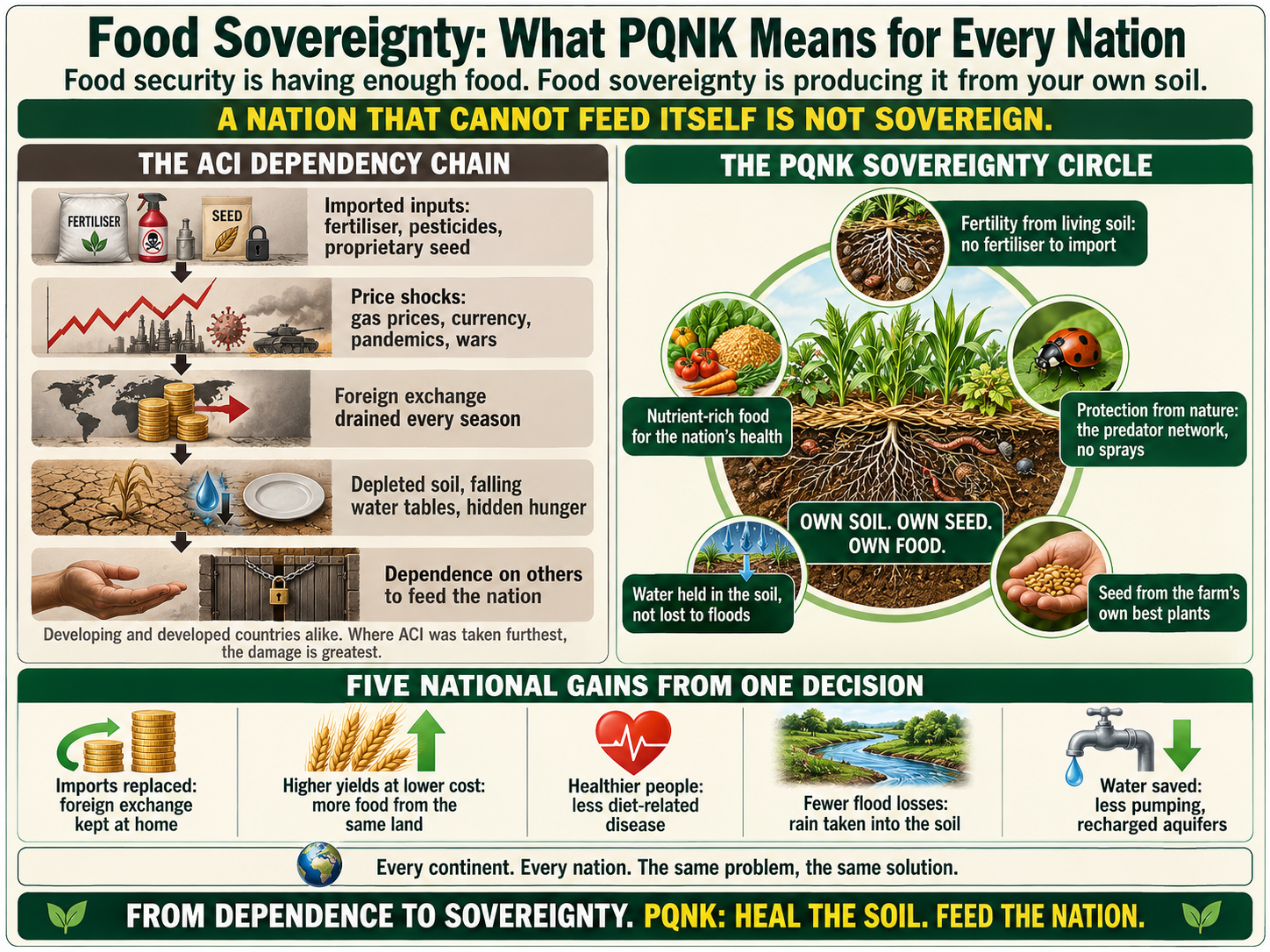
Food Sovereignty: What PQNK Means for Every Nation. From the ACI dependency chain to the PQNK sovereignty circle.
“A country that cannot feed itself is not sovereign. It is dependent. It will always defer to whoever controls its food supply. A nation’s food security is compromised not by lack of agricultural potential but by a farming system that is destroying the potential it has. PQNK does not improve food security. It restores food sovereignty. These are not the same thing.”
Asif Sharif, Lahore, 2024
The distinction between food security and food sovereignty is not semantic. Food security means having enough food. Food sovereignty means producing your own food, from your own land, with your own biological capital, independent of the input supply chains, the commodity markets, and the geopolitical dependencies that determine whether a country that purchases its food will continue to receive it at a price it can afford. Country after country, Pakistan among them, has pursued food security through the Green Revolution and found that the system that increased yields simultaneously created dependencies that made the security fragile. PQNK offers food sovereignty: the biological independence from which genuine food security can be built and sustained.
THE GLOBAL FOOD SECURITY POSITION
Food security in the twenty-first century is a global challenge with a common structural cause. Across South Asia, Sub-Saharan Africa, the Middle East and Latin America, and most intensively in the industrialised farm belts of North America, Europe and Australia, where ACI (Ancient Conventional Industrial) was taken furthest, the same pattern repeats: agricultural soils whose biological capacity has been degraded, declining yields masked by increasing input costs, aquifer depletion in irrigated regions, and nutritional quality declining even where caloric production is maintained. The following analysis draws on the country where PQNK’s evidence base is deepest, Pakistan, as a detailed case study of a pattern that is recognisable on every continent where industrial agriculture has operated.
The developed countries are not exempt; they are further down the same road. Having intensified ACI the most, they now carry its costs in their most advanced form: farm belts that have lost much of their topsoil and organic matter, part of the 24 billion tonnes of fertile soil the world loses to erosion every year (FAO); aquifers such as the Ogallala beneath the American plains among the 21 of the world’s 37 largest aquifers now in deficit (NASA GRACE); fertiliser run-off feeding the dead zones of their coastal waters; farmers kept in business by subsidies; and diet-related disease that costs the United States alone an estimated $1.2 trillion a year. When natural gas prices soared in 2022, fertiliser plants across Europe cut their output, and the richest farming systems in the world discovered how dependent they had become. The problem is not Pakistan’s, or the developing world’s. It is ACI’s, wherever ACI is practised.
Pakistan’s food security position is more precarious than its agricultural statistics suggest. The country produces large volumes of several major crops, wheat, rice, cotton, sugarcane, and exports some of them. But these production volumes are sustained by inputs that are predominantly imported or produced domestically from imported feedstocks: fertiliser made from natural gas that is increasingly imported, and imported phosphate, pesticides from imported chemical intermediates, and increasingly seed from proprietary varieties whose royalties flow to external companies. The food that Pakistan produces is structurally dependent on the imported inputs that produce it.
For any country in this position, the dependency has three consequences for food security. First, input price volatility: the farmer who depends on imported fertiliser is exposed to global natural gas prices, currency exchange rates, and the supply chain disruptions that the COVID period, the war in Ukraine and the recent Gulf war demonstrated can occur without warning. Second, foreign exchange vulnerability: the fertiliser and pesticide import bill consumes foreign exchange that countries with chronically constrained balances of payments, Pakistan among them, can ill afford. Third, geopolitical exposure: a country that depends on imports for the inputs that produce its food is dependent on the willingness of its trading partners to supply those inputs.
Annual fertiliser import bill: Hundreds of billions of rupees (primary agricultural foreign exchange drain)
Pesticide import dependency: Major (chemical intermediates predominantly imported)
Wheat import frequency: Increasing (domestic production below demand in deficit years)
Cotton production decline: From about 15M bales at its peak to as low as 5–6M (soil degradation under ACI)
WHAT PQNK DOES TO IMPORT DEPENDENCE
The PQNK transition eliminates the import dependence of a country’s agriculture at its root: by eliminating the need for the imported inputs that create it. Once the soil matures, often around the third crop cycle, a fully established PQNK farm requires no fertiliser, no pesticide, no proprietary seed. The fertility comes from the biological system. The pest management comes from the predator network. The seed comes from the farm’s own harvest or from community seed sharing of open-pollinated varieties that farmers select and save.
At national scale, the elimination of fertiliser imports through PQNK adoption would represent, for every fertiliser-importing country, one of the largest single improvements in its trade balance achievable from any policy intervention. In Pakistan’s case, the fertiliser import bill runs to hundreds of billions of rupees annually. The pesticide import dependency adds to this. The combined import substitution from universal PQNK adoption would free foreign exchange for investment in infrastructure, healthcare, and education that Pakistan’s development has been unable to fund because its agricultural import bill consumes the resources.
The production and export dimension is equally significant. Pakistan’s cotton production, which has fallen from about 15 million bales at its peak to as low as 5 to 6 million in recent seasons, leaving its own textile industry short of cotton, would be restored and potentially expanded by PQNK transition. The rice and wheat export sectors, which already earn significant foreign exchange, would see both volume and premium market positioning improve from PQNK’s nutritional quality advantage. The fruit and vegetable export potential from PQNK’s quality improvement, and the frontier crops of Chapter Forty-Two, olive, saffron and strawberry, open categories that Pakistan does not yet export at scale.
FOOD SOVEREIGNTY THROUGH SEED INDEPENDENCE
The seed dimension of food sovereignty is the most politically charged and the most practically consequential for any nation’s long-term agricultural independence. The Green Revolution’s proprietary seed model transferred control of the agricultural starting point, the seed, from the farmer to the seed company. A farmer who must purchase seed every season from a company that controls the genetics of the varieties that the extension service recommends is not a sovereign farmer. They are a licensee.
PQNK’s approach to seed is part of the closed-loop philosophy that extends through every element of the system: the best-performing plants in a PQNK field are selected for seed production, their seeds are saved, dried, and stored, and they are planted the following season. This seed-saving practice is not only economically beneficial, saving the seed purchase cost that can represent 5 to 15 percent of total production cost in conventional systems, but is biologically beneficial: seeds selected from plants that performed well in PQNK conditions carry the genetic expression of biological fitness in that environment. Each generation of PQNK-selected seed is slightly better adapted to the PQNK system than the generation before.
The community seed library system that PQNK encourages, where farmers in a district share seeds from their best-performing PQNK plants, creating a diverse local seed portfolio that no single seed company can replicate or control, is the biological expression of food sovereignty at the community level. It restores to farming communities the genetic autonomy that the proprietary seed industry has progressively removed.
The seed is the farmer’s most fundamental asset. It is the beginning of every crop and the bridge between one season and the next. A farmer who saves their own seed from their own best plants owns the beginning of every crop. A farmer who must buy their seed from a company owns nothing until they pay.
NATIONAL NUTRITION SECURITY: THE QUALITY DIMENSION
Food security discussions, in Pakistan as in most countries, are almost entirely caloric: does the country produce enough food to provide adequate calories for its population? The nutritional dimension, does the food provide adequate vitamins, minerals, and complex nutrients for the population’s health?, receives much less attention despite the evidence that nutritional deficiency is a more widespread public health problem in Pakistan than caloric deficiency.
Worldwide, this “hidden hunger” sits alongside obesity, in rich countries as well as poor: diets full of calories and short of minerals. Pakistan’s documented rates of micronutrient deficiency, iron deficiency anaemia, iodine deficiency, zinc deficiency, are among the highest in the Asia-Pacific region. These deficiencies are not primarily the result of inadequate food intake. They are the result of inadequate micronutrient content in the food that Pakistanis eat, food produced by a soil biology that can no longer deliver the micronutrient spectrum that the plant was designed to accumulate from a functioning geological delivery system.
PQNK food, grown from a biologically active soil with a functioning mycorrhizal delivery system, carries more of the micronutrients whose deficiency is costing nations billions in healthcare and immeasurable losses in educational attainment, labour productivity, and the cognitive development of children whose nutritional environment during the first 1,000 days of life determines their intellectual capacity for the rest of it. National nutrition security, properly understood, requires not just more food but more nutritious food. PQNK provides both.
THE NATIONAL ECONOMIC TRANSFORMATION: CALCULATING THE PQNK DIVIDEND
Chapter Fourteen explains why no single global dollar figure for the benefits of PQNK can be defended: the independent estimates behind such totals have different scopes, base years and definitions, and adding them together overstates them. The national case is made more soundly category by category, each measured on its own terms. For any nation, five categories matter most; Pakistan shows how each one applies.
Import substitution: Elimination of fertiliser and pesticide imports saves hundreds of billions of rupees annually in foreign exchange. At current import values, this represents a material improvement in Pakistan’s current account balance.
Agricultural productivity increase: PQNK yield improvements across Pakistan’s major crops would add to agricultural GDP every year, through higher yields per acre and more crops per year on the same land. In the NARC wheat trial, PQNK produced a 7 to 10 percent higher yield at less than half the cost of production (Chapter Thirty-Four).
Healthcare cost reduction: In the United States alone, diet-related disease is estimated to cost $1.2 trillion a year. Pakistan’s own burden of diet-related chronic disease, which more nutritious PQNK food would reduce, represents averted healthcare expenditure that Pakistan’s health system cannot currently afford to pay.
Flood damage prevention: Pakistan’s average annual flood damage is measured in billions of dollars. The infiltration improvement of PQNK at national scale reduces flood peak flows and the downstream damage they cause, representing a cost saving that exceeds the entire machinery subsidy programme within a single major flood event.
Water infrastructure cost reduction: The 80 percent reduction in agricultural irrigation demand reduces the energy cost of pumping and the capital cost of irrigation infrastructure that the government and farmers must invest in annually to maintain the conventional system’s enormous water requirement.
Each of these five categories is real and measurable, and together they make the national economic case for PQNK transition as a national programme. They are reported separately, as Chapter Fourteen does, because their boundaries overlap and one headline total would overstate them. What they share is a single source: the decision to implement a national PQNK transition programme.
PQNK AS A MODEL FOR EVERY AGRICULTURAL NATION
Pakistan’s situation, a large agricultural population dependent on imported inputs for food production, with declining soil health, falling water tables, nutritional deficiency despite adequate caloric production, and farmer debt that makes rural life economically unviable, is not unique. It is the condition of the majority of developing countries that adopted the Green Revolution package in the second half of the twentieth century, and, in a more intensive form, of the industrialised countries that created it.
Nigeria, Bangladesh, India, Indonesia, Ethiopia, Kenya, and dozens of other countries share the same structural condition: ACI agricultural dependency, input import vulnerability, soil biological depletion, and the social consequences of rural economic failure. PQNK’s documented results in Pakistan, and the demonstrations and farmer applications that Pedaver records in South Korea, Israel, China, Thailand, India and Nigeria (Chapter Thirty-Three), show that the system is adaptable to the full range of developing-world agricultural contexts while delivering the same structural transformation, zero inputs, superior yields, water independence, nutritional superiority, in each of them.
Pakistan, as PQNK’s country of origin and the site of its most extensive and most institutionally documented evidence base, has the opportunity to lead the global agricultural transformation that the crisis of food sovereignty demands. A Pakistan that implements PQNK at national scale does not follow others toward sustainability. It shows the way.
Pakistan invented PQNK. Pakistan’s farmers have practised it on many thousands of farms. Pakistan’s National Agricultural Research Centre has tested it side by side with conventional practice in a controlled trial. The peer-reviewed literature is published in Pakistan’s name. If Pakistan does not lead the agricultural transformation that this system enables, it will follow other countries who adopt it first and learn from Pakistan’s evidence without Pakistan’s benefit. The same choice faces every nation: those that act first will lead, and those that wait will learn from other countries’ fields.
WHAT THIS CHAPTER HAS ESTABLISHED
Food sovereignty, the biological independence to produce food from one’s own soil without dependence on external inputs, is what PQNK restores at every scale from the individual farm to the national economy. The elimination of import dependence, the restoration of export capacity, the seed independence of the closed-loop system, the nutritional quality improvement that addresses the micronutrient crisis of Pakistan and of the world from its biological root, and the national economic gains from reduced agricultural imports, healthcare costs, flood damage and water infrastructure burden, all of these are consequences of the same biological restoration that begins with eight steps on one acre.
The next chapter develops the nutritional chain argument in its deepest form: bio-potentiation, the process by which a biologically active soil produces food that restores the human biology it nourishes, from soil to soul.
Chapter Forty-Eight: Bio-potentiation, From Soil to Soul: The Food Chain as Fountain of Life