

Industrial Devastation To Natural Abundance
The Transformation · Chapter 46
Climate, Carbon, and Atmospheric Water
PQNK as Climate Solution
Release 1.0 · 2026-10-23
If you use “Listen”, the text of the page may be sent to your browser or operating system’s speech provider, such as Apple, Google or Microsoft, depending on the voice your device uses. Pedaver does not process, transmit or store any audio.
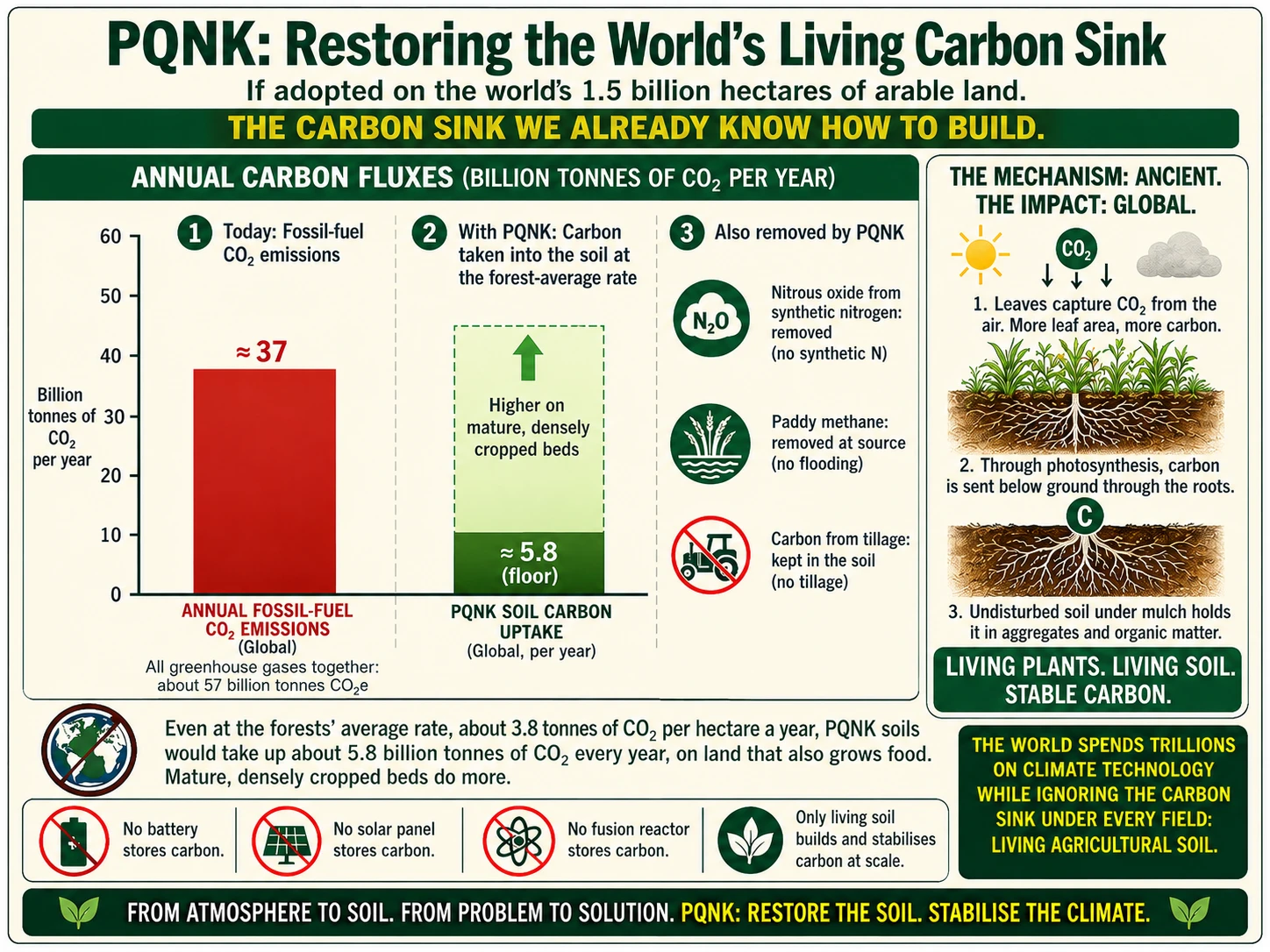
PQNK: Restoring the World’s Living Carbon Sink, about 5.8 billion tonnes of CO₂ a year at the standing-forest rate, more on mature beds, plus the emissions it stops
“The world is spending trillions on solar panels and wind turbines while the most effective carbon sequestration technology in the history of the planet sits in the topsoil of every agricultural field waiting to be restored. We do not need new technology to fight climate change. We need to stop destroying the technology that has been managing it for four hundred million years.”
Asif Sharif, Lahore, 2024
Agriculture, forestry and other land use account for approximately 24 percent of global greenhouse gas emissions (IPCC), more than the transport sector, more than the buildings sector, more than industrial manufacturing excluding energy. It is the second-largest emitting sector after electricity generation and the one most directly amenable to rapid, cost-negative transformation through a change in management practice rather than through capital expenditure on new technology. This chapter makes the climate case for PQNK: not as an agricultural supplement to climate technology but as the most significant single climate intervention available at the scale and speed that the crisis requires.
AGRICULTURE’S CLIMATE CONTRIBUTION: THREE CHANNELS
Agricultural greenhouse gas emissions enter the atmosphere through three primary channels, each of which PQNK addresses directly.
Channel One: Carbon dioxide from soil organic matter oxidation. Every tillage pass exposes accumulated soil organic matter to the oxygen that oxidises it, releasing as carbon dioxide the carbon that the previous season’s root exudates and decomposing mulch had deposited in the soil. Global agricultural soils are estimated to have lost 50 to 70 percent of their pre-agricultural carbon stocks through tillage. Each tilled field is a net carbon source. Each PQNK field, with its mulch-fed decomposer community building humus from each season’s residue, is a net carbon sink.
Channel Two: Nitrous oxide from synthetic nitrogen fertiliser. Synthetic nitrogen fertiliser is the most significant direct source of nitrous oxide (N₂O) emissions from agriculture. Nitrous oxide is about 300 times more potent as a greenhouse gas than carbon dioxide over a 100-year horizon. The microbial processes that convert synthetic nitrogen to nitrous oxide are active whenever fertiliser is applied. PQNK uses no synthetic nitrogen. Its nitrogen is supplied by free-living nitrogen-fixing bacteria in the biologically active soil and by the recycling of organic matter. Zero fertiliser nitrogen means near-zero nitrous oxide from fertiliser application.
Channel Three: Methane from paddy rice and livestock. Paddy rice flooding generates methane through the anaerobic decomposition of organic matter by methanogenic bacteria. PQNK rice on aerobic raised beds is never flooded, so it removes the persistent oxygen-free conditions responsible for most paddy methane (Chapter Thirty-Three). Livestock methane from enteric fermentation is partially addressed by the improved nutritional quality of PQNK fodder: mineral-complete fodder supports more efficient rumen fermentation, and so less methane for each litre of milk, than nutritionally deficient conventional fodder.
CO₂ from tillage elimination: soil carbon rebuilt every season instead of lost (vs net emission from tilled soils)
N₂O from fertiliser elimination: ~100% reduction (from zero synthetic nitrogen application)
Methane from paddy conversion: removed at source: no flooding, no oxygen-free soil (aerobic PQNK rice vs conventional flooding)
Net GHG position: Carbon sink rather than source (as the PQNK soil matures)
CARBON SEQUESTRATION: WHAT A PQNK SOIL STORES AND HOW
The carbon sequestration potential of PQNK agriculture operates through three interacting mechanisms that compound across seasons.
Humus formation from mulch decomposition. The mulch layer that the PQNK protocol maintains decomposes from below in aerobic conditions. In aerobic decomposition, a significant fraction of the organic carbon is stabilised into humus, long-lived organic compounds with residence times of decades to centuries, rather than being fully mineralised to CO₂. This humus accumulation is visible as the progressive darkening of PQNK soil across successive seasons. In established PQNK systems this humus builds season after season, wherever the soil stays covered and undisturbed.
Deep root carbon. Plant roots deposit carbon-rich exudates throughout the root zone as they grow. Root turnover, the death and decomposition of old roots as new roots grow, deposits carbon-rich organic matter at depth in the soil profile where it decomposes slowly and is partially stabilised into humus. PQNK crops with deep root systems extending through fractured hardpan deposit carbon at depths that conventional shallow-rooted crops never reach. This deep carbon is more stable than surface carbon and less vulnerable to disturbance or oxidation.
Mycorrhizal carbon. The mycorrhizal fungal network that is the biological engine of PQNK’s mineral delivery system is also one of the most significant carbon storage mechanisms in agricultural soils. Mycorrhizal hyphae contain glomalin, a glycoprotein that is among the most stable carbon-containing compounds in soil organic matter, with average residence times estimated at several decades. The greater the mycorrhizal biomass in a PQNK soil, the greater the glomalin carbon stock. In conventionally tilled soils, glomalin is depleted by tillage that severs and oxidises the hyphal network.
The soil food web is the largest carbon storage system on the planet’s surface. We have been mining it with a plough for ten thousand years. PQNK stops the mining and restarts the accumulation. The carbon that returns to the soil is the same carbon that the atmosphere needs to lose.
THE BROKEN ATMOSPHERIC WATER CYCLE AND HOW PQNK REPAIRS IT
One of the least discussed but most consequential contributions of ACI agriculture to the climate crisis is the disruption of the atmospheric water cycle through the elimination of transpiration from biologically active vegetation. This disruption has been described as a major climate mechanism by researchers including the Slovak hydrologist Michal Kravčík, whose New Water Paradigm centres on the small water cycle, and the Australian soil scientist Walter Jehne, whose work on the soil carbon sponge aligns closely with PQNK’s understanding of the same mechanisms.
The atmospheric water cycle works as follows in a naturally vegetated landscape. Plants transpire water vapour from their leaves into the atmosphere. This water vapour condenses as clouds over the landscape. The clouds release rain that falls on the landscape, infiltrates the biologically active soil, and is drawn up again by plant roots to be transpired. The cycle is self-sustaining: the landscape generates its own rainfall from the water it transpires. The Amazon is the most complete expression of this self-generated rainfall cycle: a significant proportion of Amazonian rainfall is recycled water that the forest itself transpired.
ACI agriculture disrupts this cycle in two ways. The bare soil that ACI management produces in the periods between crops eliminates transpiration from that surface: the water that would have been transpired as vapour into the atmosphere evaporates as sensible heat instead, heating the air rather than humidifying it and contributing to the dry, hot microclimate that characterises the world’s irrigated plains, Pakistan’s among them, in the hot, dry weeks before and after the rains. And the monoculture crop, when it is present, transpires at a single rate from a single canopy height rather than the layered, diverse transpiration rates of a biologically diverse plant community that sustain more complex and more stable atmospheric moisture dynamics.
PQNK’s permanent vegetation cover, the mulch layer, the inter-crops, the cover crops between main crop seasons, restores year-round transpiration from the agricultural surface. The diverse plant community of a PQNK farm transpires at multiple heights and rates, generating the atmospheric moisture patterns that support local rainfall recycling. At landscape scale, a region of PQNK farms keeps more moisture moving into the dry-season air than a region of bare or monoculture conventional farms because the PQNK landscape is always transpiring and the conventional landscape is often not.
PQNK IN THE GLOBAL CARBON BUDGET
The global significance of soil carbon sequestration through biological farming has been recognised in the scientific literature for two decades. The 4 per 1000 initiative, launched at the 2015 Paris Climate Conference, proposed that an annual increase of 0.4 percent in global soil carbon stocks would be sufficient to offset the total annual increase in atmospheric CO₂ from all human emissions. How much carbon a field takes up is not a fixed number. Uptake depends on the leaf surface that absorbs carbon dioxide, and that varies with the crop and its density: a wheat acre, a cotton acre and a sugarcane acre each fix a different amount, and a dense crop with a large leaf surface and a short growth cycle, such as wheat, can fix more carbon than an acre of forest. A seasonal crop carries only young, fresh leaves, and fresh leaves absorb carbon dioxide most actively. A forest’s uptake is variable too: it depends on how much new growth the forest is making, on its density and leaf surface, and on how much of its canopy receives direct sunlight, since much of a mature forest’s leaf area stands in shade. How much of it stays depends on the soil being left undisturbed and covered with organic mulch, and there the forest excels, because its soil is never disturbed and is always under a thick layer of leaf litter. A mature, well-kept PQNK bed brings the two together: a high rate of uptake and, like the forest floor, soil that is never disturbed and always covered. As a conservative reference, the world’s standing forests take up about 15.6 billion tonnes of CO₂ a year (Harris and others, Nature Climate Change, 2021; their net uptake is 7.6 billion tonnes once the emissions from deforestation and fire are subtracted) across about 4 billion hectares (FAO, Global Forest Resources Assessment 2020), an average of about 3.8 tonnes of CO₂, or about 1 tonne of carbon, per hectare per year. Even at that forest rate, a PQNK soil would exceed the 4 per 1000 target for the land it manages.
If PQNK were adopted across the world’s 1.5 billion hectares of arable agricultural land, and its soils took up carbon only at the standing-forest rate of about 1 tonne of carbon per hectare per year, the uptake alone would be about 1.5 billion tonnes of carbon, roughly 5.8 billion tonnes of CO₂ a year, about 10 percent of total annual global greenhouse gas emissions of roughly 57 billion tonnes of CO₂ equivalent. That is only the carbon taken in. PQNK also stops what conventional farming releases: the carbon that every tillage pass oxidises out of the soil and sends back to the atmosphere, the nitrous oxide from synthetic nitrogen, the methane from flooded paddies, and part of the methane from livestock, which ferment their feed more efficiently on mineral-complete PQNK fodder. The climate benefit of the transition is the uptake and the avoided release together, and both grow as the beds mature: wherever the crop is denser and its leaf surface larger, the rate climbs above the forest figure, and the total climbs with it.
These numbers require context. Universal PQNK adoption across all arable land is a theoretical maximum, not an implementation timeline. The practical sequestration potential is constrained by adoption rates, transition timelines, and the fact that sequestration rates decline as soils approach their carbon saturation point. But the order of magnitude is not in question: the restoration of soil biological function through PQNK management has the potential to sequester carbon at rates that are material to the global climate budget and that are achievable without any technology deployment beyond a subsoiler, a mulch layer, and a precision seeder.
PQNK carbon sequestration: at least the standing-forest average, about 3.8 t CO₂ (1 t C)/ha/year (rising with crop density, leaf area and bed maturity)
Nitrous oxide elimination: Near total (from zero synthetic nitrogen application)
Rice methane elimination: Removed at source (aerobic vs anaerobic management)
Global potential (floor): about 5.8 Gt CO₂/year (standing-forest rate across 1.5 bn ha), plus the tillage, fertiliser and methane emissions avoided
Global potential (mature PQNK beds): above the floor (rises with crop density, leaf area and the maturity of the beds)
WHY PQNK IS THE MOST COST-EFFECTIVE CLIMATE SOLUTION AVAILABLE
The climate economics of PQNK are the most favourable of any carbon sequestration or emissions reduction option available. PQNK does not require capital expenditure on new technology. The machinery required is simple, durable, and already available. The input costs that the conventional system incurs are eliminated rather than replaced. The farmer who adopts PQNK is paid by the improved economics of their farm while simultaneously providing the carbon sequestration service that the climate requires.
The cost-effectiveness comparison with other climate solutions is stark. Engineered carbon removal, such as capturing CO₂ directly from the air and storing it underground, currently costs hundreds of dollars for every tonne removed. PQNK sequestration occurs at zero or negative cost because the farmer’s input costs fall by more than the marginal cost of the machinery and transition. The carbon sequestration is a co-benefit of a management change that is economically superior for the farmer regardless of the climate benefit.
The comparison is worth extending explicitly to afforestation, because tree-planting is the climate intervention most familiar to policymakers and the public, and Pakistan has invested heavily in it through programmes such as the Billion Tree Tsunami. Trees are a genuine carbon sink, but a slow one: a young tree sequesters a fraction of a tonne of CO₂ per year during its first decade, and large-scale afforestation competes directly with food production for land, water, and, in many documented cases, achieves survival rates well short of the trees planted. Agricultural soil under biological management is a faster and larger carbon sink than newly planted forest, does not compete with food production for land, and restores the same atmospheric water cycle that afforestation is meant to protect, because the disruption was never a shortage of trees. It was the conversion of the world’s most extensive land-cover system, cultivated soil, into a bare, tilled surface between crops.
Reforestation and PQNK are not competing solutions, but where the next unit of climate investment is directed, restoring the water cycle through the 1.5 billion hectares already under cultivation reaches the same atmospheric mechanism faster, at lower cost, and without asking the land to produce a forest instead of a harvest. This argument is developed at length in the Knowledge Paper KP-172, “The Greatest Climate Solution Is Not More Trees: It Is Changing How We Farm.”
This cost structure makes PQNK the rarest of climate solutions: one that pays for itself. The farmer who transitions to PQNK earns more from their farm while the atmosphere benefits from their transition. No subsidy is required for the climate benefit to occur, though a subsidy for the transition machinery would dramatically accelerate the adoption timeline.
The climate solution that is cheaper than doing nothing, that pays the farmer who implements it, that requires no new technology, and that addresses food security, water security, and climate simultaneously is not a future possibility. It is PQNK. It exists. It is proven in the field. It is available. The only question is why it is not being implemented.
THE SMALL FARMER’S CLIMATE CONTRIBUTION
The climate argument for PQNK is typically framed at the national or global scale. But the climate contribution of PQNK is made, farm by farm, by individual farmers who are responding to the economic case for transition rather than to a climate policy incentive. The PQNK farmer who transitions for economic reasons is simultaneously making one of the most significant individual climate contributions available to any actor in any sector.
A single PQNK farm of 5 acres taking up carbon at only the standing-forest rate of about 1 tonne per hectare per year sequesters about 2 tonnes of carbon, roughly 7.5 tonnes of CO₂, a year, and more where the crop is dense. It also stops the carbon that tillage used to release from those 5 acres. It simultaneously eliminates the nitrous oxide from synthetic fertiliser that would have been applied to those 5 acres, with a warming impact hundreds of times greater than CO₂, and, if rice is grown, eliminates the methane from conventional paddy flooding. The total greenhouse gas benefit of a 5-acre PQNK farm is comparable to taking two cars off the road every year, achieved at zero cost and with positive income for the farmer.
PQNK AS A FOUNDATION FOR RECOVERY UNDER EXTREME DISRUPTION
Among the less-discussed but deeply consequential properties of the PQNK system is its capacity to function, and to rebuild, under conditions of large-scale environmental disruption. Scenarios such as prolonged reduction in solar radiation, atmospheric contamination, or radioactive fallout are rarely addressed in mainstream agricultural literature, yet they represent precisely the conditions under which conventional input-dependent farming would fail completely and irreversibly.
Conventional agriculture has no answer to such disruptions. It depends on an unbroken chain of external inputs, synthetic fertilisers, chemical protection, mechanised seed supply, all of which require functioning industrial infrastructure and predictable growing conditions. Remove those, and the system collapses with no internal capacity for recovery.
PQNK is structured differently. Its foundation is the living relationship between permanent root systems and soil microbial communities, a biological engine that does not depend on external supply, operates below the soil surface where much of its biological activity remains buffered from many surface disturbances, and continuously rebuilds the mineral and organic architecture of the soil from within.
This does not make PQNK immune to catastrophic disruption. But it does make it the only production system with a genuine biological basis for recovery. A PQNK farm, given time and the return of even partial growing conditions, can restore its own productivity from the soil life it has preserved. A conventional farm, under the same conditions, has nothing left to restore from.
This property was not designed into PQNK, it emerges naturally from a system built on ecological principles rather than industrial ones. Nature has always recovered from catastrophe through exactly this mechanism: the persistence of living soil, the resilience of root systems, and the regenerative capacity of microbial communities. PQNK, by aligning itself with these principles, inherits their resilience.
It is a quiet but important truth: the farming system best suited to feeding humanity in ordinary times is also the system best equipped to sustain it in extraordinary ones.
WHAT THIS CHAPTER HAS ESTABLISHED
PQNK is the most cost-effective climate solution available at the scale the crisis requires because it addresses all three agricultural emissions channels simultaneously, at zero or negative cost, while restoring the atmospheric water cycle that intensive agriculture has disrupted, and while sequestering carbon at rates that are material to the global budget.
The farmer who transitions to PQNK for economic reasons is the world’s most cost-effective climate actor, and they require no subsidy for the climate benefit, only the machinery subsidy that makes the transition economically immediate rather than merely superior over time.
The next chapter turns to food security, food sovereignty, and national economy, the political dimension of what PQNK’s transformation means for Pakistan as a nation-state and for the countries that face similar agricultural, water, and nutritional challenges.
Chapter Forty-Seven: Food Security, Food Sovereignty and Economy, What PQNK Means for Pakistan as a Nation-State