
KP-211 · Crop-Specific Guides
Why PQNK Sugarcane Does Not Need Earthing Up
Earthing up is mandatory in conventional sugarcane: the set is placed in a furrow 6 to 8 inches deep between ridges 6 to 8 inches high, above a compacted hardpan, roots stay shallow, and the profile has to be reversed with soil piled around the stool. PQNK removes the cause instead: the hardpan is broken once, cane grows on permanent beds, roots go deep, the crown stays near the aerated surface and the full sugar-rich base can be harvested.
Read or listen to the full paper ↓Abstract
Earthing up is mandatory in conventional sugarcane. The set is placed in a furrow 6 to 8 inches deep, between ridges 6 to 8 inches high, and as the crop develops soil is moved from the ridges toward the cane stool, often more than once, until the profile is reversed. PQNK asks why the operation became necessary. In the conventional system the furrow is first made to keep moisture around the planted set; later, soil from the adjoining ridge is moved back into that furrow, so the original furrow becomes the cane row and the ridge becomes the new furrow.
Where repeated tillage and traffic have left a compacted hardpan, roots are confined to the loosened upper layer and spread sideways, so the tall, heavy crop is poorly anchored. Earthing up adds support around the stool, but it treats the consequence and leaves the hardpan in place. Repeated earthing also buries the crown and buds, giving new tillers a longer path to the surface, and it leaves about 12 inches of mature basal cane below the cutting level, a well-observed condition and on the lower side in conventional cultivation.
PQNK changes the field before planting: the hardpan is broken once with a subsoiler set at about 22 inches, permanent raised beds are formed, traffic stays in the furrows and the bed is never rebuilt. Roots can then go deep, anchoring the plant from below, the crown stays near the mulched, aerated surface, and mature cane can be cut close to its base while younger shoots continue the plantation.
Sugarcane is not a high-water crop: on mature beds with 400 mm or more of annual rainfall, rain, dew, humidity and capillary rise carry the crop and furrow water is supplementary. Earthing up becomes unnecessary not because an operation is skipped but because the system is redesigned so that its original purpose is removed: the hardpan is broken and the sets are placed higher, on the permanent PQNK bed.
Earthing up is also said to control tillering. On PQNK beds it is not possible at all, because the cane grows in the centre of the permanent 42-inch bed. PQNK instead removes the dominant leader tiller within a few weeks of emergence to break apical dominance, releasing the secondary tillers to grow together, uniform in height and girth. The full sequence is one-time hardpan correction, centre planting, unrestricted rooting, no earthing up, early leader removal, uniform tiller development and selective or circular harvesting; how many tillers become millable canes depends on the variety’s genetic potential, the soil’s progress from the regenerative to the sustained state, and planting accuracy.
Full Paper
If you use “Listen”, the text of the page may be sent to your browser or operating system’s speech provider, such as Apple, Google or Microsoft, depending on the voice your device uses. Pedaver does not process, transmit or store any audio.
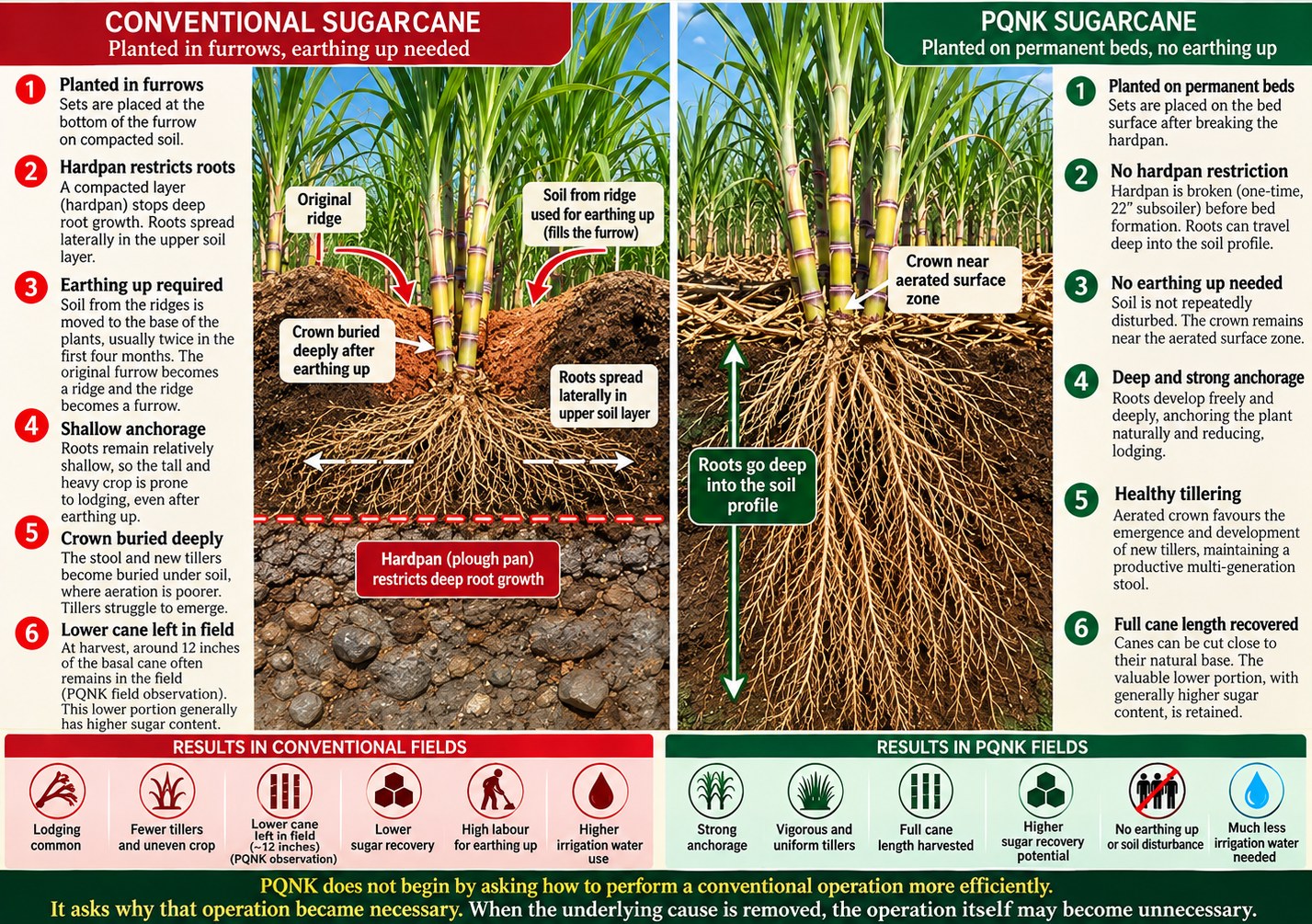
Conventional and PQNK sugarcane compared: furrow planting, hardpan, earthing up and crown burial on the left; one-time hardpan correction, permanent beds and deep rooting on the right.
1. Why the conventional system begins with furrows
After conventional land preparation, sugarcane sets are laid in furrows. At this stage the prepared soil may be dry. Dry soil draws moisture from the planted sets, causing them to lose moisture and dry. When the sets lose too much moisture during this critical establishment period, germination becomes poor and uneven.
The furrow therefore has an important original purpose: it allows irrigation water to be concentrated around the planted sets without wetting the entire prepared field. Farmers can irrigate the furrows frequently with a smaller quantity of water so that the soil immediately surrounding the sets remains wet during germination. In the conventional system, the furrow begins as a practical moisture-management solution for establishing cane in dry, freshly prepared soil.
This explains a sequence that is easily missed. The furrow is first made to maintain moisture around the planted set. Later, as the crop develops, soil from the adjoining ridge is moved back into that same furrow during earthing up. The original furrow is progressively filled and becomes the raised cane row, while the former ridge area becomes the new depression or furrow. PQNK changes this sequence from the beginning by establishing the cane on a permanent, moisture-managed biological bed rather than repeatedly creating and reversing ridges and furrows.
2. Why conventional sugarcane is earthed up
In a conventional ridge-and-furrow system, sugarcane sets are commonly established in the furrow. The cultivated upper layer may be loose, but repeated tillage and machinery traffic can create a compacted hardpan, or plough pan, beneath the normal working depth. In PQNK terminology, hardpan and plough pan are the same compacted layer.
When that compacted layer restricts downward penetration, roots exploit the easier pathways available in the cultivated upper soil and spread laterally. As the crop becomes taller and heavier, a relatively shallow root architecture provides less anchorage than a freely developed deep root system. Lodging can therefore remain a problem even when soil is subsequently placed around the stool.
In conventional cultivation earthing up is therefore not optional but mandatory. The set is placed in a furrow 6 to 8 inches deep, between ridges 6 to 8 inches high, and the profile has to be reversed as the crop grows. Earthing up responds to this field architecture. Soil is moved from the adjoining ridges toward the cane row, filling the original furrow and raising soil around the base of the plants. With repeated operations, the original furrow effectively becomes the raised cane row, while the former ridge area becomes the new irrigation or traffic depression. The operation can provide mechanical support, cover exposed roots and help reorganize irrigation pathways.
3. Earthing up treats the consequence, not the hardpan
Adding soil around the cane base can improve support, but it does not remove a compacted layer beneath the root system. The plant may therefore receive more soil around the crown while the principal restriction to deeper rooting remains below.
This distinction is central to the PQNK interpretation. Earthing up became normal because it compensates for conditions the conventional production system itself creates: a hardpan below the root zone, and seed sets placed low in a furrow. Those conditions are removed only when the hardpan is broken and the sets are placed higher, on the permanent PQNK bed. Once both are done before the crop is established, earthing up is no longer necessary.
4. PQNK changes the field before the cane is planted
PQNK does not begin with the conventional furrow and then try to improve the earthing-up operation. During conversion, the compacted hardpan is broken in a one-time deep operation, with the current PQNK standard setting the subsoiler at approximately 22 inches. Permanent raised beds are then formed, and machinery traffic is confined to the furrows.
Sugarcane sets are placed on the permanent biological bed. Once established, the production bed is not repeatedly tilled or rebuilt. Roots are therefore given the opportunity to move downward through the soil profile rather than being repeatedly confined to a shallow cultivated layer.
Germination depends on the moisture balance between the set and the soil. At planting, the soil should hold more moisture than the set itself; where it is drier, it draws juice out of the set through the exposed pores at its cut ends, and the bud dries before it can germinate. In practice that soil moisture is often hard to maintain. It is therefore worthwhile to coat both cut ends of each set, bud or node with pure cement. The coating closes the exposed pores at both ends and keeps the juice inside the set, so it germinates properly even when the soil is drier than the set.
Deep rooting has three simultaneous functions. It increases the volume of soil explored for moisture, expands access to nutrients and biological associations, and creates a larger anchoring system for the tall cane above ground. PQNK therefore seeks to let the plant support itself biologically from below rather than relying on repeated movement of soil around a shallow stool.
5. The crown remains close to the aerated biological surface
Repeated earthing up progressively raises soil around the stool (the clump of shoots that grows from one planting and regrows after each harvest). In heavily earthed-up cane, the basal crown and developing buds can become deeply buried. New tillers then have a longer path to the surface and may encounter a less aerated environment than buds emerging close to the biologically active surface.
PQNK avoids repeatedly burying the crown. The stool remains close to the mulched, aerated surface zone of the permanent bed. This supports the continuing emergence of tillers and is particularly important in the PQNK circular sugarcane concept, where different generations of cane can coexist within the same undisturbed stool.
This should not be interpreted as a claim that earthing up is the only factor controlling tillering. Variety, temperature, light, moisture, plant population, nutrition, disease, and harvest management also influence tiller initiation and survival, which is intrinsically provided by the PQNK system. The PQNK point is narrower: unnecessary deep burial of the crown is avoided while the root system is allowed to develop below.
6. Lodging: build anchorage rather than pile soil around the stem
Sugarcane lodging is influenced by several interacting factors, including stalk height and weight, wind, soil moisture, variety, root strength and root distribution. Earthing up can add mechanical support, but it cannot guarantee an upright crop.
PQNK approaches lodging through root architecture. Once the hardpan has been broken and the bed remains undisturbed, roots can occupy a deeper and larger soil volume. The objective is a plant that is anchored by its own root system. This does not mean that PQNK makes lodging physically impossible under severe wind, saturated soil or other extreme conditions. It means that the system removes a major avoidable restriction to deep anchorage.
7. Why the basal cane matters at harvest
Deep burial also changes the practical cutting point. Conventional earthing up leaves a substantial basal section of mature cane below the convenient harvest level: in PQNK field observations this is about 12 inches, a well-observed condition and on the lower side in conventional cultivation.
The basal mature internodes are valuable because the lower internodes are the oldest part of the stalk and have been storing sucrose the longest. Leaving usable basal cane in the field can therefore sacrifice both cane mass and recoverable sugar. PQNK keeps the natural cane base accessible so that a mature stalk can be cut close to its base while younger shoots and basal tillers are left standing.
This selective harvest is part of the circular production architecture. The objective is not to destroy the stool at each harvest but to remove the mature cane while protecting the root system, crown and younger generations that continue the plantation.
8. One avoided operation changes more than labour
Eliminating routine earthing up removes repeated soil movement and the labour, machinery energy and field disturbance associated with it. More importantly, it preserves the permanent bed as a biological production zone. Roots remain in place, residues can remain as mulch, traffic remains in the furrows, and the soil is not repeatedly reconstructed around the crop.
Water management also changes. PQNK does not require the large water volumes associated with repeatedly inundating a furrowed field. Sugarcane is not a high-water crop. On mature beds where annual rainfall is 400 mm or more, rain, dew, humidity and capillary rise carry the crop; furrow water is a supplementary option, given only when the soil-ball test shows a need, slowly and never higher than half the furrow depth (no more than a 4-inch head), so that moisture moves laterally into the bed while preserving aeration.
9. From corrective agriculture to biological architecture
Earthing up is a useful example of the difference between conventional process improvement and PQNK system redesign. Conventional agronomy can become highly skilled at performing a recurring operation: when to earth up, how much soil to move, which implement to use and how to irrigate afterwards. PQNK moves one step earlier in the causal chain and asks what field condition created the need for that operation.
In sugarcane, the answer includes the relationship among furrow planting, compacted subsurface soil, shallow root distribution, crop anchorage, crown burial and harvest geometry. PQNK therefore redesigns the production environment before the crop is established: break the hardpan once, form permanent beds, keep traffic in the furrows, avoid subsequent tillage, maintain mulch, manage moisture without inundation and allow the root system to occupy the soil profile.
The resulting objective is not simply 'sugarcane without earthing up.' It is a different biological architecture: deeper anchorage, an aerated crown, continuing tiller emergence, retained roots, selective mature-cane harvest and a permanent stool capable of supporting successive generations. Earthing up becomes unnecessary not because an operation has been omitted, but because the system has been redesigned so that the operation’s original purpose is removed.
10. A field question: does earthing up control tillering?
PQNK practitioners growing sugarcane on permanent beds asked a question that conventional advisers often raise: is earthing up needed to control the number of tillers? The conventional view is that excess tillers stay thin, never reach millable size and waste purchased fertiliser, so the final population should be held to about 40,000 to 45,000 canes per acre, partly through earthing up. The same practitioners counted 12 to 20 tillers per stool at about 70 days on their PQNK plot, against 4 to 5 on a conventional plot of the same age, and more than 40 tillers on one semi-PQNK stool the previous season.
In PQNK, conventional earthing up is not possible in the first place. The cane is planted in the centre of the permanent 42-inch bed, with the irrigation furrows on either side. There is no ridge to pull soil from, and moving soil onto the cane would destroy the protected bed. Anchorage has to come from the roots below, not from soil piled around the stem.
Nor does PQNK bury the stool to suppress tillers. Tillering is managed biologically, by removing the leader tiller early to break apical dominance. The leader is not allowed to grow to maturity: within a few weeks of emergence, once several secondary tillers have developed enough leaf area for photosynthesis, the dominant leader tiller is removed. While the leader remains, apical dominance suppresses the growth of the secondary tillers; removed at this stage, that dominance is broken and the secondary tillers are released. PQNK fields have repeatedly shown the response: instead of one dominant cane with weaker, uneven followers, the released tillers develop together and become much more uniform in height and girth. The objective is not simply many tillers but a uniform population of millable canes. This early leader removal is a different operation from the later selective harvesting of mature canes in circular production.
A high tiller count is therefore not automatically “excess tillering”. Conventional agronomy treats 12 to 20 tillers at 70 days, or 40 and more on one stool, mainly as competition to be suppressed, because its population recommendations were developed above a hardpan, around a buried crown and in a restricted rooting volume. PQNK creates different conditions: a broken hardpan, an aerated crown and root zone, unrestricted rooting volume and apical dominance managed early. PQNK does not borrow the conventional population target. Where circular harvesting is not possible and the whole crop is cut at once, the population is shaped through planting density and early leader removal. PQNK rests on natural principles: how many tillers become millable canes depends on the variety’s genetic potential, on how far the soil has progressed from the regenerative to the sustained state, and on planting accuracy.
PQNK does not control tiller population by burying the stool. It manages the plant biologically: it provides unrestricted roots and an aerated crown, then breaks apical dominance at the appropriate early stage so that the secondary tillers can develop together. The PQNK sugarcane sequence is therefore: one-time hardpan correction, centre planting on the permanent 42-inch bed, unrestricted rooting, no earthing up, early leader removal to manage apical dominance, uniform tiller development, and selective or circular harvesting where practicable.
The Broader PQNK Principle: PQNK does not begin by asking how to perform a conventional operation more efficiently. It asks why that operation became necessary. When the underlying cause is removed, the operation itself becomes unnecessary.
Related PQNK Sources
1. PQNK Book, Chapter 37: Sugarcane, The Bamboo Principle. https://pedaver.com/books/natural-ecosystem-science/sugarcane/
2. PQNK Book, Chapter 25: Hardpan, and Chapter 23: The Eight-Step Transition Protocol (one-time hardpan correction, permanent raised beds, no subsequent soil disturbance, permanent organic cover, Soil Moisture Management). https://pedaver.com/books/natural-ecosystem-science/
3. Pedaver Knowledge Papers KP-027 Sugarcane: The Bamboo Principle and KP-028 Sugarcane Cultivation on PQNK. https://pedaver.com/papers/
About This Paper
- Crop
- Sugarcane
- Problem
- Hardpan · Weak / Shallow Root Establishment · Soil Compaction (General) · High Input / Production Cost · Labor Scarcity / Cost
- Science
- Soil · Plants · Production Architecture
- Evidence
- Field Observation
- Authority
- Current / Approved PQNK Knowledge
Related PQNK Science
Key Takeaways
- Earthing up exists because conventional cane is planted in furrows above a hardpan that keeps roots shallow; it treats the consequence, not the cause.
- PQNK breaks the hardpan once (subsoiler at about 22 inches), forms permanent beds and never rebuilds them, so roots can anchor the cane from deep in the profile.
- Avoiding repeated earthing keeps the crown and buds near the aerated surface, supporting continuing tiller emergence.
- Conventional earthing up leaves about 12 inches of mature, sugar-rich basal cane below the cutting level, a well-observed condition and on the lower side; PQNK keeps the base accessible.
- Lodging is addressed through deeper root anchorage rather than soil piled around the stem, without claiming lodging becomes impossible.
- Sugarcane is not a high-water crop: on mature beds at 400 mm or more of rainfall, furrow water is supplementary and given only when the soil-ball test shows a need.
- PQNK does not control tiller population by burying the stool: it removes the leader tiller early to break apical dominance, so the secondary tillers grow together; millable-cane numbers depend on variety, soil maturity and planting accuracy.
- Where soil moisture cannot be kept above the set’s own, coat both cut ends of each set, bud or node with pure cement: it closes the exposed pores and keeps the juice inside for proper germination.
Related Crops
Related Knowledge
same problem
Deep Subsoil Remediation & Activation: Strategic Pathways for Compacted Soils
This paper lays out PQNK's two-track response to hardpan: a preferred one-time mechanical subsoiling where machinery is available, and a patient, plant-and-fungi-driven biological pathway for farms where it isn't, with mycorrhizal fungi cast as the ecosystem's 'stone breaker.'
same problem
Production Architecture: Engineering the Farm So the Living System Never Has to Be Rebuilt
Explains the physical engineering behind the four PQNK principles: permanent raised beds and furrows that separate destructive tractor traffic and irrigation from a protected biological zone, so a field accumulates biological function crop after crop instead of being torn down and rebuilt every season.
same problem
When 13 Inches of Rain Falls in Eight Hours
After 13 inches of rain in eight hours, the PQNK orchard beds of Jaskaran Singh in Fazilka district, Indian Punjab, had taken the water into the soil and could be walked on in slippers, while neighbouring conventional orchards and fields stood under water, and so did a strip of his own orchard where the hardpan had not been broken. The paper explains why hardpan is a water barrier as well as a root barrier, and why the soil is the first reservoir.
same problem
The Farm You Only Have to Build Once: How PQNK Converts a Conventional Field into a Permanent, No-Till System
Most fields across Pakistan and northern India's irrigated plains are still laid out for nineteenth-century bullock-and-plough flood irrigation. This paper walks through the one-time engineering project, topography survey, field redesign, hardpan fracture, laser levelling, and permanent bed shaping, that converts such a field into a permanent PQNK system, citing published water-savings and yield data specific to Pakistani Punjab.