

KP-154 · Plant Physiology & Production Systems
Two Pathways to "Pest Resistance": Genetic Selection, Sub-Lethal Dosing, and the Human Parallel
Answers a farmer's question about why pests develop resistance to sprays while humans grow more susceptible to residues, identifying a second, dosage-driven resistance pathway alongside classic genetic selection, and drawing a direct parallel to chronic low-dose human toxin exposure.
Read or listen to the full paper ↓Farmer Question
“Why do pests develop resistance to sprays over time, while humans grow more susceptible to the same chemical residues?”
— Asked in a PQNK WhatsApp learning group — a second, deeper treatment of the same question answered in “The Paradox of Resistance”. Preserved here as Pedaver’s own account of the question, not a verbatim quotation.
Pedaver’s Answer
Abstract
Responding to a farmer's question about pest immunity and human susceptibility to toxic residues, this paper identifies two distinct mechanisms behind pesticide resistance. The first is classic genetic selection: a rare, pre-existing gene for detoxification or a modified target site lets a small fraction of a pest population survive a spray, and those survivors become the next generation's parents.
The second, and the paper's central addition, is a dosage and exposure factor: a significant share of any pest population survives not from special genetics but because it never receives a lethal dose, due to physical hiding, incomplete spray coverage, chemical degradation from sunlight or rain, or simple behavioral avoidance. Critically, the paper argues that a sub-lethal dose is not a neutral non-event: it actively trains and upregulates an insect's own detoxification pathways, functioning like repeated stress conditioning that raises baseline biochemical resilience across generations.
The paper describes the combination of both pathways as a 'synergy': genetic survivors from direct hits and dosage/tolerance survivors from marginal exposure together form a far larger breeding pool than genetic mutation alone would produce, which it argues dramatically accelerates the population-level evolution of resistance. It further notes that spraying disproportionately harms natural predators, who are typically more chemically susceptible and slower to recolonize than the pests themselves, compounding the resistance problem by removing the system's own check.
Drawing the explicit human parallel the farmer asked about, the paper argues that humans occupy an analogous position at the end of the same poisoned chain: chronic low-dose exposure to multiple residues does not confer immunity but instead forces the body into a state of constant, low-grade inflammatory defense that drains vitality and contributes to disease over time, framed as population-level resistance in pests versus individual-level degeneration in humans.
Its conclusion frames PQNK's escape from this dynamic as systemic rather than tactical: building soil microbial life, plant nutritive density, and biodiversity removes the conditions (uniform chemical exposure, weakened natural predators, toxin-laden food webs) that force the arms race described, rather than attempting to out-engineer resistance with a better spray.
Full Paper
If you use “Listen”, the text of the page may be sent to your browser or operating system’s speech provider, such as Apple, Google or Microsoft, depending on the voice your device uses. Pedaver does not process, transmit or store any audio.
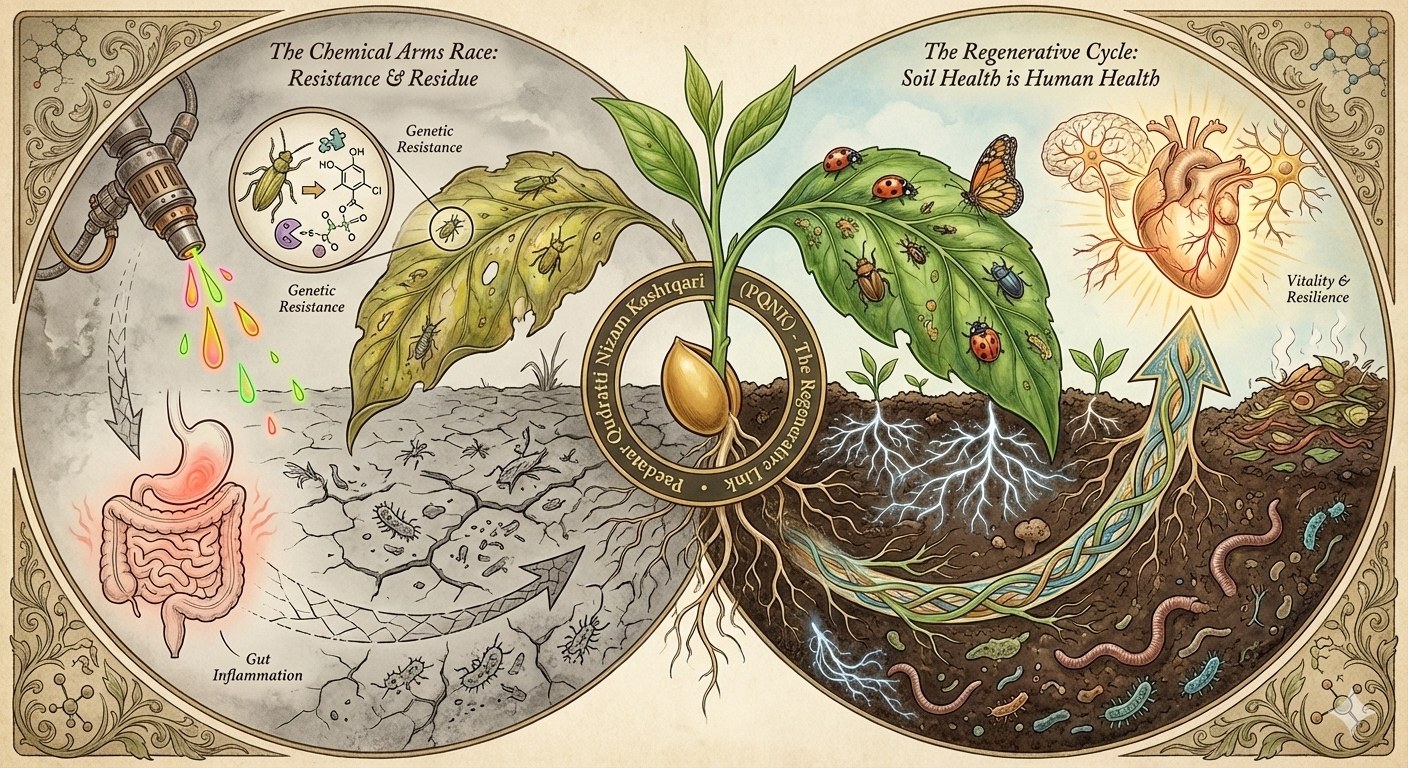
Question raised by a practicing PQNK farmer:
Sometimes I wonder small creatures like pests develop immunity against lethal sprays, meant to kill them. Why are we, humans so susceptible to toxic residues in the food that diseases are constantly on rise? Or is the mechanism at work but falls short? (Of course I don't mean to suggest any spraying.) Just a curiosity. DrSaab, your valuable guidance please. Deep regards Vasudha
PQNK Answer:
1. Genetic Selection (The "Random Genetic Luck")
Few individuals possess a rare gene (e.g., for a detoxifying enzyme or a modified target site) that makes them inherently less susceptible. The spray acts as a brutal filter, killing all others. These survivors become the parents of the next, more resistant generation.
2. The Dosage & Exposure Factor (Your Key Point)
This is where application reality meets biology. A significant portion of a pest population survives not due to special genes, but simply because they do not receive a lethal dose. In PQNK, we understand that uniformity is an industrial illusion; nature is patchy.
• Why don't they get a lethal dose?
• Physical Hiding: Insects are on undersides of leaves, deep in crevices, or in the soil at the time of spraying.
• Incomplete Coverage: No spray application achieves 100% coverage on every square millimeter of a crop.
• Degradation: The chemical may break down (by sunlight, rain) before reaching all pests.
• Behavioral Avoidance: Some insects may temporarily move away from the sprayed area.
• How does this lead to resistance?
• The Sub-Lethal Dose as a Training Ground: When an insect receives a sub-lethal dose, it is not a neutral event. That low-level exposure activates and upregulates its own detoxification pathways. It's like a constant, stressful exercise that makes its biochemical defense systems more efficient over its lifetime.
• Selection for "Tolerance": Individuals that can better tolerate these sub-lethal doses (through a mix of behavior, physiology, and mild genetic advantages) are the ones that survive and reproduce. Their offspring may start with a slightly higher baseline tolerance.
• The Synergy: Over repeated spray cycles, the combination is devastating: first, the genetic freaks survive the direct hits; second, the dosage-avoiders and tolerant individuals survive the marginal exposure. Together, they form a much larger "survivor" breeding pool than if only the rare genetic mutants survived. This dramatically accelerates the evolution of resistance in the population.
The PQNK Insight: The System's Response to Poison
PQNK views this not as a "pest problem" but as a system imbalance. The spray is a blunt, violent intervention that:
1. Disrupts the Predator-Prey Balance: It kills the natural enemies (beneficial insects, spiders, birds) more effectively and lastingly than the pests, as predators are often more susceptible and slower to recolonize.
2. Creates the Perfect Storm for Resistance: By ensuring only the most resistant/ tolerant pests breed, and by wiping out their natural controls, it guarantees a stronger, more resilient pest outbreak in the future.
3. Mirrors the Human Condition: This is precisely analogous to the human condition you asked about. We, too, receive chronic sub-lethal doses from residues. While it doesn't make us "immune," it forces our bodies into a state of constant, low-grade inflammatory defense, draining our vitality and leading to system breakdown (disease) over time. The pest develops population-level resistance; we suffer individual-level degeneration.
Conclusion: The PQNK Path is One of Nurture, Not Warfare
Therefore, the answer to your question, through the PQNK lens, becomes even clearer:
Pests develop "resistance" through a double mechanism of genetic selection and selection for tolerance to sub-lethal doses, both driven by the repeated, crude application of a toxin. Humans become susceptible because we are at the end of this poisoned chain, consuming low doses of multiple toxins that undermine our complex biology, while being deprived of the true nourishment that comes from a vibrant, toxin-free soil-food web.
PQNK escapes this entire trap by building systemic health—focusing on soil microbial life, plant nutritive density, and biodiversity. This creates a self-regulating system where pests are managed by natural forces and plants are robust, eliminating the very conditions that force the desperate, toxic arms race you so astutely observed.
Your addition was not just correct; it was essential to a complete understanding.
With deep respect for your insightful observation,
Footnote: Any Production Process That Inundates Soil With Water, Disturbs Soil Through Tillage, Or Leaves Soil Bare Without Organic Mulch Cover Does Not Qualify As Natural Ecosystem Science For Production Agriculture.
PQNK, to be pronounced as 'picnic', which stands for Paedar Qudratti Nizam Kashatqari, and means: the regenerative & sustainable Pristine Organic Farming System.
About This Paper
- Problem
- Pesticide Resistance · Beneficial Insect / Predator Decline · Contamination / Residue / Food Safety Risk
- Science
- Crop Protection · Food Quality
- Evidence
- Scientific Mechanism
- Authority
- Current / Approved PQNK Knowledge
Related PQNK Science
Key Takeaways
- Two distinct resistance pathways operate together: classic genetic selection (rare pre-existing resistance genes) and a dosage/exposure factor, where sub-lethal survivors actively upregulate their own detoxification systems.
- Sub-lethal spray exposure functions as a biological 'training ground,' raising an insect population's baseline tolerance across generations, not just selecting for pre-existing genetic outliers.
- The combination of genetic and dosage-driven survivors creates a much larger breeding pool than genetic mutation alone, accelerating population-level resistance evolution.
- Spraying disproportionately kills natural predators, who are typically more susceptible and slower to recolonize than pests, removing the system's own check and compounding the resistance problem.
- Draws a direct parallel to human health: chronic low-dose residue exposure does not confer immunity but drives constant low-grade inflammatory defense, framed as individual-level degeneration versus the pest population's collective resistance.
Related Knowledge
same problem
The Paradox of Resistance: Why Pests Adapt While Humans Degrade – A PQNK Scientific Perspective
A farmer asked why pests evolve immunity to pesticides while human diseases from the same chemicals keep rising. This paper explains both outcomes through the same mechanism operating at different biological scales, rapid population-level genetic selection in short-lived pests versus slow, cumulative, individual-level degeneration in humans, and argues PQNK escapes the trap entirely by removing the toxic pressure driving both.
same problem
GMO Maize and the Question Pakistan Has Not Yet Asked: Before Engineering the Plant, Should We Restore the Biological System That Protects It?
Pakistan is weighing whether to commercialize GM maize while its domestic hybrid-seed industry warns that pollen-mediated gene flow could compromise non-GM seed stocks. This paper argues the debate is incomplete: before comparing GM maize against non-GM maize, Pakistan should test both against the same hybrid grown under a fully restored PQNK biological production system, since Bt itself began as a naturally occurring soil bacterium and no genetic trait can substitute for repairing the degraded ecosystem in which the plant must function.
same problem
White Grub: Friend, Foe, or Part of the Living Soil?
A farmer noticed that soil with white grubs looked more porous and full of small dark aggregates. This paper explains why finding an insect is not the same as having a pest problem, how white grubs take part in the soil food web, and the PQNK field protocol: observe first, compare roots, and intervene only when measurable damage shows the biological balance is failing.
same problem
Why the World Needs PQNK
A case for large-scale PQNK adoption addressed to five constituencies: farmers, governments, environmentalists, health professionals and poverty-alleviation institutions. Because agriculture sits where soil, water, biodiversity, food, farm economics and human health meet, restoring the farm as a living ecosystem benefits all of them at once.