

KP-210 · Soil Science & PQNK System
The Underground Network We Have Been Farming Against
New 3D synchrotron imaging (Braunmiller et al., New Phytologist 2026) shows mycorrhizal hyphae spanning air-filled pores, bridging soil particles and growing along roots in intact soil. This paper separates what the research shows from what it means for PQNK: soil architecture is part of the root-fungal partnership, conventional farming dismantles it after every harvest, and a moist but aerated, undisturbed root zone protects it.
Read or listen to the full paper ↓Abstract
A 2026 New Phytologist methods paper by Braunmiller and colleagues, reported in Eos, used synchrotron-based X-ray micro-computed tomography to image arbuscular mycorrhizal fungi, roots, soil particles and pore space together in three dimensions in intact soil. Hyphae were seen spanning air-filled pores, forming branching networks, connecting soil particles and growing toward and along roots. The method detects hyphae best in air-filled pores, because water in fine pores obscures them.
The study did not test PQNK, rice, flooding or Alternate Wetting and Drying. Its significance for PQNK is that it makes visible the living architecture that the four governing rules are meant to protect: no inundation, no soil disturbance after conversion, permanent organic cover and encouraged biodiversity. Soil structure is not merely a container for roots; it is part of the operating environment of the root-fungal partnership.
Conventional production rebuilds the field after every harvest: residue is burnt or removed and the soil is ploughed, rotavated, levelled and re-ridged, tearing hyphal networks and collapsing the pores they occupy. The same holds for SRI as commonly practised, which still ploughs and usually puddles before each transplanting. PQNK, which began in 2009 as a mechanised SRI trial on raised beds, added permanence, so the network can accumulate from crop to crop.
PQNK Soil Moisture Management keeps the root zone moist but aerated, at roughly 30 percent water to 70 percent air in the pore space. Field photographs from PQNK beds show central rows standing taller and denser than the rows beside the furrows. For rice, flooding fills the pores and starves the network of air, AWD drowns it again at every flooding, and PQNK keeps the root zone moist and aerated throughout, so the network stays in place, crop after crop.
Full Paper
If you use “Listen”, the text of the page may be sent to your browser or operating system’s speech provider, such as Apple, Google or Microsoft, depending on the voice your device uses. Pedaver does not process, transmit or store any audio.
1. A hidden system becomes visible
For most of agricultural history, the most important biological infrastructure around a plant root has been largely invisible. Farmers could see the crop, roots could be excavated, and fungi could be stained or cultured, but the intact three-dimensional relationship among roots, fungal hyphae, soil particles and pore space was extraordinarily difficult to observe without destroying the very architecture being studied.
In 2026, Henri M. Braunmiller and colleagues reported a synchrotron-based X-ray micro-computed tomography workflow that can noninvasively image AMF structures in intact soil. Their method permits quantitative three-dimensional assessment of hyphal length, branching, volume and surface area, measurement of AMF-soil and AMF-root interfaces, and microscale analysis of pore-space occupancy. The authors emphasize that micro-CT can visualize AMF in air-filled soil pore space and can connect fungal architecture directly with surrounding soil structure.
Emily Gardner’s Eos article, forwarded to us by Norman Uphoff, translated this methodological advance into a striking visual story. The importance is not that science has only now discovered mycorrhiza. Mycorrhizal symbiosis has been studied for generations. The advance is that parts of the network can now be reconstructed in situ, in three dimensions, with roots, fungal structures and soil retained in their spatial relationship.
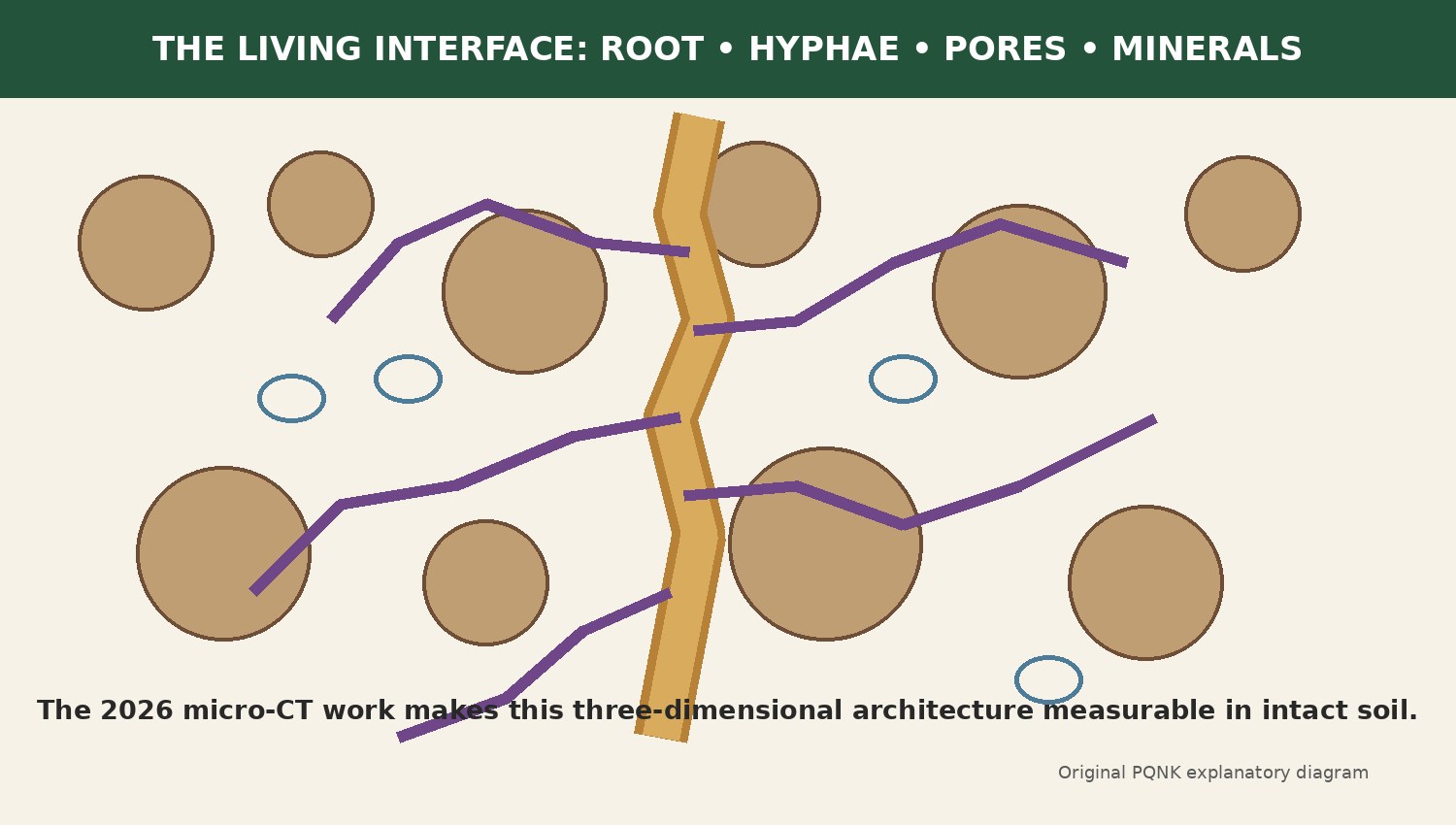
Figure 1. PQNK explanatory diagram of the root-hypha-pore-mineral interface. The diagram is interpretive, not a reproduction of the Braunmiller et al. images.
2. What Braunmiller and colleagues actually found
The study used two complementary systems and included tomato plants grown in coarse sand and silty loam with AMF. The researchers imaged extraradical fungal structures and, in rhizosphere samples, roots together with fungal structures. They demonstrated that hyphae could be detected spanning air-filled pores, forming branching networks and connecting soil particles. In rhizosphere samples, fungal networks were observed growing toward and along root surfaces and extending into surrounding soil.
The method is important because architecture matters. A fungal network is not simply a list of species. Its length, branching, connectivity, interfaces with roots and minerals, and occupation of pore space determine how the biological system is physically organized. The new workflow makes several of those features measurable without first dismantling the soil.
The authors also state an important limitation: water in fine pores can obscure fungal structures because water and fungal hyphae have similar X-ray attenuation. Their technique therefore detects hyphae most effectively in air-filled pores. This is a limitation of the imaging method, not proof that fungi cannot occur in wetter microsites.
3. Why this matters to PQNK
PQNK has consistently treated soil as a living production system rather than an inert material that must repeatedly be mechanically rebuilt and chemically supplied. Its four governing rules are designed to protect the physical and biological continuity of that system: no inundation, no soil disturbance after conversion, permanent organic cover, and encouragement of biodiversity.
The new imaging does not validate those four rules as a package, because that was not the experiment. What it does provide is direct visual and quantitative access to a part of the living architecture that those rules are intended to protect. Hyphae occupy pore space, bridge soil particles, attach to roots and extend the effective biological reach of the root system. Soil structure is therefore not merely a container for roots. It is part of the operating environment of the root-fungal partnership.
This distinction is central to PQNK. Conventional production agriculture often asks how much nutrient should be added to soil. PQNK first asks whether the biological pathways capable of finding, mobilizing, transporting and exchanging nutrients have been protected. The question is not fertilizer versus fungi as competing products. It is whether the production system allows the natural nutrient-acquisition architecture to remain functional.
4. Air is not empty space
In production agriculture, pore air is easily treated as unused space. Biologically, it is not. Aeration governs respiration, redox conditions and the physical environment through which roots and microorganisms operate. PQNK Soil Moisture Management therefore seeks a moist but aerated root zone rather than a saturated one, at roughly 30 percent water to 70 percent air in the pore space (the 30/70 rule). Water remains essential as the carrier of dissolved minerals and as the raw material for plant physiology, but it must coexist with air in the pore system.
The Braunmiller study is especially thought-provoking because the structures that could be resolved by micro-CT were those occupying air-filled pores. That does not establish a preferred agronomic water-air ratio. It does, however, make the physical reality of air-filled biological pathways unusually visible.
PQNK’s practical question is therefore not simply 'How much water did we apply?' It is 'What root-zone condition did that water create?' A field can receive water without the root zone remaining inundated. The objective is to replenish moisture while preserving the aerated biological habitat.
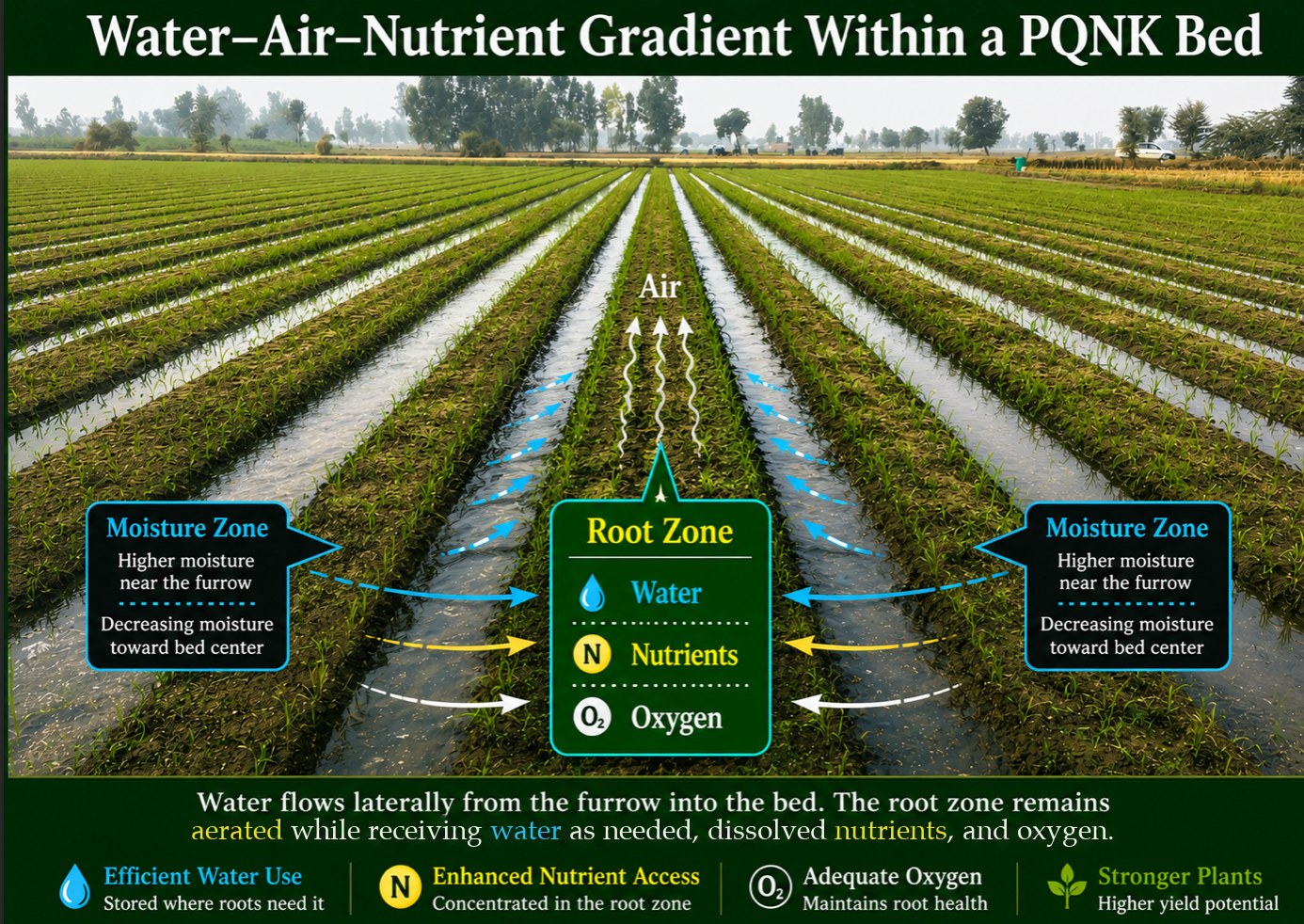
Figure 2. PQNK field-scale interpretation of water, air and nutrient movement within the permanent raised bed. Water moves laterally from the furrows while the protected production zone is managed to remain moist and aerated. The observed nutrient gradient toward the central rows is a PQNK field observation; it is not a finding of Braunmiller et al. (2026).
At field scale, water is supplied intermittently according to soil moisture need, never continuously and never above half the furrow depth. After furrow application, moisture moves laterally through the bed pore system. As it moves, water can carry dissolved nutrients while the management objective is to preserve air in the root zone. The center-row nutrient gradient shown in Figure 2, and visible in the field photographs in Figure 3, is a well-observed PQNK field condition: crop after crop, the central rows stand taller, denser and greener than the rows beside the furrows.
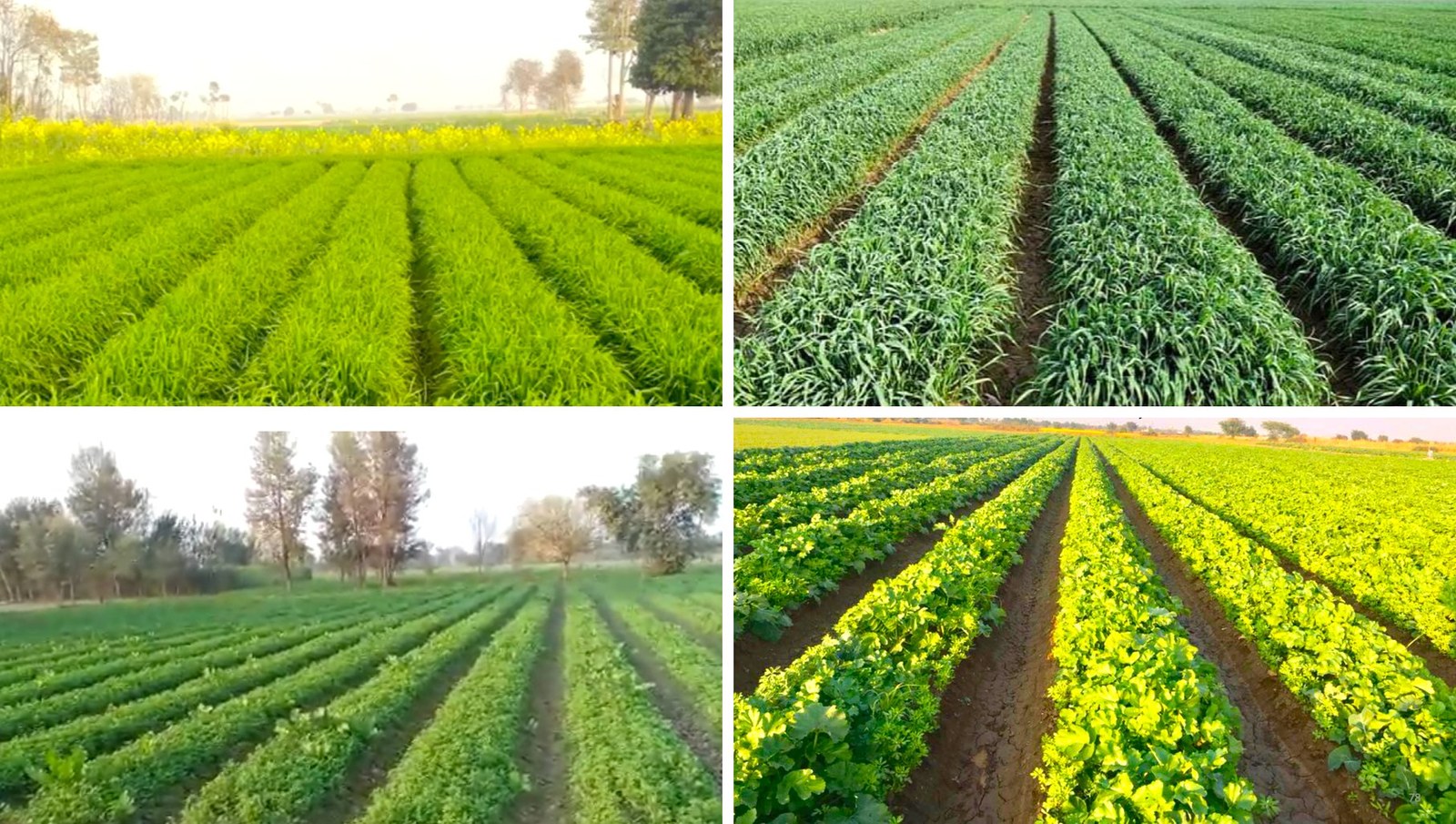
Figure 3. Field evidence from PQNK permanent raised beds (from Knowledge Paper KP-042): in wheat and other crops, the central rows of each bed stand taller, denser and greener than the rows beside the furrows, consistent with a better-aerated bed centre receiving a more concentrated nutrient solution. PQNK field observation.
5. Rice: flooding, AWD and the PQNK question
The email exchange that brought this article to our attention raised the question of rice. Jan Willem Ketelaar asked how rice roots behave under aerobic and anaerobic conditions, and under Alternate Wetting and Drying. The new imaging shows why the answer matters: the living architecture it reveals occupies the air-filled pores that flooding takes away.
PQNK adds a third treatment that should not be confused with AWD. Continuous flooding maintains standing water and creates a predominantly reduced bulk-soil environment. AWD deliberately alternates wetter and drier phases. PQNK seeks neither permanent flooding nor a designed cycle of flooding and drying. Its target is a continuously moist but aerated root zone, with irrigation governed by actual soil moisture and plant need.
The three regimes treat that architecture very differently. Continuous flooding fills the pores with water and starves the network of air. AWD lets air back in during each drying phase, only to drown it again at the next flooding. PQNK keeps the root zone moist and aerated throughout, so the root-fungal network is never drowned and never rebuilt: it stays in place, crop after crop.
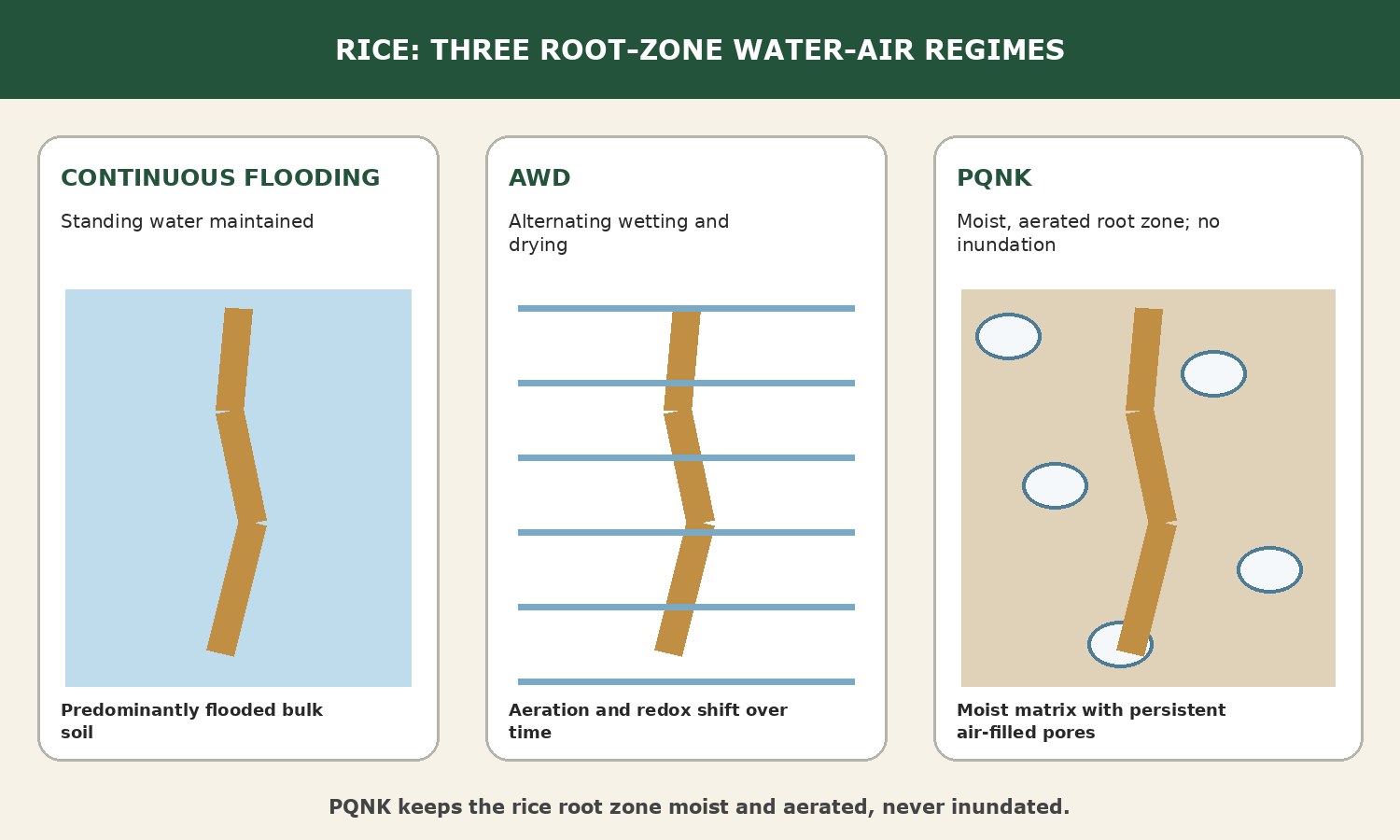
Figure 4. Three root-zone water-air regimes for rice: continuous flooding, alternate wetting and drying, and the PQNK moist, aerated root zone.
6. What PQNK has been teaching
PQNK did not invent mycorrhiza, photosynthesis, biological nitrogen fixation or natural nutrient cycling. These processes evolved in nature long before agriculture. Pedaver’s work has been to identify agricultural practices that conflict with the natural production ecosystem, remove those contradictions, and develop a practical field architecture in which natural processes can perform more of the work of production.
From that perspective, tillage is not objectionable merely because fuel is consumed. Repeated disturbance breaks continuity in the soil habitat and repeatedly reconstructs the physical environment in which roots, fungi and other organisms operate. Inundation is not objectionable merely because water is used. It changes the balance between water and air in the root-zone pore system. Bare soil is not objectionable merely because it looks exposed. It loses the thermal, moisture and biological buffering supplied by cover. Reduced biodiversity matters because the soil food web functions through relationships rather than isolated organisms.
Conventional production does not disturb the soil once; it rebuilds the field after every harvest. The residue is burnt or removed, the soil is ploughed, rotavated, levelled and re-ridged, and the next crop is sown into a freshly loosened, bare seedbed. Each of these passes tears the hyphal networks, collapses the pores they occupy, separates the fungi from the roots and mineral surfaces they had connected, and exposes the soil to heat and drying. The living architecture that the new images make visible is dismantled with every crop and has to begin again from fragments, often under a fresh dose of soluble fertiliser, which is known to reduce mycorrhizal colonisation. Agriculture has been farming against this underground network not by choice but by routine. PQNK reverses the sequence: the field is engineered once, and from then on the permanent beds, retained roots, surface residues and fungal networks are carried forward from crop to crop instead of being reconstructed after every harvest.
The same holds for the System of Rice Intensification (SRI) as it is commonly practised. SRI was a major step forward: young seedlings, wide spacing and intermittent rather than continuous flooding all give roots and soil life more room and more air. But the field is still ploughed, and usually puddled, before every transplanting, and the rotary weeder stirs the topsoil several times during the season, so the underground network is still dismantled and rebuilt with each crop. PQNK itself began in 2009 as a mechanised SRI trial on raised beds; what it added over the following years was permanence: beds that are never rebuilt, roots and residues that stay in place, and no inundation at any stage, so that the root-fungal architecture can accumulate from one crop to the next.
The new images are therefore valuable to PQNK because they help make visible what has often been described only conceptually: the crop is not operating through roots alone. It is operating through a root-associated biological and physical network embedded in the pore architecture of living soil.
7. What this research does not prove
• Braunmiller et al. did not study PQNK.
• They did not study rice.
• They did not compare flooded and non-flooded production.
• They did not compare AWD with a continuously moist, aerated root zone.
• Their ability to visualize hyphae in air-filled pores should not be interpreted as evidence that all mycorrhizal activity occurs only in dry or air-filled soil.
• The study is principally a methodological advance. It creates a new capacity to observe and quantify structures that can now be investigated under contrasting management systems.
8. What this means for rice
PQNK rice is grown without inundation. Water is given to the furrow only when the soil-ball test shows a need, never above a 4-inch (10 cm) head, so the root zone stays moist while its pores keep holding air. The root-fungal architecture that the new imaging reveals is left intact from season to season instead of being drowned with every irrigation.
Farmers already grow rice on PQNK beds without a flooded field. The new imaging makes visible what happens inside that living root zone when inundation is removed and air stays available: the network of roots and hyphae that feeds the crop remains in place.
9. The larger lesson
Industrial agriculture became extraordinarily skilled at managing what could be seen and measured above ground: seed, machinery, fertilizer, pesticide, irrigation and harvest. The biological infrastructure below ground remained comparatively opaque. That imbalance encouraged agriculture to treat soil primarily as a medium to be cultivated and supplied.
The black box is now opening. As imaging improves, the distinction between 'soil' and 'soil life' becomes increasingly artificial. Roots, fungal hyphae, microorganisms, mineral particles, organic residues, water and air form one operating environment. Management changes any one of these and therefore changes the conditions experienced by the others.
This is why PQNK’s four rules must be understood together. They are not four independent techniques. They are management boundaries intended to preserve the continuity of the natural production ecosystem. The 2026 imaging work does not prove the whole PQNK system, but it gives agriculture a new window into precisely the kind of underground architecture that PQNK has been teaching farmers to protect.
PQNK Principle: Do not merely feed the plant. Protect the living architecture through which nature feeds the plant.
Image and Reuse Note
The Eos article includes several striking research images credited to Henri Braunmiller and Jan Jansa. Because those article images should not be republished without confirming the applicable reuse permission, this paper does not reproduce them. Figures 1 and 4 are original explanatory diagrams prepared for this Knowledge Paper. Figure 2 is an existing Pedaver/PQNK field-scale infographic supplied by the author, and the field photographs in Figure 3 come from Pedaver Knowledge Paper KP-042. If reuse permission is confirmed for the original micro-CT images, they can be added as research evidence with full credit without changing the scientific distinction maintained in the text.
References
1. Braunmiller, H. M., Bitterlich, M., Koebernick, N., Jacob, E., Heck, A. S., Schnepf, A., Pausch, J., Suuronen, J.-P., Hesse, B., Delzon, S., Perrin, J., King, A., Jansa, J., & Ahmed, M. A. (2026). Opening the black box: in situ imaging of arbuscular mycorrhizal fungal structures in soil using synchrotron-based micro-CT. New Phytologist, 251, 3687–3702. DOI: 10.1111/nph.71379. Open Access.
2. Gardner, E. (2026, September 29). Fungi Are Holding the Food Web Together. New Research Images This Underground Network. Eos, 107. DOI: 10.1029/2026EO260307.
3. Pedaver. PQNK: The Natural Ecosystem Science of Production Agriculture. Current online chapters and Knowledge Papers on the living soil engine, Soil Moisture Management, natural plant nutrition, mycorrhiza and rice production. https://pedaver.com
4. Pedaver. Soil Water Dynamics, Microclimate Feedback, and Plant Vigor in Raised Bed Systems (Knowledge Paper KP-042). https://pedaver.com/papers/soil-water-dynamics-microclimate-feedback-and-plant-vigor/
Source Distinction
Research-derived statements in this paper are attributed to Braunmiller et al. (2026) and Gardner (2026). Statements describing PQNK principles and field architecture are Pedaver/PQNK interpretation and are not presented as findings of the Braunmiller study.
About This Paper
- Crop
- Rice · Wheat
- Problem
- Tillage Damage to Soil Biology / Structure · Weak Below-Ground Symbiosis (Mycorrhizae/Nitrogen-Fixers) · Low Root-Zone Oxygen / Poor Aeration · Waterlogging · Soil Biology / Microbiome Decline · Poor Soil Structure / Aggregation
- Science
- Soil · Plants · Water · Biodiversity
- Evidence
- External Scientific Evidence
- Authority
- Current / Approved PQNK Knowledge
Related PQNK Science
Key Takeaways
- Synchrotron micro-CT (Braunmiller et al., 2026) images mycorrhizal hyphae, roots, soil particles and pores together in intact soil for the first time.
- Hyphae are resolved in air-filled pores, bridging particles and growing along roots; this is a limit of the imaging method, not proof that fungi avoid wetter microsites.
- The study did not test PQNK, rice, flooding or AWD; it makes visible the architecture PQNK’s four rules protect.
- Conventional farming, and SRI as commonly practised, rebuild the field after every harvest and dismantle the underground network each crop.
- PQNK keeps the root zone moist but aerated at roughly 30 percent water to 70 percent air, with beds, roots and residues carried forward from crop to crop.
- For rice, PQNK keeps the root zone moist and aerated, never inundated: water only on the soil-ball test, never above a 4-inch (10 cm) head, so the root-fungal network is never drowned.
Related Knowledge
same problem
Chemical Fertiliser Dependency Through the PQNK Lens
An evidence-qualified review of the article “Chemical Fertilizer Industry”. It keeps the article's warning about soil degradation, nutrient pollution and biological decline, disciplines its headline numbers, and argues that fertiliser dependency is a symptom of a damaged production system (tillage, flooding, bare soil and simplified biology) that PQNK removes by restoring aerated, covered, living soil, reaching zero purchased fertiliser and pesticide at maturity.
same problem
Beyond the Nodule: How Underground Air Serves Every Crop in the PQNK System
A technical follow-up paper, prompted by a direct response from Cornell's Professor Norman Uphoff, showing that the water:air soil balance central to nitrogen fixation governs four further services, phosphorus and potassium solubilization, soil bioporosity, pH stability, and root aquaporin function, that benefit every crop, not only legumes.
same problem
Knowledge Paper: The Plant as CEO — A PQNK Perspective on Biological Agency in Rhizobial Partnerships
Reading a 2018 transcriptomic study that found rhizobia activate over 2,400 rice genes, this paper argues the standard framing has the causality backwards: the plant is not colonized, it is informed, and it makes the decision. It develops a full 'plant as CEO' recruitment-interview analogy for how legumes and rice actively select, test, and hire their bacterial partners.
same problem
Production Architecture: Engineering the Farm So the Living System Never Has to Be Rebuilt
Explains the physical engineering behind the four PQNK principles: permanent raised beds and furrows that separate destructive tractor traffic and irrigation from a protected biological zone, so a field accumulates biological function crop after crop instead of being torn down and rebuilt every season.