

Crop-Specific Guides
PQNK Factsheet: Production of HD Castor
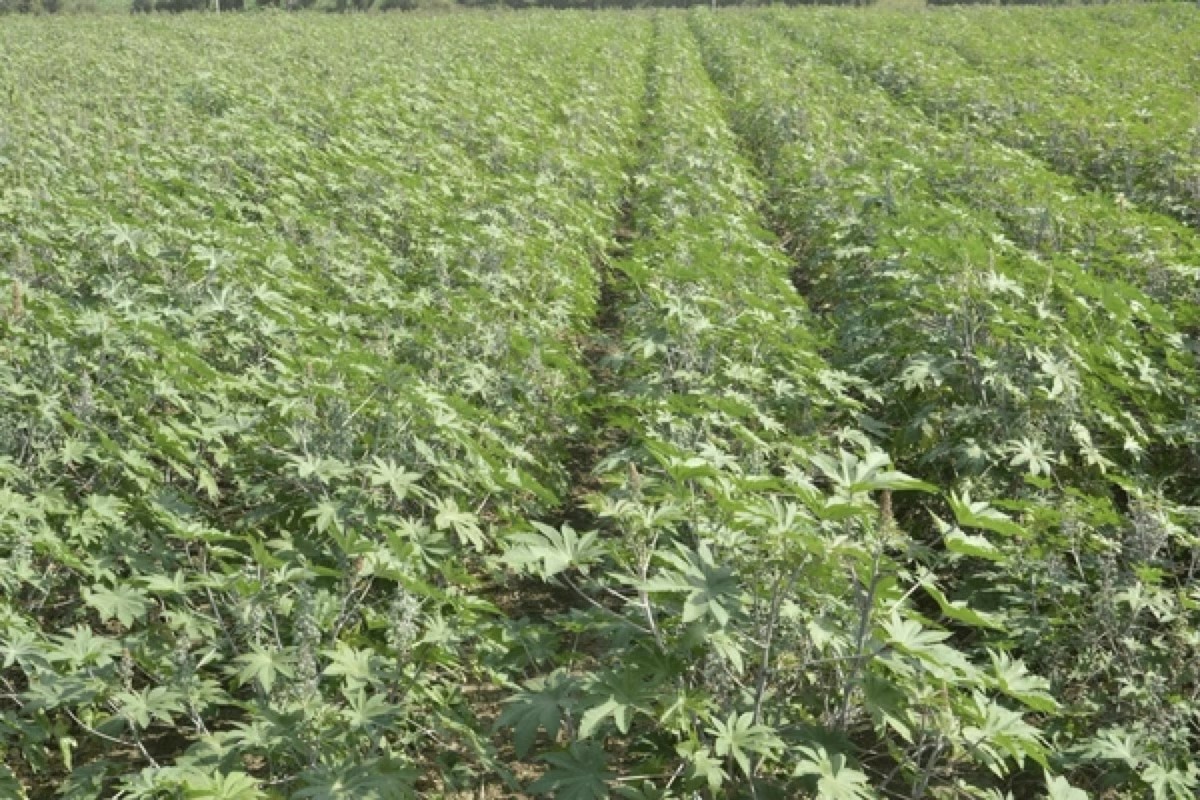
A field factsheet for High-Density (HD) Castor grown as a 3-5 year perennial under PQNK, covering the mandatory land-preparation sequence, planting density, and the pruning schedule that keeps the crop productive across multiple harvest years.
Abstract
HD Castor (Ricinus communis) is managed under PQNK as a short- to medium-term perennial shrub rather than an annual cash crop, with an economic productive life of 3 to 5 years from a single plantation. Fruiting begins roughly 4 to 5 months after planting, and the crop is harvested 2 to 3 times per year, yielding an estimated 6 to 8 total harvests from a 3-year stand and 10 to 12 harvests from a 5-year stand, with peak productivity falling in years 2 through 4.
Land preparation follows the standard PQNK mandatory sequence: breaking the subsurface hardpan to restore deep water, air, and root movement; correcting soil chemistry where pH exceeds 8 by leaching salts with deep irrigation and applying 8 kg of sulfuric acid per the PQNK protocol; building permanent raised beds with furrows for controlled tractor traffic; and establishing Jantar (Sesbania) as a biological subsoiler whose roots are left in place and above-ground biomass chopped and mulched rather than removed. HD Castor is then planted no-till, directly into that mulch layer.
Recommended row spacing is 76 cm (30 in), with plant spacing of 45 to 60 cm (1.5 to 2 ft), giving a target population of 9,000 to 12,000 plants per acre on a standard 198 ft by 220 ft acre. This density range is set to preserve deep, healthy root systems and balanced microbial nutrition rather than maximizing plant count, and the paper contrasts it with two higher-density reference configurations of roughly 11,600 and 8,700 plants per acre. Nutrition, weed suppression, and pest protection are all closed-loop: no external fertilizer, compost, or sprays, with nutrients released through microbial mineralization, decomposing Jantar roots and mulch, and continuous root exudates, and pest pressure kept low through BT bacteria and mulch-supported predator populations rather than chemical inputs.
Because HD Castor is grown as a multi-year perennial, pruning is treated as mandatory rather than optional. The factsheet lays out a three-stage schedule: formative pruning 35-45 days after emergence to remove the apical tip and establish a low, branched architecture; post-harvest pruning that cuts fruiting branches back 25-30% after the first major raceme harvest; and annual maintenance pruning in years 2 through 4 that holds plant height at 4-5 ft and retains 6-8 productive branches per plant. All pruned biomass is chopped and returned to the same bed as mulch, and at the end of the 3-5 year cycle the plants themselves are cut and mulched in place, with roots left in the soil to decompose before the bed moves into its next crop cycle.
Key Takeaways
- HD Castor is managed as a 3-5 year perennial under PQNK, producing 6-8 harvests from a 3-year stand or 10-12 harvests from a 5-year stand, at 2-3 pickings per year.
- Target planting density is 9,000-12,000 plants per acre (30 in row spacing x 1.5-2 ft plant spacing), lower than the 8,700-11,600 plants/acre used in conventional high-density reference layouts.
- Where soil pH exceeds 8, land prep calls for deep leaching irrigation plus 8 kg of sulfuric acid per the PQNK protocol to unlock minerals and correct alkalinity before planting.
- Pruning is mandatory, not optional: formative pruning at 35-45 days, post-harvest pruning removing 25-30% of fruiting-branch length, and annual maintenance pruning holding plants at 4-5 ft with 6-8 productive branches.
- Nutrition, pest control, and weed suppression are fully closed-loop: no external fertilizer, compost, sprays, pesticides, or fungicides at any stage.
- At the end of the 3-5 year cycle, plants are cut and mulched on the same bed with roots left to decompose, so the bed transitions directly into the next crop cycle with rising, not depleting, fertility.