

Soil Science & PQNK System
Agriculture in Sandy Soil: A PQNK Lecture Transcript
A transcribed lecture explaining why sandy soils fail to retain water and nutrients, and demonstrating, with live experiments, the PQNK clay-slurry treatment that seals the upper root zone of a raised bed so sandy soil can hold moisture and support crops without imported topsoil.
Abstract
The lecture opens by framing water strictly as a nutrient carrier, analogous to blood in the body: it dissolves the food already present in soil, carries the solution upward through fine root hairs by osmosis, and evaporates as pure water once it reaches the leaf, leaving nutrients behind in the plant. Good soil is defined by a target texture near 10 percent sand, 25 percent silt, and 25 percent clay with the balance organic matter, a mix in which pore spaces hold water long enough for roots to use it. In coarse sand, the same pore spaces are too large: water drains straight past the root zone before it can be absorbed, the central failure the lecture sets out to solve.
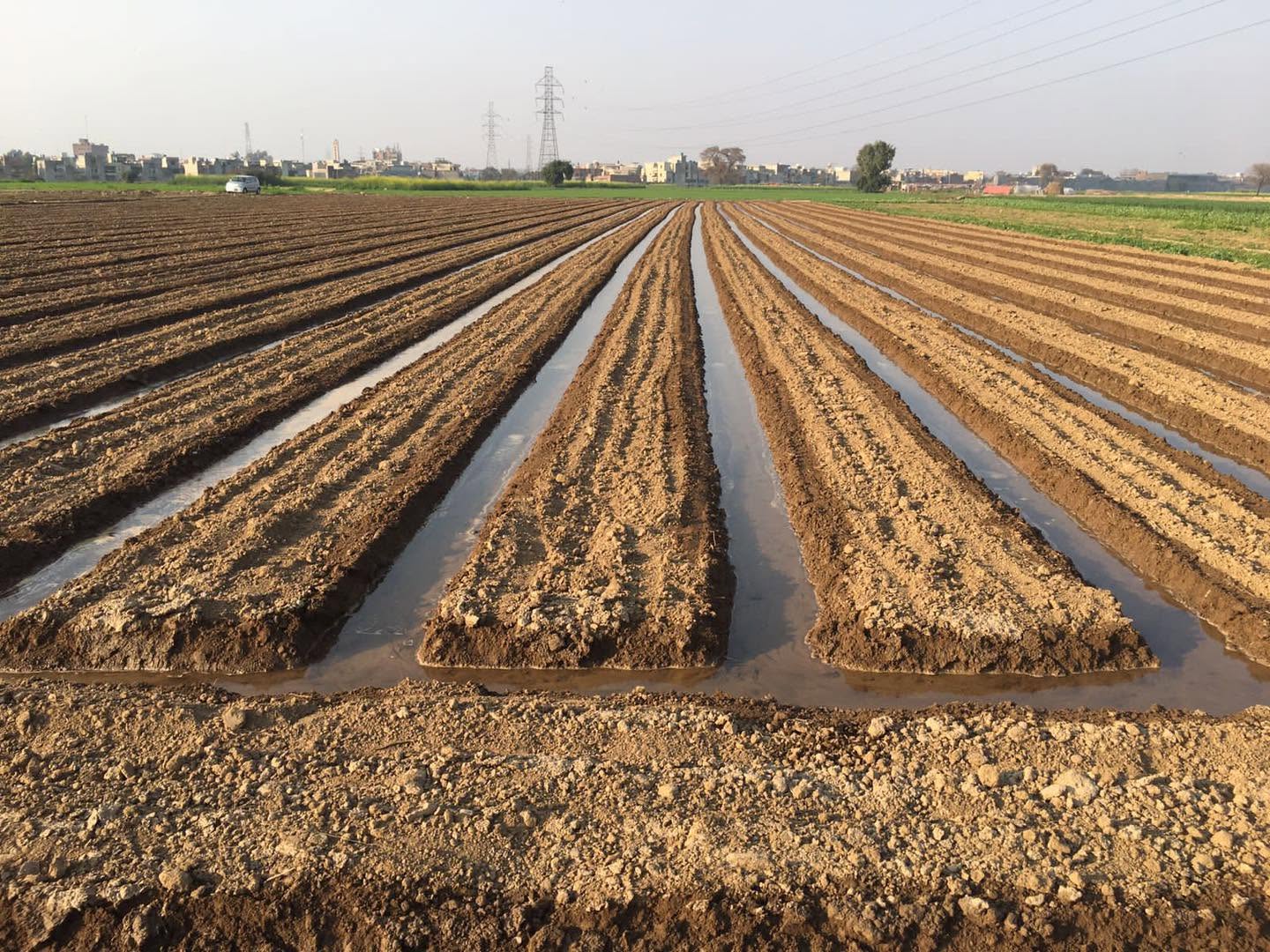
Rather than trucking in clay and silt to rebalance sandy soil field-wide, a cost the lecture works through in detail (calculating trolley-loads and haulage costs per acre and showing they are often prohibitive), the demonstrated PQNK method treats only the upper portion of the raised bed. A very thin clay-water slurry is poured over the top roughly one inch deep on the beds; the fine clay particles lodge between the coarse sand grains and seal the pores, so applied water can no longer drain straight through. Live experiments in the lecture show water sitting on treated sand for over six hours without draining, while untreated sand alongside absorbs and passes an equivalent volume within moments.
Practical calculations follow for laying out beds: at a 98-foot by 220-foot plot (one acre), roughly 41 beds of 98-inch width are formed, with about 72 percent of the area as bed top and 28 percent as furrow/traffic zone; treating roughly half the depth of each bed's topsoil with the clay slurry is presented as sufficient to change the field's water-holding behaviour throughout. The lecture also covers root-zone water storage using deep-rooted crops like radish, turnip, and Dosan (left in the ground, tops cut for mulch, roots never pulled) to bring subsoil water back toward the surface and to fix nitrogen without added urea.
The lecture closes on nutrition delivery once the water problem is solved: foliar application of dissolved fertilizer is presented as roughly ten times more effective than soil application on sandy ground, since soil-applied nutrients drain beyond root reach with the water; correct timing (early morning or evening, before or after peak heat) and fine nozzle mist are specified so the leaf can absorb the spray before it dries or drips off. It ends by reiterating that soil temperature above 60°C kills soil life entirely, making organic mulch cover, not fertilizer, the more fundamental fix for sandy-soil viability.
Key Takeaways
- Target soil texture is roughly 10 percent sand, 25 percent silt, 25 percent clay, and about 5 percent organic matter; coarse sand's oversized pore spaces let water and dissolved nutrients drain past the root zone before uptake.
- A thin clay-water slurry applied to roughly the top half-depth of a sandy raised bed seals pore spaces with fine clay particles, demonstrated in the lecture to hold water on the surface for over six hours versus immediate drainage in untreated sand.
- A one-acre plot (98 x 220 feet) is laid out as roughly 41 beds of 98-inch width, with about 72 percent of the area as bed top and 28 percent as furrow, treating only the bed tops rather than trucking in bulk clay for the whole field.
- Deep-rooted crops such as radish, turnip, and Dosan are left unharvested in the ground (tops cut, roots intact) to draw subsoil water upward and fix nitrogen without added urea.
- Foliar fertilizer application is described as roughly ten times more effective than soil application on sandy ground, since soil-applied nutrients drain beyond root reach along with the water.
- Soil temperatures above 60°C are stated to kill all soil life, making organic mulch cover the more fundamental requirement for sandy-soil viability, ahead of any fertilizer programme.