
Industrial Devastation To Natural Abundance
Policy and the Future · Chapter 64
Policy Recommendations
What Governments, Academia, Finance, and Extension Must Do
Release 1.0 · 2026-10-27
If you use “Listen”, the text of the page may be sent to your browser or operating system’s speech provider, such as Apple, Google or Microsoft, depending on the voice your device uses. Pedaver does not process, transmit or store any audio.
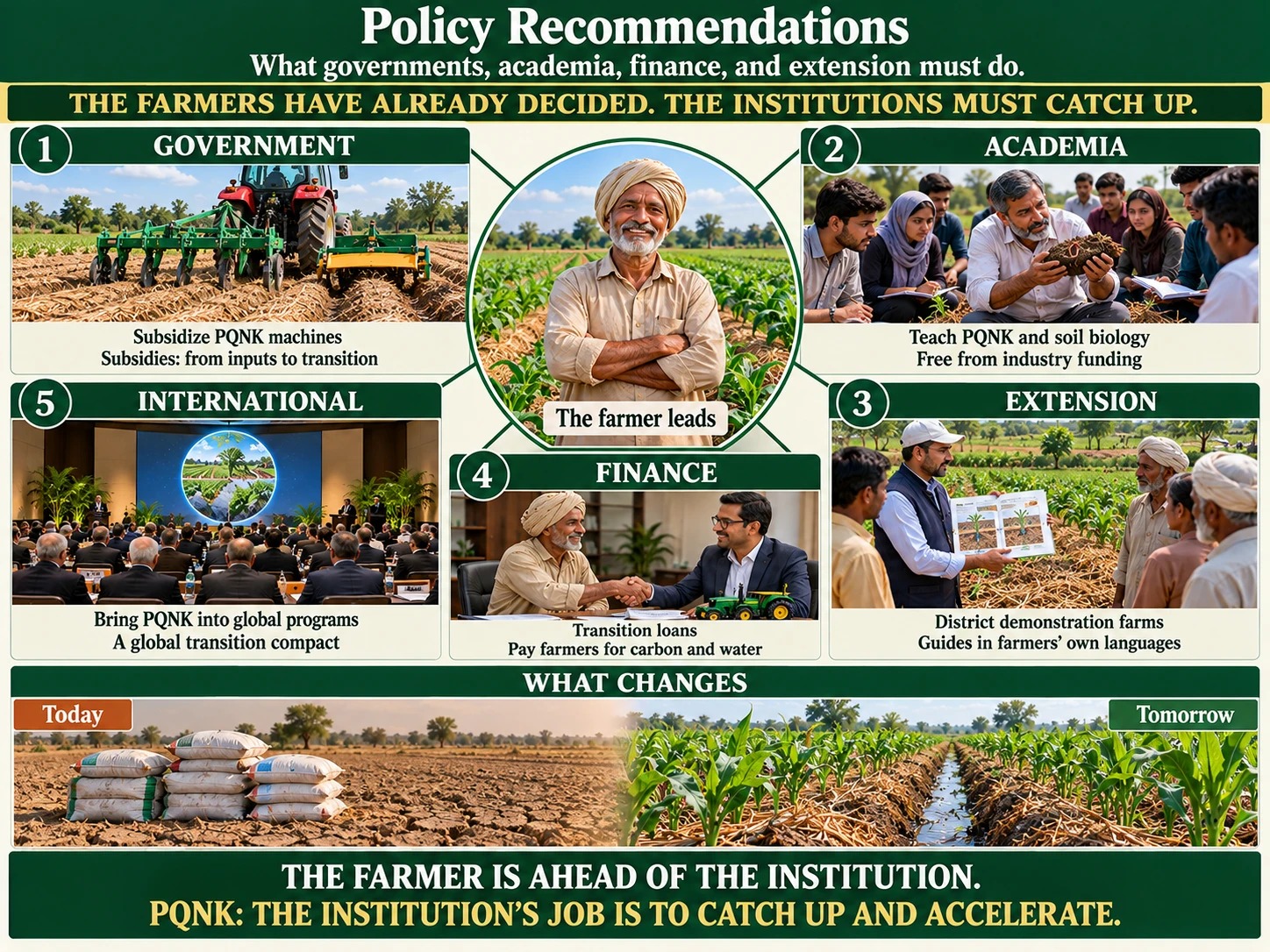
Policy Recommendations: what governments, academia, extension, finance, and international institutions must do.
“The evidence is in. The protocol is documented. The results are verified. The economic case is overwhelming. The climate case is urgent. The health case is undeniable. The only thing that stands between where we are and what is possible is institutional inertia, vested interest, and the unwillingness of those who benefit from the current system to allow the better one to replace it. This chapter names what they must do instead.”
Asif Sharif, Lahore, 2024
PQNK is not waiting for policy. It is already happening on farms across Pakistan and beyond, driven by farmer-to-farmer testimony, the Pedaver knowledge network, and the self-evident economics of a system that costs less and produces more from the first season. The farmers who have adopted PQNK did not wait for a government subsidy or a research institution’s endorsement. They looked at the results on a neighbor’s field and made a decision. This is how transformations begin.
But the speed of transformation that the evidence demands and the scale of benefit that the crisis requires cannot be achieved through farmer-to-farmer diffusion alone. It requires the institutions whose mandates include agricultural development, food security, climate response, rural livelihoods, and public health to align behind the transformation rather than continuing to resist it. This chapter addresses them directly.
FOR GOVERNMENT: THE FOUR ESSENTIAL INTERVENTIONS
Government is the actor with the greatest ability to accelerate or obstruct PQNK transition at national scale. Four specific interventions would transform the speed of adoption from the current farmer-driven organic diffusion to a structured national program with the scale and speed that the evidence warrants.
GOVERNMENT
1. Machinery subsidy program. Subsidize the four key PQNK machines, subsoiler, bed shaper, SIPP/VIPP precision planter, and crimper-mulcher, for all registered smallholder farmers below five acres. The economic case is straightforward: the cost of the subsidy is recovered within one flood season’s damage prevention, one year’s fertilizer import substitution, or three years of reduced healthcare expenditure from nutritional improvement. The subsidy does not fund consumption; it funds the installation of a biological infrastructure that eliminates the ongoing input costs that make conventional farming unviable.
2. Restructure agricultural subsidies from inputs to transition. Current fertilizer subsidies incentivize the biological destruction that PQNK is designed to reverse. Redirecting a portion of these subsidies, which in Pakistan alone run to hundreds of billions of rupees a year, toward PQNK transition support, knowledge dissemination, and precision seeding adoption would simultaneously reduce the fiscal burden of input subsidy, accelerate the biological transformation, and improve the tax and foreign exchange position by reducing the import dependency that fertilizer subsidies sustain.
3. Mandate PQNK curriculum in agricultural education at all levels. Every agricultural university, college, and extension training program, in Pakistan and every other country, should include the PQNK protocol, its scientific basis, its documented outcomes, and its implementation methodology as core curriculum rather than optional elective. The generation of agricultural graduates who emerge from today’s agricultural education systems knowing only the ACI (Ancient Conventional Industrial) paradigm cannot advise farmers on the biological alternative that is already performing on those farmers’ fields.
4. Commission an independent national PQNK scale-up program with five-year targets for adoption coverage, water savings, import substitution, and carbon sequestration, with progress tracked against the documented outcomes of existing PQNK farms and the economic and environmental targets that the national interest requires.
FOR AGRICULTURAL RESEARCH AND ACADEMIA: THE TEACHING OBLIGATION
Agricultural research institutions and universities, in Pakistan as in most countries, have a specific obligation that none of them has yet fully discharged: to teach, demonstrate, and support the system that farmers’ fields have already proven. The institutional capture examined in Chapter Twelve has produced a research system structurally oriented toward optimizing the ACI paradigm. That orientation must change.
AGRICULTURAL RESEARCH AND ACADEMIA
1. Free the agenda from industry funding. End the fertilizer and pesticide industry partnerships that have shaped what agricultural institutions study, teach, and recommend, so that the biological alternative already performing on farmers’ fields receives the place in teaching and advice that its results have earned.
2. Put soil biology at the center of soil science. The mycorrhizal community, the bacterial community, the earthworm population, and the build-up of soil organic carbon under PQNK management are the living basis of fertility. Every soil science course should teach them, using PQNK fields as the classroom.
3. Offer accredited laboratory testing of produce. Institutional laboratories should test the residue-free status, micronutrients, and secondary metabolites of farmers’ produce on request, so that PQNK farmers can issue the Food Value reports described in Chapter Sixty-Three and reach the premium markets and healthcare partners that the farmacy argument opens.
4. Engage the international agricultural research community, CGIAR, FAO, IRRI, CIMMYT, with the PQNK evidence base, specifically the peer-reviewed rice result and the NARC wheat trial, to bring PQNK into their training and outreach programs. Pakistan originated PQNK; the international research system should be learning from Pakistan’s evidence, not the other way around.
FOR AGRICULTURAL EXTENSION: THE KNOWLEDGE INFRASTRUCTURE
Agricultural extension is the institutional bridge between research and the farmer. In Pakistan, as in most countries, it is currently a bridge that carries primarily one kind of traffic: input recommendations from the agrochemical industry to the farmer’s field. Extension workers whose training has been sponsored by fertilizer companies and whose performance metrics are measured in input adoption rates cannot advise on a system whose central achievement is the elimination of purchased inputs. The extension system must be redesigned for the biological paradigm.
AGRICULTURAL EXTENSION
1. Retrain extension workers in PQNK protocol, biological soil science, and ecological pest management. The current extension curriculum is dominated by ACI management practices, input application timing, and agrochemical product knowledge. A redesigned curriculum based on the biological farming paradigm, with PQNK as its primary example, would equip extension workers to advise farmers on the transition to zero-input biological farming rather than the continued optimization of input-dependent conventional farming.
2. Establish district-level PQNK demonstration farms managed by extension departments, open to farmer visits, showing the soil, yield, water use, and income before and after a full three-year transition. The most effective extension tool for PQNK adoption is a demonstrably better farm in the same district, managed by the same institution that farmers expect to receive advice from.
3. Develop and distribute PQNK knowledge in the languages of each country’s farming communities, Urdu, Punjabi, and Sindhi in Pakistan among them, in formats accessible to farmers with limited formal education: illustrated protocol guides, video walkthroughs, voice-recorded knowledge packets, and community radio programming. The Pedaver network has demonstrated that this kind of knowledge dissemination works; the extension system should replicate and scale it.
4. Create a national PQNK farmer validation and recognition program that publicly identifies and celebrates PQNK farmers, creates peer learning networks between established and transitioning PQNK practitioners, and provides a market credential that PQNK produce can carry to premium market channels.
FOR THE FINANCE SECTOR: THE INVESTMENT CASE
The finance sector, development banks, commercial lenders, impact investors, and the multilateral financial institutions that fund agricultural development in countries such as Pakistan, has been structurally aligned with the ACI input system through the agri-credit products that fund input purchases and the commodity price instruments that finance conventional commodity production. The transition to PQNK requires a different financial architecture.
FINANCE AND DEVELOPMENT INSTITUTIONS
1. Develop PQNK transition financing products that provide the capital for the one-time machinery investment, subsoiler, bed shaper, precision planter, mulcher, at terms that reflect the improved income trajectory of PQNK farms rather than the risk profile of conventional farming. A PQNK farm that has completed the three-year transition is a materially lower credit risk than a conventional farm of the same size, because its input cost is zero and its yields are stable. Transition finance should price this risk differential.
2. Redirect agricultural development finance from input subsidy support to biological transition infrastructure. The World Bank, ADB, and bilateral development agencies that have co-financed the Green Revolution infrastructure of Pakistan and other developing countries should develop programs to support its national-scale adoption as the most cost-effective agricultural development investment available.
3. Develop carbon credit markets and payment-for-ecosystem-services mechanisms that compensate PQNK farmers for the carbon sequestration, water infiltration improvement, and biodiversity restoration that their farms provide. The farmer who transitions to PQNK is providing ecosystem services worth far more than the current market recognizes. Financial instruments that capture and compensate this value would accelerate adoption and provide additional income to transitioning farmers during the three-year journey to zero input cost.
4. Establish a PQNK premium market development fund that supports the retail infrastructure, validation systems, and consumer communication programs needed to connect PQNK producers to the premium market channels that their produce’s quality merits. The market premium for chemical-free, biologically grown produce in major cities, Pakistan’s among them, is real and growing; the infrastructure to capture it at scale is underdeveloped.
FOR INTERNATIONAL INSTITUTIONS: THE GLOBAL FRAMEWORK
The FAO, IFAD, CGIAR, and the UN system’s agricultural and food bodies have the mandate, the resources, and the global reach to accelerate the adoption of proven biological farming systems across the developing world. The PQNK evidence base is available, published, and independently verified. What is missing is the institutional will to place it in the mainstream of global agricultural development strategy.
INTERNATIONAL INSTITUTIONS
1. Bring PQNK into FAO and CGIAR programs on the strength of its field record, specifically the peer-reviewed rice data, the NARC wheat trial, and the accumulated farmer outcome data across Pakistan’s major crops, and extend it to the agricultural contexts of South Asia, sub-Saharan Africa, and other developing regions where the same ACI degradation dynamics are operating and the same biological restoration potential exists.
2. Include PQNK in the COP agricultural mitigation agenda as a documented and scalable soil carbon sequestration and agricultural emissions reduction strategy. The PQNK evidence base provides what the 4 per 1000 initiative has called for but rarely received: a specific, reproducible farming protocol that builds soil carbon at farm scale.
3. Fund global PQNK knowledge dissemination in the languages and formats of the developing-world farming communities that would benefit most from transition: Hausa, Swahili, Bengali, Hindi, Bahasa, and the other languages of the billion smallholder farmers whose agricultural conditions most closely resemble those in which PQNK has been demonstrated.
4. Establish a Global PQNK Transition Compact between governments, financial institutions, and civil society organizations, modeled on the Paris Climate Accord’s voluntary commitment framework, in which signatory countries commit to specific PQNK adoption targets, biological transition financing, and outcome reporting within a shared accountability framework.
THE INSTITUTIONAL CHANGE PRINCIPLE
Every recommendation in this chapter encounters the same institutional obstacle: the systems being asked to change are the systems that benefit, directly or indirectly, from the continuation of the current system. Agricultural research institutions whose funding comes from agrochemical partnerships. Extension services whose metrics measure input adoption. Development banks whose portfolios are built around commodity production finance. International institutions whose programs are aligned with the donors that fund them and the corporations that advise them.
This is not a counsel of despair. Every one of these institutions has within it individuals who understand what the evidence shows and who are looking for the mandate to act on it. The policy recommendations in this chapter are addressed as much to those individuals as to the institutions they work for: the professor who wants to teach PQNK but cannot find a place for it in the syllabus, the extension officer who has seen what PQNK does on a farmer’s field and wants a curriculum to teach it, the development bank analyst who can see the transition finance opportunity but cannot find a product to offer. This chapter gives them the argument they need to make the case internally.
The farmers have already decided. They looked at the evidence on their neighbor’s field and they transitioned. The institutions are the laggards. This is the normal pattern of agricultural transformation. The farmer is always ahead of the institution. The institution’s job is to catch up and then to accelerate what the farmer has already started.
WHAT THIS CHAPTER HAS ESTABLISHED
The policy recommendations of Chapter Sixty-Four are specific, implementable, and economically justified by the evidence accumulated across every preceding chapter of this book. The machinery subsidy that unlocks national transition. The teaching reform that puts what farmers already know into every classroom. The extension redesign that bridges the knowledge gap between what the evidence shows and what the farmer can access. The transition finance that makes the three-year investment economically immediate. The international framework that places PQNK in the global agricultural transformation agenda.
The final chapter is the call to action: not for governments or institutions but for the individuals, farmer, consumer, scientist, student, environmentalist, parent, who will determine whether the transformation happens at the speed the world requires.
Chapter Sixty-Five: A Call to Action