
Industrial Devastation To Natural Abundance
Policy and the Future · Chapter 65
A Call to Action
For Farmers, Consumers, Youth, Environmentalists, and Scientists
Release 1.1 · 2026-10-27
If you use “Listen”, the text of the page may be sent to your browser or operating system’s speech provider, such as Apple, Google or Microsoft, depending on the voice your device uses. Pedaver does not process, transmit or store any audio.
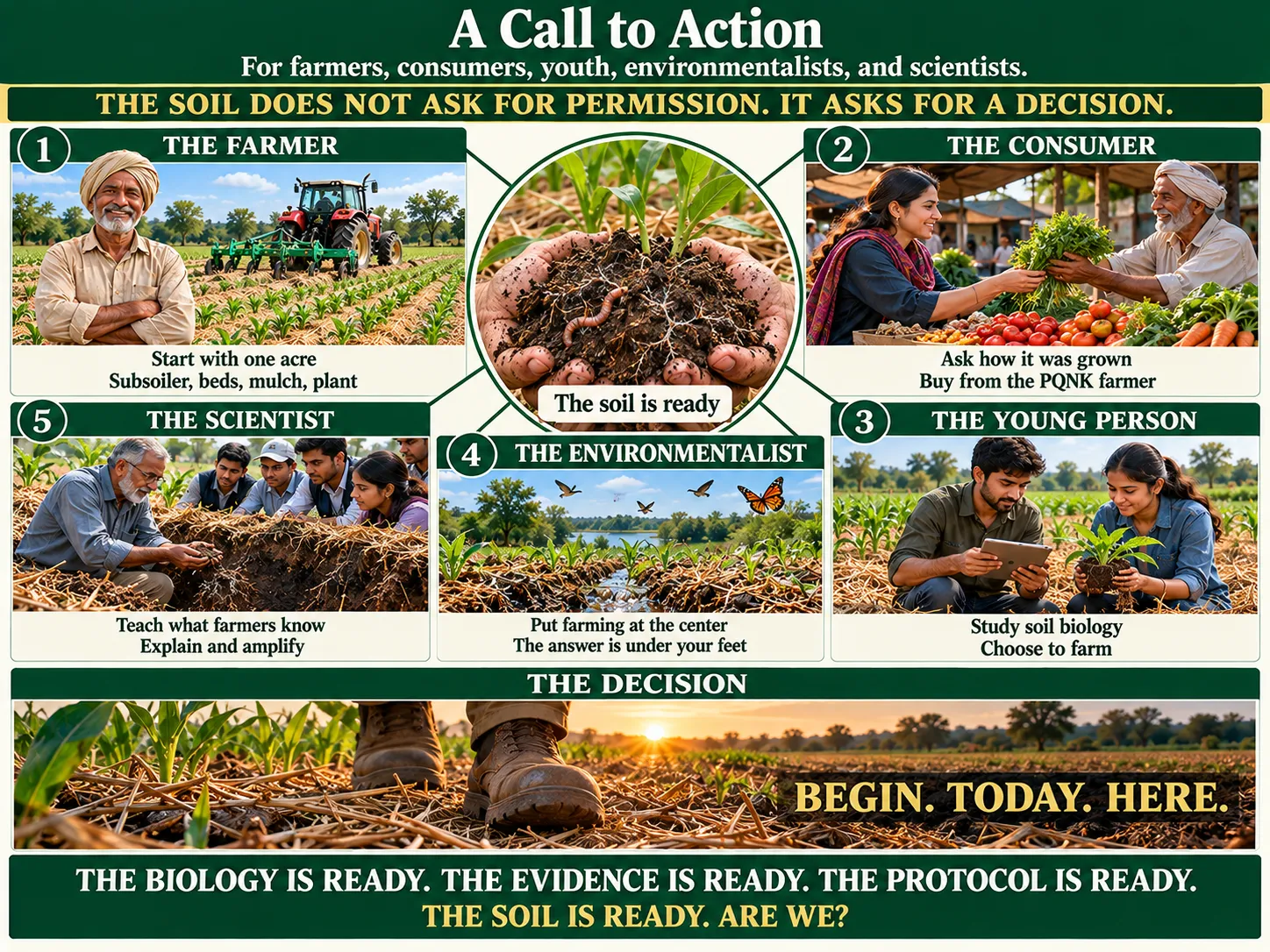
A Call to Action: farmers, consumers, youth, environmentalists, and scientists, each with a first step to take today.
“The soil does not ask for permission. It does not wait for consensus or for the institution to catch up or for the policy to arrive. Put the biology back and the soil recovers. This is the most reliable thing I know about the natural world: it wants to heal. Our only job is to stop preventing it.”
Asif Sharif, Lahore, 2024
This is the last chapter of this book and it is addressed differently from every other. The preceding sixty-four chapters have made arguments: biological, historical, economic, hydrological, climatic, nutritional. Each argument has been supported with evidence, data, and the documented outcomes of real farms, real seasons, real results. This chapter does not add another argument. It asks for a decision.
The decision is not complicated. It is not expensive. It does not require technology that does not yet exist or money that is not yet available or science that has not yet been done. Everything needed to begin is already present: the knowledge, the protocol, the evidence, the machines, the biological system waiting in the soil to recover the moment the conditions that prevent it are removed. The decision required is the decision to begin.
VOICES OF ACTION
This chapter addresses five groups whose decisions, taken together, constitute the agricultural transformation that this book has described. Each group has a specific role and a specific first step. None of them needs to wait for the others to begin.
TO THE FARMER: YOUR LAND IS ALREADY CAPABLE OF WHAT PQNK PRODUCES
You have read this book, or you have seen what it describes on a neighbor’s field, or you have heard about it from another farmer in your district. You are considering whether to try. This chapter has one thing to say to you: try it on one acre.
Not your whole farm. Not yet. One acre. Follow the steps of Chapter Twenty-Three in order. Lay out the acre so that water reaches every part of it evenly. Find the hardpan with a probe, a smooth metal rod pushed into moist soil, and fracture it once with a subsoiler at about 22 inches. Wash the soil where it is needed, with about 8 kg of sulfuric acid per acre in the irrigation water where the pH is above 8. Shape the permanent raised beds. Sow a deep-rooted cover crop such as Jantar on the new beds; when you end it, leave its roots in the soil and lay its stems and leaves on the beds as the first mulch. Then plant your crop through that mulch, with a SIPP if you can access one or by careful hand placement if you cannot, at the spacing and seed rate the protocol sets out. Water by the ball test, not by the calendar, and when you harvest, leave the soil undisturbed for the next crop. Then observe.
Observe what the soil does when it rains. Observe how long the beds stay moist after irrigation. Observe what the plants do when they have adequate space and a mulch-protected root zone. Count the tillers. Watch for the earthworms. Look for the white mycelium in the mulch. These are not indicators that the biology has recovered. They are the biology recovering.
By the second season on that one acre, the evidence will be in front of you: in the yield, in the fewer irrigations the beds need, in the input bill that is already shorter than it was before. The decision to expand will not require persuasion. It will require only what the first decision required: the willingness to begin.
TO THE CONSUMER: EVERY PURCHASE IS A VOTE FOR THE FARMING SYSTEM THAT PRODUCED IT
The consumer who reads this book and continues to purchase conventionally grown food without asking where it came from and how it was produced is participating in the system this book has documented. Not because they are wrong to eat but because they are unaware that their purchase is a vote for the soil management that produced it.
The consumer who asks the questions (Where does this come from? How was it grown? Is it chemical-free?) and who is willing to pay the premium that biologically grown food warrants and will increasingly command is voting differently. They are creating the market signal that tells the farmer that the quality of the PQNK product is worth more than the commodity price of the conventional alternative. This market signal, accumulated across millions of individual purchases, is the economic force that accelerates transition faster than any policy instrument.
The consumer’s first step is to ask the question. The second is to find the PQNK farmer in their district and to buy from them directly. The third is to tell others. This is how markets change: one purchase at a time, one conversation at a time, one farmer’s income that reflects the quality of what they have grown rather than the price of what everyone else is selling.
Every meal you eat came from a farming system. You choose which one every time you choose what to eat. The choice is not always available. But the intention to choose is the beginning of making it available. Consumers who want better food create the market that makes better food economically possible to produce.
TO THE YOUNG PERSON: YOU WILL INHERIT THE SOIL. YOU HAVE THE MOST TO GAIN AND THE MOST TO LOSE
The young person reading this book will live in a world whose food security, water security, climate stability, and public health are all determined by which agricultural system their generation chooses to sustain. The consequences of continuing the conventional system for another generation are not abstract projections. They are the water table, already fallen from a few feet below the surface to two hundred feet or more in many farming regions, falling further still. The soil that will be 30 years further into its biological depletion. The climate that will be warmer by the carbon that continues to be released from the tilled soils of the continuing system.
The young person who chooses to study biology, agronomy, ecology, or agricultural engineering with the intention of contributing to biological farming systems is choosing the most consequential professional path available to anyone in their generation. The young person who chooses to farm, who looks at the One Acre Prosperity (OAP) model of Chapter Forty-Four and calculates that one PQNK acre generates more income than urban employment at lower cost and with better quality of life, is making the most economically rational decision available to them. And the young person who advocates, in school, in university, on social media, in government, for the agricultural transformation this book describes is contributing to the policy environment that makes institutional change possible.
The soil you will inherit will be what the generation before you decided to make it. What you decide to make it for the generation after is the most important agricultural decision of the twenty-first century. It is being made right now, on every farm that transitions and on every farm that does not.
TO THE ENVIRONMENTALIST: THE MOST EFFECTIVE ENVIRONMENTAL INTERVENTION IS UNDER YOUR FEET
The environmental movement has spent decades advocating for the protection of forests, the reduction of industrial emissions, the preservation of biodiversity, and the transition from fossil fuels. All of these are necessary. None of them addresses the largest single land use system on the planet’s surface and a leading driver of biodiversity loss, carbon emission, and water system disruption on land: the way we farm.
PQNK is the environmental intervention that the environmental movement has been looking for: a farming system that restores rather than destroys the soil, sequesters rather than releases carbon, infiltrates rather than runs off rainfall, restores rather than eliminates biodiversity, and does all of this while making farming more profitable for the farmers who implement it. It does not require sacrifice. It requires only the substitution of a biologically intelligent system for a biologically destructive one.
The environmentalist’s first step is to place agricultural transformation at the center of the environmental agenda rather than at its margins. The second is to communicate the PQNK evidence in the public spaces and political conversations where agricultural policy is formed. The third is to support PQNK farmers as environmental heroes, because they are: the farmer who transitions to PQNK is doing more for the climate, the water cycle, and the biodiversity of their landscape than any other single actor in any other sector.
TO THE SCIENTIST: THE BIOLOGY IS AHEAD OF THE INSTITUTION. CATCH UP TO THE FARMER
The scientist who has read this book and whose field intersects with any part of its argument, soil microbiology, agronomy, hydrology, nutritional science, atmospheric chemistry, plant physiology, ecological economics, is invited to walk the PQNK fields, see what farmers have already established there, and carry it into the places where the next generation is trained: the lecture hall, the textbook, the laboratory, and the extension manual.
The PQNK evidence is already in the field: in the soil that crumbles in the hand, the rain that soaks in, the crops that stand without fertilizer or pesticide, and the yields and incomes of the farmers who grow them. What institutional science can add is not another proof but its reach. Soil science courses can be rebuilt around the living soil. Accredited laboratories can test PQNK produce so that farmers can show its food value (Chapter Sixty-Three). Textbooks can teach the root-microbe nexus as the foundation of fertility rather than a footnote to fertilizer.
The scientist’s obligation is to communicate PQNK: to bring the evidence into the journals, the conferences, the textbooks, and the public discourse where agricultural futures are argued and decided. The farmer has done what the scientist calls a field experiment at enormous scale and over many seasons. The results are available. The scientist’s job is to explain and to amplify them in the language of institutional science that institutional decision-makers are waiting to hear.
WHAT THIS BOOK HAS SAID
This book began with a question that Chapter One posed and every subsequent chapter has answered from a different direction: what happened to the soil? The answer, assembled across sixty-four chapters of biological science, agricultural history, documented evidence, and the vision of what restoration makes possible, is: the same thing that always happens when a living system is treated as an inert medium.
The soil is not an inert medium. It is the most complex living system on the planet’s surface: a biological community of bacteria, fungi, protozoa, nematodes, earthworms, and the thousands of other organisms that together transform rock into fertility, rainfall into food, and sunlight into the biological inheritance of every living thing that eats from it. The ACI (Ancient Conventional Industrial) system treated this system as if it were dirt: an inert substrate through which to deliver the synthetic inputs that would substitute for the biological function the system was designed to provide. The consequences of this treatment are documented in every chapter of this book. They are the world we are living in.
PQNK is the restoration. It is not a new invention. It is the rediscovery of what the soil was always capable of and the design of a farming protocol that allows it to do what it has always done when it is not prevented: sustain life, build fertility, manage water, regulate climate, and feed the species that depends on it with food that is worthy of the word.
THE DECISION
The world is facing three convergent crises that are driven by the same root cause: the biological destruction of the agricultural soil that sustains all life on land. The food security crisis. The water crisis. The climate crisis. All three have the same solution. All three can be substantially addressed by the same action: the restoration of soil biological function through PQNK management on the agricultural land that currently drives them.
This is not a utopian claim. It is a documented, peer-reviewed, farmer-verified, institutionally tested biological reality that is already happening on farms across Pakistan and beyond. The question is not whether it works. The question is how quickly the world will decide that it should happen at scale.
The answer to that question is determined by the farmer who tries one acre, the consumer who asks where their food came from, the young person who chooses biology over banking, the environmentalist who adds agriculture to the top of the agenda, the scientist who takes PQNK into the classroom and the textbook, the government official who moves the subsidy from fertilizer to subsoiler, and the development banker who prices the risk of a zero-input farm at what it actually is. All of these are decisions that can be made today. All of them are being made, by some people, right now. The only question is how many more will make them before it is too late to matter.
The soil is patient. It has been waiting for this for sixty years. It will wait a little longer. But the species that depends on it does not have sixty more years to decide. The biology is ready. The evidence is ready. The protocol is ready. The only thing that needs to be ready is us.
PQNK
Paedar Qudratti Nizam Kashatqari
The Natural Ecosystem Science of Production Agriculture
Asif Sharif
Founder, Pedaver | Inventor, PQNK | Lahore, Pakistan
The soil is ready. Are we?