

Industrial Devastation To Natural Abundance
The Original System · Chapter 1
Earth's Original Design
Release 1.0 · 2026-08-27
If you use “Listen”, the text of the page may be sent to your browser or operating system’s speech provider, such as Apple, Google or Microsoft, depending on the voice your device uses. Pedaver does not process, transmit or store any audio.
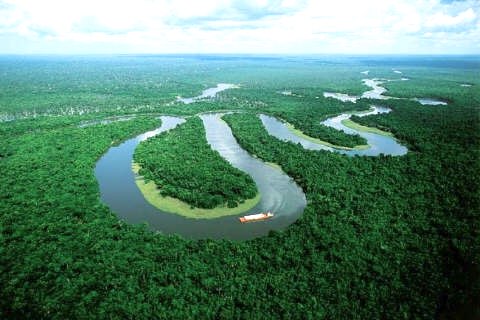
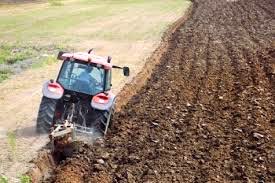
Left: nature's original design. Every layer occupied, every niche filled, no bare soil, no chemical input. Right: the bare, exposed earth of conventional tillage. The same design, dismantled. This is the contrast PQNK restores.
“For four hundred million years, the planet solved the problem of food. It solved it without a single bag of fertilizer, a litre of pesticide, or a moment of human intervention. We did not inherit a broken world. We broke it ourselves.”
Asif Sharif, Lahore, 2024
Before the first human hand ever disturbed the ground, before the first seed was buried in soil to keep it safe from the birds and to draw moisture from the earth, before any civilisation rose and fell on the grain it could extract from the earth, the planet was already feeding every living thing upon it. It had been doing so, without interruption, for four hundred million years. Not adequately. Not just enough. In extraordinary abundance.
This is the fact that changes everything. It is also the fact that modern agricultural science, in more than a century of organized endeavour, has been most careful never to fully examine. To do so would be to ask an uncomfortable question: if nature solved the problem of food production so completely, and sustained that solution for a span of time so vast it resists human comprehension, then what exactly has agriculture been doing for the last ten thousand years? And what has it been doing, with far greater violence, for the last sixty?
The answer, as this book will demonstrate, is that agriculture has not been improving upon nature’s design. It has been dismantling it. The fertilizers, the pesticides, the deep plowing, the inversion, the flood irrigation, these are not refinements of a natural process. They are substitutes for one that has been destroyed. We have been tilling, at enormous cost and with diminishing returns, the biological void we created. We have mistaken the patch for the cure.
PQNK does not propose a new way of farming. It proposes a return to the only way that has ever actually worked, a way that was working, perfectly, for four hundred million years before we interfered.
This chapter is about understanding what that original system was. Not romantically, nature is not sentimental, and this book will not be. But precisely. The mechanisms that sustained life across four hundred million years of geological time are not mysteries. They are knowable. They have been decoded, slowly and painstakingly, through more than five decades of field observation and experiment. And once understood, they reveal with devastating clarity how wrong our present system is, and how available the correction is.
THE LIVING PLANET: A SYSTEM DESIGNED FOR ABUNDANCE
The Earth was not assembled neutrally. Its crust, formed over billions of years of geological process, contains within it every mineral that any plant will ever require for growth, iron, phosphorus, potassium, calcium, magnesium, zinc, and dozens of trace elements. Not in one place, but everywhere. Distributed through every rock formation, every ancient seabed, every compressed stratum of geological time. The planet is a mineral bank of incomprehensible depth, and it was available to life long before any human farmer thought to add a handful of something to the soil.
What nature required, then, was not the minerals themselves, those were already present in staggering abundance. What it required was a mechanism for making them accessible. That mechanism, perfected over hundreds of millions of years of biological evolution, is the soil food web: the intricate, self-organising community of bacteria, fungi, protozoa, nematodes, earthworms, and ten thousand other organisms that inhabit every cubic centimetre of healthy ground.
At the centre of this web, performing a role so fundamental that calling it “important” is an understatement, are the mycorrhizal fungi. These are the first ecosystem engineers Earth ever produced. They emerged approximately four hundred and sixty million years ago, and the story of how they did so is also the story of how land life became possible at all.
ROCK TO DIRT TO SOIL TO LIFE: NATURE’S FOUR-STAGE ENGINE
The process by which bare rock becomes living soil, and living soil sustains an entire biosphere, unfolds in four stages. Understanding these stages is not an academic exercise. It is the prerequisite for understanding PQNK, because PQNK is, at its heart, an attempt to faithfully replicate all four of them on a farm.
Stage One: Rock. The journey begins with solid stone. Mycorrhizal fungi, along with specialised bacteria called lithotrophs, secrete powerful enzymes and organic acids that attack the mineral surface of rock. Over time, geological time, measured in millennia rather than seasons, this biological weathering breaks rock down into mineral-rich particles. This is not erosion, which is a physical process and destroys structure. This is dissolution: a chemical and biological process that liberates the minerals locked inside the rock while preserving their availability. The stone becomes dirt.
Stage Two: Dirt. Mineral-rich dirt is not yet soil. It has the raw materials but not the architecture. What transforms dirt into soil is biological activity, specifically, the work of the microbial community that colonises it. Bacteria produce sticky polysaccharides that bind mineral particles into aggregates. Fungi produce glomalin, a glycoprotein that further cements these aggregates into stable structures. Earthworms pass the material through their digestive systems, creating perfectly structured castings. Over time, the once-inert mineral particles are organised into a complex, porous architecture that holds water like a sponge, exchanges gases like a lung, and teems with biological activity at every scale.
Stage Three: Soil. Living soil is the most complex ecosystem on Earth by volume. A single teaspoon of healthy soil contains more organisms than there are people on the planet. These organisms are not merely present; they are organised. They form what ecologists call a soil food web: a layered, interdependent community where every organism serves a function, every function serves the whole, and the whole serves the plants that grow in it. Bacteria fix atmospheric nitrogen, making it available to roots. Fungi form vast networks, mycorrhizal highways, that extend a plant’s effective root system by orders of magnitude. Protozoa graze on bacteria, releasing nutrients in plant-available form. Nematodes regulate bacterial populations, preventing any single organism from dominating and disrupting the balance. The system is self-regulating, self-renewing, and self-funding. It requires no external input whatsoever.
Stage Four: Life. Upon this living soil, plants establish themselves. But they do not simply take from the soil; they invest in it. Through their roots, plants exude sugars, amino acids, and complex organic compounds, a substantial portion of everything they produce through photosynthesis, sometimes as much as half. These exudates are the ‘wages’ paid to the microbial community in exchange for nutrients. The plant communicates its specific nutritional needs through this chemical language, and the microbial community responds by mining and delivering the precise minerals required. It is a relationship of mutual dependence, evolved over hundreds of millions of years, and it works with a precision no agrochemical programme has ever matched.
A plant growing in a healthy soil ecosystem is not merely surviving. It is operating within the most sophisticated nutrient delivery system ever developed, one calibrated by four hundred million years of evolutionary refinement, and available, free of charge, in every acre of ground on Earth.
THE 0.083% PARADOX: PLANTS DO NOT EAT SOIL
Here is the fact that demolishes the entire intellectual foundation of modern input-dependent agriculture, and the one that the industry that profits from it has worked hardest to obscure: plants do not eat soil. They eat air.
More than ninety-five percent of a plant’s physical mass, every leaf, every stem, every grain of wheat or kernel of corn, is constructed from carbon, hydrogen, and oxygen. Four percent nitrogen also comes from the atmosphere through soil-living bacteria. These elements are sourced not from the ground but from the atmosphere and from water, through the process of photosynthesis. The sun provides the energy. The air provides the carbon. The water provides the hydrogen. The soil provides, in net terms, approximately 0.083 percent of a plant’s total mass, the trace minerals that are essential to life but required only in quantities almost too small to measure.
The implications of this figure are staggering. Consider what it means for a wheat crop growing on one acre of ground. The topsoil beneath that acre, just the upper six inches, contains approximately eight hundred kilograms of phosphorus, fourteen thousand kilograms of potassium, and two thousand kilograms of nitrogen. The wheat crop growing above it will remove, from that geological reserve, approximately 4.4 kilograms of phosphorus, twelve kilograms of potassium, and forty kilograms of nitrogen per tonne of yield. The ratio of what the soil holds to what the crop withdraws is, for phosphorus, one hundred and eighty-two to one. For potassium, it is over one thousand to one.
And this is only the topsoil. Below it lies a virtually inexhaustible geological reserve: the subsoil, the weathered bedrock, and ultimately the planet’s crust, containing minerals in quantities that would never exhaust. To be precise about this claim: the reserve in question is not the deep geological mantle accessed through volcanic or tectonic processes, those operate on timescales of millions of years and play no direct role in agricultural nutrition. What is meant by the geological reserve is the mineral matrix of the local soil profile itself: the rock particles, clay minerals, and mineral compounds distributed through every centimetre of soil down to the depth that roots can penetrate. Biological weathering, the secretion of organic acids and chelating compounds by mycorrhizal fungi and bacteria, dissolves minerals from these local particles through chemistry that happens in place. Gravity does tend to move soluble minerals downward through the profile; this is precisely why deep roots in a PQNK system, made possible by hardpan fracture, access what has concentrated at depth, while capillary rise driven by evapotranspiration moves dissolved materials upward. The biological system does not oppose gravity, it works intelligently with the full depth of the soil profile. For nitrogen specifically, the ultimate bank is the atmosphere itself, seventy-eight percent nitrogen gas, continuously fixed into plant-available form by nitrogen-fixing bacteria, free of charge, in every cubic centimetre of healthy soil.
Why, then, do farmers face nutrient deficiencies? Why do soils ‘run out’ of nutrients? The answer is not that the minerals are absent. They are present, in overwhelming abundance. The answer is that the biological machinery required to access them, the mycorrhizal networks, the microbial assembly lines, the root exudate communication systems, has been destroyed. By tillage. By flooding. By pesticides. By the very practices that modern agriculture defines as ‘farming’.
When a farmer applies synthetic nitrogen fertiliser to a field, he is not feeding his crop. He is bypassing, and thereby further destroying, the biological system that would have fed it naturally. The fertiliser disrupts the plant’s production of root exudates, effectively laying off the microbial workforce that the plant had previously employed. With each application, the soil’s biological capacity diminishes further. The farmer must apply more next season to achieve the same yield. The cycle deepens. The dependency becomes absolute. And the companies that sell the fertiliser grow more profitable with every passing year.
Nutrient deficiency in modern agriculture is not a shortage of minerals. It is a shutdown of the biological machinery that accesses them. The farmer who buys fertiliser is not solving a problem. He is paying for a problem that was created for him.
400 MILLION YEARS WITHOUT A SINGLE BAG OF FERTILISER
It is worth pausing, at this point, to sit with the weight of the number four hundred million. Not as an abstraction, but as a duration. Four hundred million years ago, the first land plants were taking root on a barren continental surface. The dinosaurs would not appear for another hundred and seventy million years. The first humans would not walk the earth for another three hundred and ninety-eight million years after that. Throughout this entire span of biological time, through mass extinctions, ice ages, continental drift, and every climate variation the planet has experienced, the natural soil-plant ecosystem did not fail. It did not require intervention. It did not run out of nutrients. It sustained, and in fact grew in complexity and productivity, entirely through the operation of its own internal logic.
This is not a romantic notion. It is an empirical fact of the geological record. And it is the most powerful argument available for the position that PQNK takes: that the principles governing this four-hundred-million-year system are not obsolete, not superseded by modern science, and not applicable only to wild ecosystems. They are the principles of production agriculture. They are the only principles that have ever actually worked, at scale, sustainably, and without destroying the resource base they depend upon.
What changed, ten thousand years ago, was not the principles. What changed was the human relationship to them. And the change was born not from hunger, the planet was already solving hunger with extraordinary generosity, but from death.
Why that first seed was deliberately buried, and what it set in motion, is a fuller story than this opening chapter needs to tell. What matters here is only its direction: once soil could be opened for human convenience, the four-hundred-million-year system just described stopped being sustained and started being drawn down.
WATER, TEMPERATURE, AND THE SELF-REGULATING FARM
The natural ecosystem did not merely solve the problem of nutrients. It solved, with equal elegance, the problems of water and temperature, the two other conditions upon which plant growth depends.
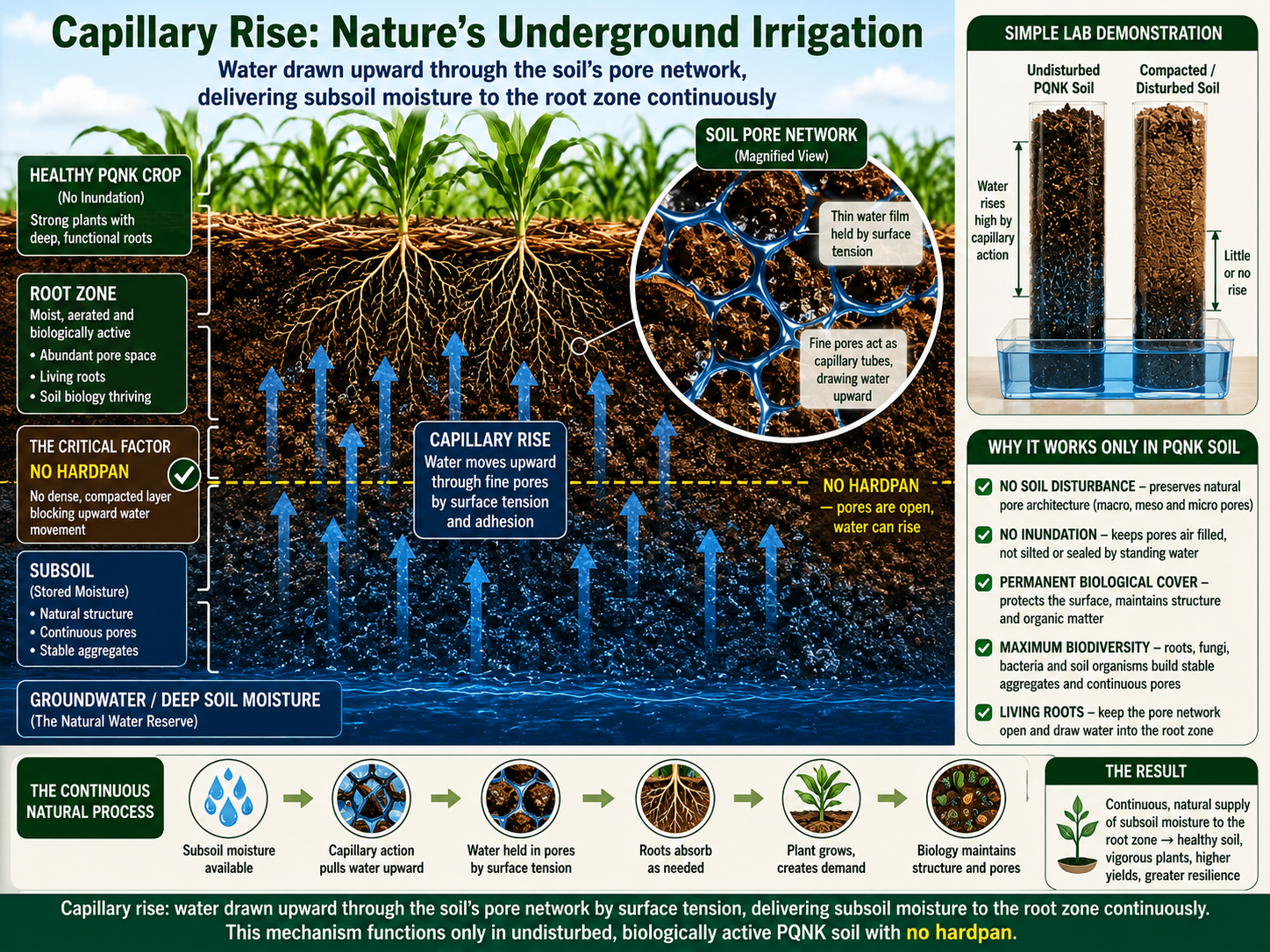
Water in the natural system does not fall from the sky and run away. It falls, is absorbed into the living sponge of healthy soil, and is stored there in a dynamic equilibrium between liquid, vapour, and solid. A healthy soil with intact structure can absorb and hold many times its own weight in water. Between rainfalls, this stored moisture is drawn upward by capillary action, the same physics that allows a paper towel to absorb a spill, continuously supplying the root zone with moisture even in dry periods. The system also harvests water directly from the atmosphere: morning dew condenses on the mulch layer of leaf litter and organic matter, and the air’s own humidity is absorbed by the carbon-rich organic surface, supplementing rainfall in ways that conventional hydrology does not fully account for.
Temperature, in the natural system, is regulated by the forest floor: the layer of decomposing organic matter that blankets the soil surface. This layer acts as an insulator, preventing extreme heat from penetrating in summer and retaining warmth in winter. The mycorrhizal fungi and microbial communities that drive nutrient cycling operate within a specific temperature window, roughly thirteen to twenty-six degrees Celsius. The natural mulch layer maintains that window even when air temperatures swing far beyond it. The soil is not at the mercy of the weather. It moderates the weather’s effects.
In a PQNK field, thick organic mulch replicates the forest floor. Measurements from PQNK farms in Pakistan’s Punjab region, where summer air temperatures routinely exceed fifty degrees Celsius, show that mulch-covered soil maintains temperatures within the optimal biological window even on the hottest days. The soil surface beneath the mulch is thirty degrees cooler than an exposed conventional field beside it. That thirty-degree difference is not a detail. It is the difference between a living soil and a baked one.
THE IMMUNE SYSTEM THAT WAS ALWAYS THERE
There is a third problem that the natural ecosystem solved, and that modern agriculture has spectacularly failed to solve in sixty years of trying: pest and disease control. The global pesticide market was worth approximately one hundred billion dollars in 2023. Farmers in Pakistan, India, and across the developing world spend between a quarter and a third of their total production costs on chemicals intended to protect their crops. Resistance to those chemicals grows steadily. The chemicals become stronger. The dosages increase. The costs rise. The pests remain.
In a natural ecosystem, this cycle does not exist. It cannot exist, because the conditions that create it, the crop vulnerability that makes chemical intervention seem necessary, are absent. Why?
The answer lies, in part, in a soil bacterium called Bacillus thuringiensis, known universally as BT. Multiple species of BT bacteria inhabit healthy soil, and each produces proteins that are specifically toxic to the larvae of particular insect groups, caterpillars, bollworms, beetles, sucking insects, whitefly, mosquitoes. Each BT species targets a different set. Together, they constitute a comprehensive, species-specific, biological pest management system, one that is free, self-renewing, and leaves no toxic residue in the food produced.
The agricultural industry discovered BT bacteria in the 1950s and responded by attempting to commercialise them, first as spray-on biological pesticides, then, more lucratively, by inserting the BT gene into crop plants to produce ‘BT cotton’ and ‘BT corn’. Billions of dollars were made. What was never told to farmers, and what took a field researcher fifty years of patient observation to understand and document, is this: BT bacteria are already in the soil. They have always been there. They require no purchase, no application, and no genetic modification. They require only one thing: a living soil ecosystem in which to thrive. The same tillage, flooding, and chemical applications that destroy the nutrient-cycling biology also destroy the pest-protection biology. And then, into the biological void thus created, the industry sells a substitute.
Beyond BT bacteria, a healthy agricultural ecosystem supports a vast and diverse community of organisms that collectively regulate pest populations. Predatory insects and spiders, parasitoids, birds, reptiles, entomopathogenic fungi and bacteria, and many other organisms form interconnected biological control networks. PQNK therefore does not depend on an arbitrary number of “natural predators.” Its strength lies in restoring the biodiversity, habitat and ecological relationships through which pest populations are naturally kept in balance. When the soil food web and the wider farm ecosystem remain intact, pest regulation becomes an ecosystem function rather than a chemical management operation.
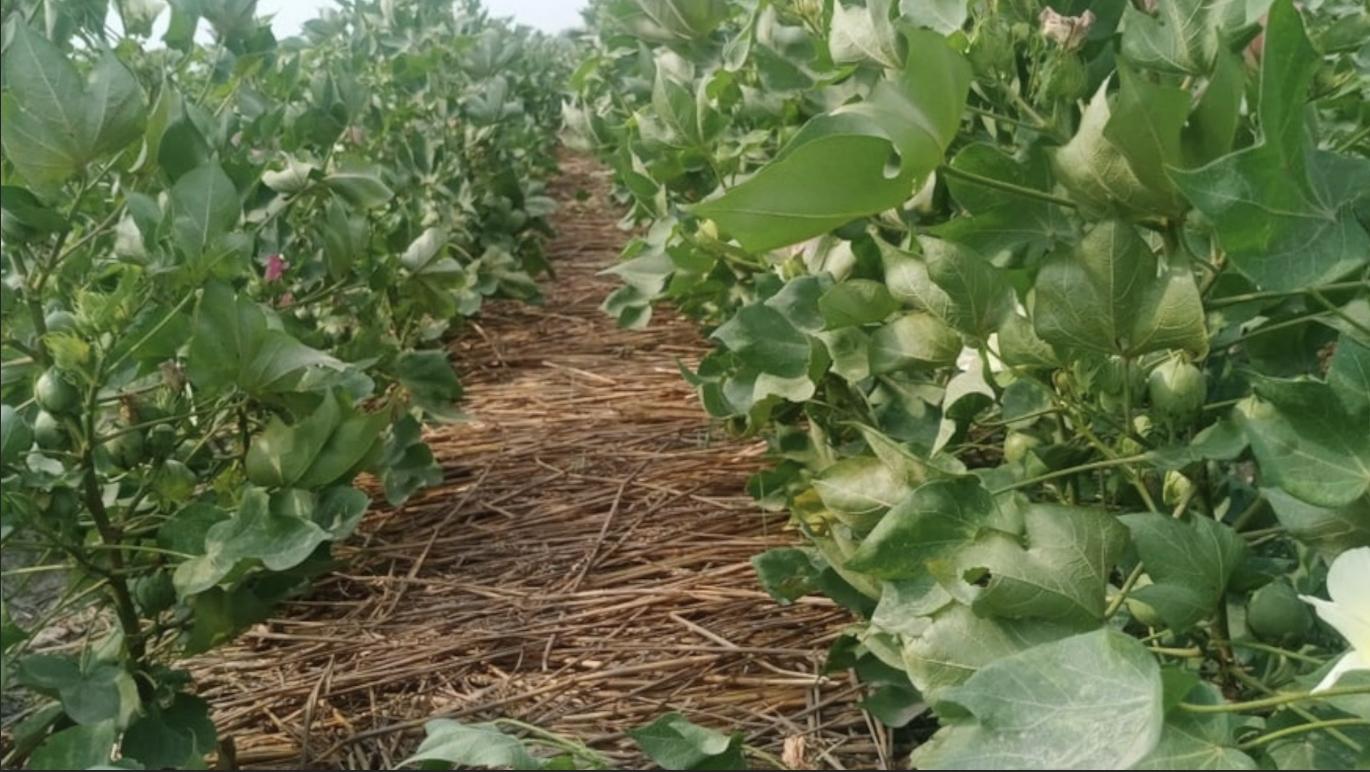
PQNK cotton: no purchased inputs, the soil surface kept permanently covered with organic mulch.
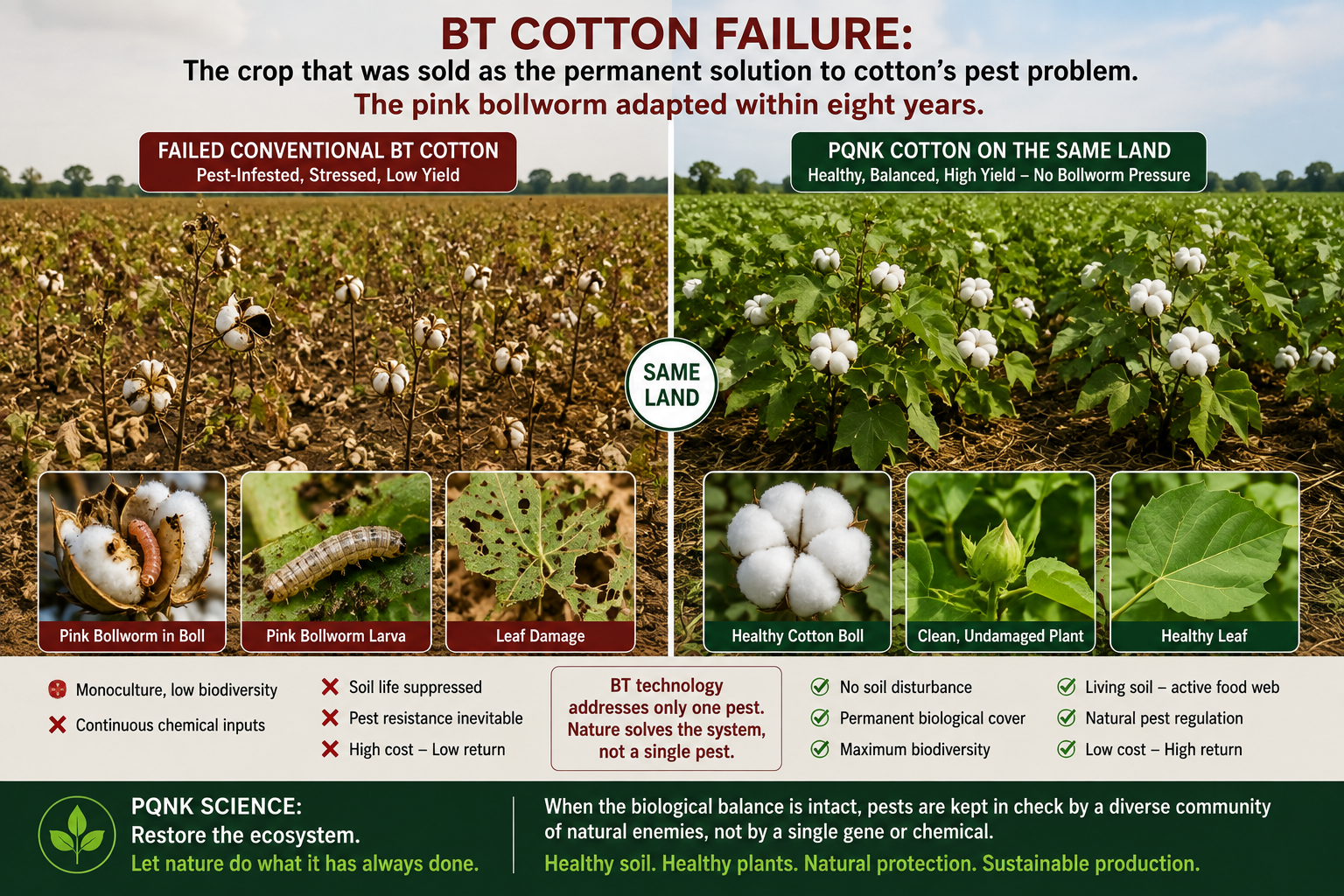
Every pesticide ever sold was sold into a biological vacuum that did not exist in nature. The vacuum was created first. Then the product was sold to fill it.
ABUNDANCE AS THE DEFAULT STATE
Everything described in this chapter, the geological mineral bank, the mycorrhizal delivery system, the microbial assembly line, the water management, the temperature regulation, the biological pest control, was operating, in full and perfect integration, across the entire land surface of this planet for four hundred million years. Not in special places. Not under exceptional conditions. Everywhere. In what we now call deserts, in what we now call the tropics, in the temperate zones, in the rain shadows of mountain ranges. Wherever life could find a foothold, the system organised itself and began producing.
The default state of the natural world, in other words, is not scarcity. It is abundance. Scarcity, in the context of agriculture, is a human achievement. It has been produced, methodically and at enormous expense, by ten thousand years of practices that systematically dismantle the system that produces abundance. It has been deepened, catastrophically, by sixty years of industrial agriculture that dismantles that system faster than any previous technology in history.
There is a useful analogy for how this happened without most of the world noticing. Imagine a frog placed in a pot of water at room temperature. The heat is raised one degree at a time. The frog does not leap out. Each change is too small to register as danger. The frog adjusts continuously, drawing on its internal reserves to withstand the rising stress, adapting to each increment as it arrives. Only when the heat becomes unbearable does it attempt to escape, but by then, its energy is exhausted and it cannot. Humanity’s relationship with its agricultural soil followed exactly this pattern. Each season of tillage was slightly more destructive than the last, but not dramatically so. Each application of synthetic nitrogen displaced a little more of the mycorrhizal community, but the crop still grew. Each pesticide spray killed a few more predator species, but pests were still controlled, with more spray. Deep soil carbon buffered the nutritional losses for decades. Mineral abundance in the subsoil compensated for the depleted surface. The vast biological reserves that four hundred million years had accumulated absorbed the assault, season by season, year by year, generation by generation. The system signalled strain. But the signals were slow, and the adjustments were incremental, and the people most directly affected, the farmers, adapted to each new diminished baseline without recognising it as diminished. The water table fell a metre. Then another. The yield plateau arrived. Then the yield decline. The input cost rose. Then rose again. The buffers are now weakening. The central question is no longer whether something went wrong. It is how far the drift has progressed, and whether correction remains possible.
Q What separates soil from dirt?
A Dirt is mineral particles without biological community. Soil is the same particles organised and managed by billions of organisms per teaspoon. The difference is not chemical, it is biological.
Q Why does Ancient Conventional Industrial Agriculture management reduce productive soil back toward dirt over time?
A Because tillage destroys the biological community that maintains soil structure, while synthetic fertiliser substitutes for what that community provides, creating a cycle where the farm needs more chemistry to compensate for the biology it has destroyed.
Q Can degraded soil recover?
A Yes. The biological community is suppressed, not extinguished. When tillage stops, the surface is covered, and biological food is restored, the community re-establishes. Every PQNK farm demonstrates this every season.
This is not a counsel of despair. It is, in fact, the most hopeful thing that can be said about agriculture’s future. Because if scarcity is a product of what we have done, then abundance is recoverable by ceasing to do it, and by restoring, as precisely as we can, the conditions that allowed the four-hundred-million-year system to operate.
That restoration is what PQNK is. Not a philosophy. Not a movement. A precise, sequential, field-tested, farmer-validated protocol for returning a degraded piece of ground to biological function, and then standing back while it produces.
WHAT THIS CHAPTER HAS ESTABLISHED
Before we can properly understand what went wrong, and how comprehensively, and at whose benefit, we need the foundation this chapter has laid. It is this:
The Earth possesses, in its geology, its biology, and its atmosphere, everything required to feed every living thing upon it indefinitely, without depletion, without pollution, without external input, and without cost. This is not a theoretical proposition. It is a proven fact of four hundred million years of uninterrupted biological operation.
The mechanisms that make this possible, the mycorrhizal networks, the microbial assembly lines, the soil food web, the organic mulch layer, the atmospheric nitrogen fixation, the BT bacterial immune system, are knowable, replicable, and available on any farm, anywhere in the world, at no cost beyond the cost of understanding them.
Modern agriculture has not improved upon these mechanisms. It has replaced them with purchased substitutes. It has done so in a way that degrades the original system further with each cycle, making the farmer more dependent on the substitutes, more indebted to their suppliers, and less capable of returning to the system that once sustained everything without his help.
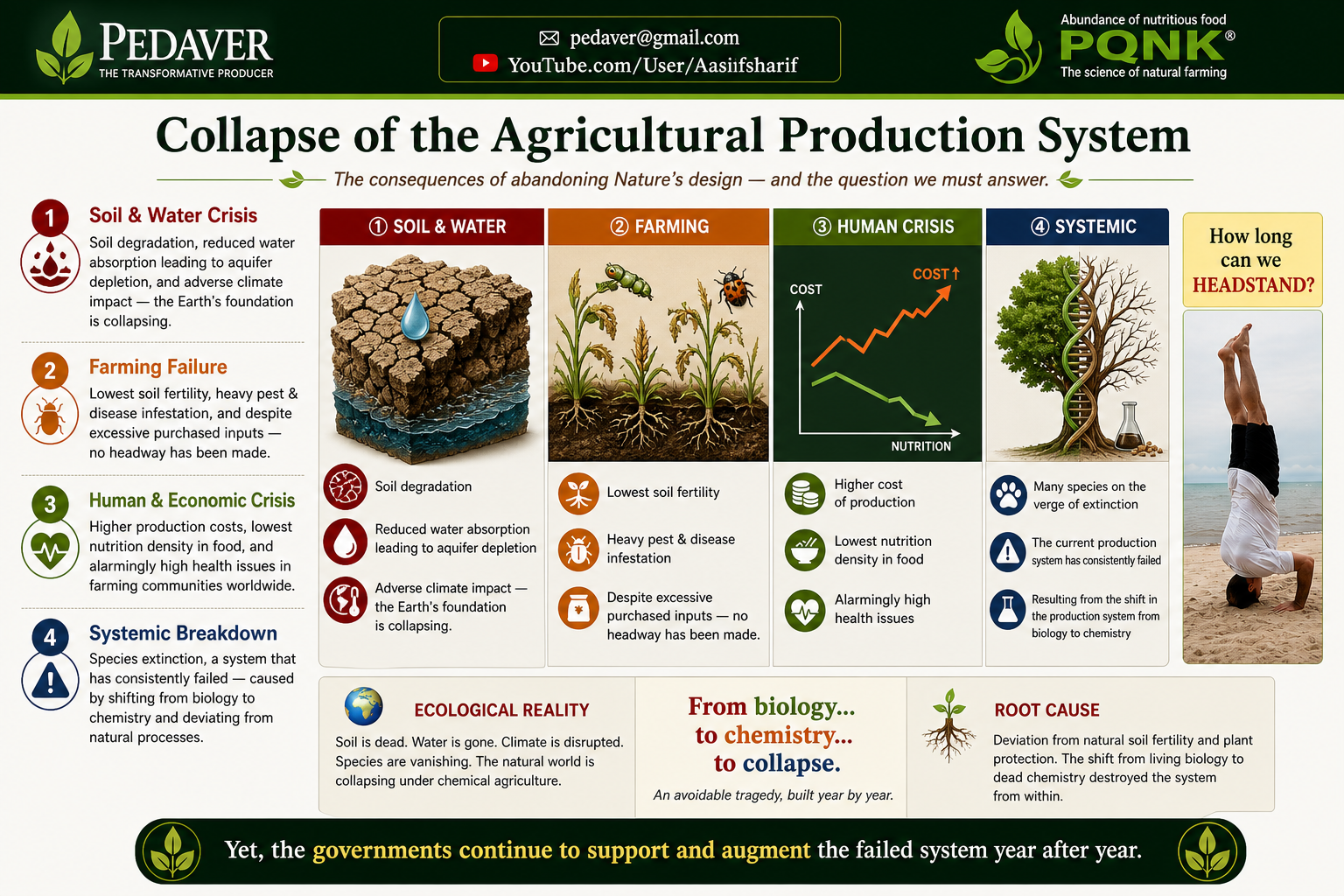
The following chapters will trace how this happened: the decisions, the institutions, the incentives, and the blindnesses that led a species capable of extraordinary intelligence to spend more than a century and a half making the ground beneath its feet progressively less able to grow food. They will also show, in the precise and documented detail of fifty-three years of field research, how to stop.
Chapter Two: Rock, Dirt, Soil, Life, The Natural Soil Cycle in Detail