

Workforce & Practice Advisories
When Mulch Becomes a Barrier: Why More Mulch Is Not Always Better
Diagnoses a farmer's report of leaf discoloration and apparent burning despite 8-9 inches of wheat-straw mulch, tracing the likely cause to finely chopped straw packing into a dense seal that blocks root-zone oxygen, and reframes mulch management around functional porosity rather than depth alone.
Abstract
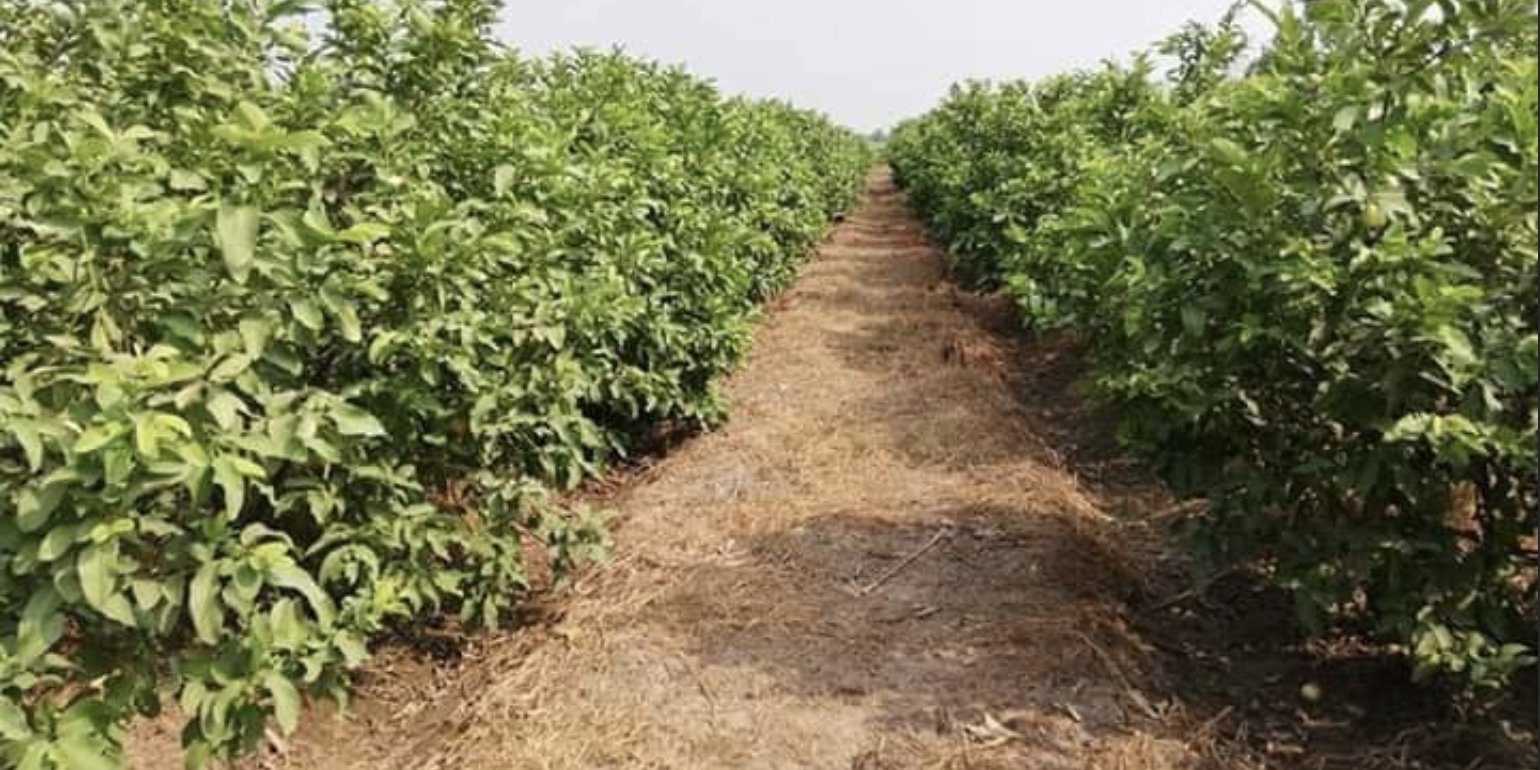
A farmer reported severe leaf discoloration and apparent burning on plants protected by roughly 8-9 inches of finely chopped wheat-straw mulch, an apparent contradiction given mulch's role in shielding soil from heat. This paper works through that field question and argues the cause is not too little protection but a specific combination: very fine particle size plus a deep layer, which can settle into a dense mat that blocks light effectively while sealing the soil from the atmosphere.
The underlying misconception it corrects is that mulch works simply by quantity, more material equals more protection. Long, coarse residue naturally leaves irregular air spaces between pieces; finely chopped material behaves differently, settling closely together after irrigation, rainfall or trampling until an 8-9 inch layer becomes far denser than an equivalent depth of coarse residue. The result can be an excellent light barrier and a poor air interface at the same time, one mulch function performed so aggressively it interferes with another.
The paper's diagnostic principle is that roots are living, respiring organs that need oxygen as much as water, so a plant can suffer physiologically even when the soil beneath it is moist, restricted root-zone aeration impairs nutrient uptake and water relations and can produce above-ground symptoms that look like an input problem when the actual cause is a sealed root zone. It reframes mulch as a porous insulating blanket rather than an airtight lid, and argues that a stated depth in inches is close to meaningless without describing the material, since functional porosity, not thickness, is what determines whether a mulch layer still lets the soil breathe.
For this specific case the paper recommends reducing the layer to roughly 2 inches, fluffing the remaining material so visible air spaces reappear, keeping mulch off the stem and root collar, and judging recovery from new growth rather than expecting already-damaged leaves to recover. It closes with a simple hand-lift field test farmers can use without instruments, and a working PQNK definition of mulching as a porous biological cover that blocks solar radiation while still permitting gaseous exchange between soil and atmosphere: mulch must shade the soil, not suffocate it.
About This Paper
- Problem
- Leaf Discoloration (Yellowing/Purpling) · Low Root-Zone Oxygen / Poor Aeration · Weak / Shallow Root Establishment · Farmer Uncertainty / Diagnostic Skill Gap
- Science
- Soil · Plants
- Evidence
- Field Observation
- Authority
- Current / Approved PQNK Knowledge
Related PQNK Science
Key Takeaways
- An 8-9 inch layer of finely chopped straw can behave as a dense seal rather than a porous blanket, restricting root-zone oxygen even though the soil beneath stays shaded and moist.
- The determining variable is functional porosity, not depth: coarse, loosely arranged residue holds interconnected air spaces, while finely chopped material can pack down and lose them.
- A plant can show visible stress even with adequate soil moisture, because roots need both water and oxygen; leaf symptoms alone cannot confirm which one is missing.
- The corrective sequence: reduce the layer to about 2 inches, fluff it to restore visible air spaces, keep it off the stem/root collar, and judge recovery from new growth rather than existing damaged leaves.
- PQNK defines mulching as a porous biological cover that blocks solar radiation and buffers temperature while still permitting gaseous exchange between soil and atmosphere, not simply 'covering soil with crop residue.'
- A simple hand-lift field test (visible air spaces, no exposed bare soil, aerated not saturated soil beneath, clear root collar) turns mulch management into an observable condition instead of a fixed number.
Related Knowledge
same problem
Subsoiler Line Spacing and Stony-Land Conversion: A Farmer Q&A
A Nigerian farmer's questions on subsoiler line spacing, converting gravelly land, integrating cocoa into an alley system, and diagnosing nitrogen lock-up, answered with the PQNK conversion protocol step by step.
same problem
The Sacred Symbiosis: Why PQNK Feeds Plants, While Chemical Agriculture Only Force-Feeds Them
Answering a practitioner's question about active versus passive nutrient absorption, this paper contrasts PQNK's living root-microbe dialogue with the 'intravenous drip' of soluble chemical fertilizer, and asks how the Amazon has sustained itself for 40 crore years while chemical farming has exhausted soils worldwide in barely 200.
same problem
Beyond the Timeline: Re-framing the Transition to Regenerative Agriculture Through the Lens of Soil Life
Challenges the common '3 to 5 year transition' claim in regenerative farming, arguing that soil biology responds to correct conditions within hours, and that a farmer should track functional benchmarks like inundation resistance rather than counting calendar years.
same problem
Monitoring Soil Life in the PQNK System: A Farmer's Guide
This farmer's guide sets out five simple, tool-free field tests for judging whether PQNK soil biology is actually taking hold: an earthworm census, a soil smell test, a water infiltration test, a mulch decomposition check, and a root architecture inspection. Each comes with concrete benchmarks separating degraded, good, and thriving soil, turning soil health from a guess into a measurement.