

Soil Science & PQNK System
Understanding Mulch: Types, Functions, and Selection
A practical selection guide to PQNK's three mulch types, live, dead/organic, and plastic, setting out the priority order for choosing between them, the seed-specific adjustments (broadleaf vs narrowleaf, small vs large seed) that determine mulch texture and depth, and the narrow, deliberately transitional case for plastic mulch.
Abstract
Every result that distinguishes a PQNK field, from its water savings to its weed-free beds to its recovering soil biology, depends on one non-negotiable condition: the soil surface is never left bare. This paper sets out how to meet that condition in practice, by choosing the right mulch for the situation rather than treating 'mulch' as a single undifferentiated material. It defines PQNK's three mulch types, live mulch (plants grown alongside the cash crop, such as clover or pea cover crops), dead or organic mulch (crop residue such as straw, leaves, or grass clippings), and plastic mulch (a synthetic, environmentally less desirable material that is nonetheless preferable to leaving soil bare), and gives farmers a clear order of preference between them.
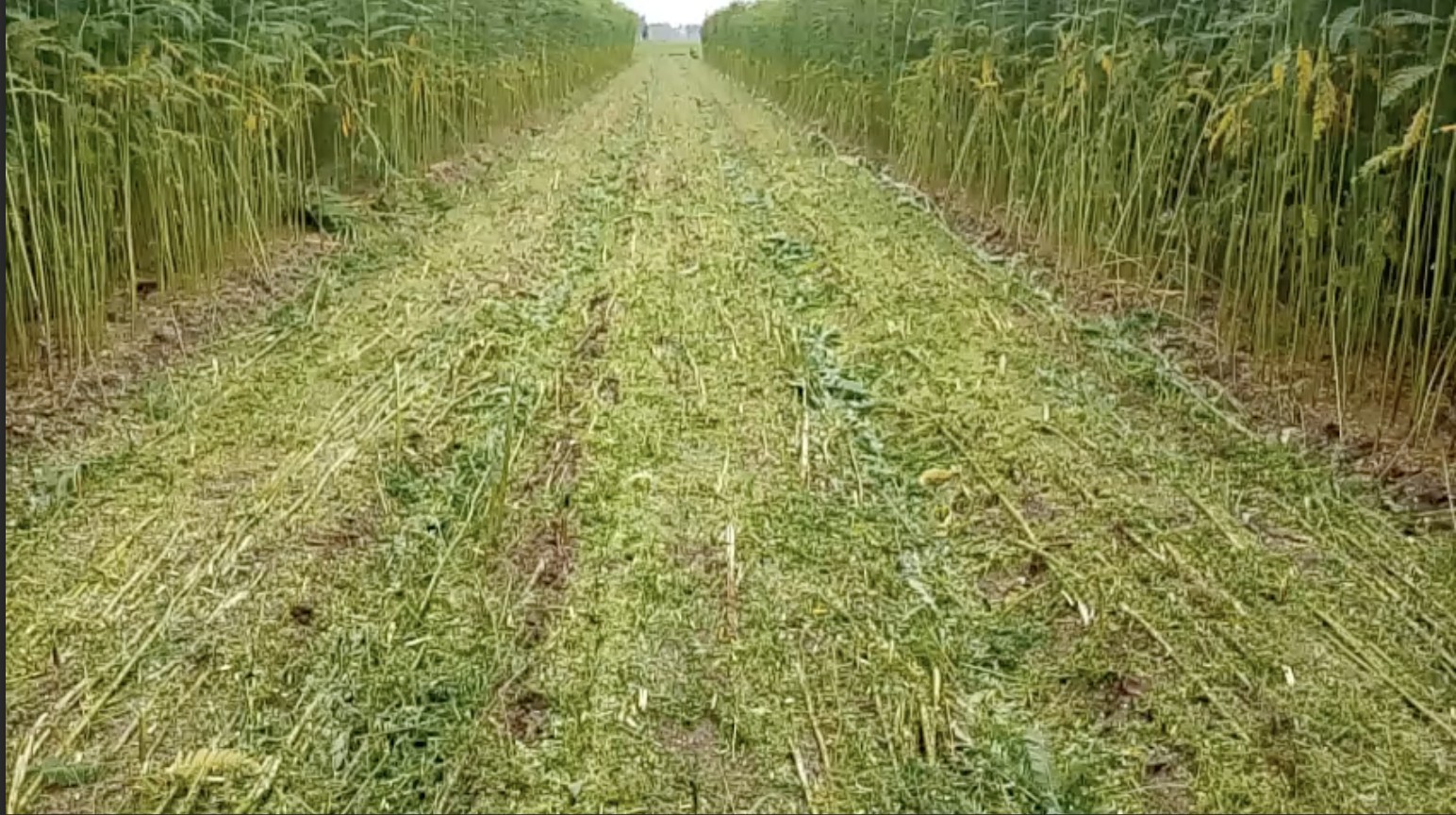
PQNK's standard live mulch is Jantar (Sesbania), sown at high density ahead of nearly every crop precisely because it does three jobs at once that no dead or plastic mulch can replicate. Its canopy holds a continuous living cover over the soil while it grows, its deep taproot physically forces open vertical channels through the compacted soil profile that water and air continue to move through long after the plant itself is gone, and its root zone develops and sustains the soil's microbial population, the bacteria and fungi that a PQNK field depends on to keep functioning. Once Jantar is slashed and left on the surface, those root channels remain in place as permanent infiltration and aeration pathways, so the same plant functions first as a live mulch while it grows and then as the entry point for a dead/organic mulch layer once it is cut.
Whichever type is used, mulch is doing the same four jobs at once: retaining soil moisture by interrupting direct evaporation, regulating soil temperature by insulating the surface from extremes of heat and cold, suppressing weed growth by blocking the light germinating weed seeds need, and protecting soil structure from the erosive impact of rain and irrigation. A mulch layer that fails to perform all four simultaneously is doing only part of its job, which is why selection and depth both matter as much as the decision to mulch at all.
The priority order for selection is live mulch first, wherever it will not compete with the cash crop for sunlight, since a living cover crop provides continuous protection while also contributing biomass and root activity to the soil. Dead or organic mulch is the default second choice, adapted to the crop and planting method in use, finer and lighter for hand-dribbled or transplanted seedbeds, more robust where a no-till planter is cutting through it. Plastic mulch sits last in the order, reserved for situations where neither living nor dead mulch is available in time or in sufficient quantity.
Seed-specific considerations follow directly from how a seedling actually emerges. Broadleaf seeds such as beans and sunflowers and narrowleaf seeds such as grasses and grains push through the surface differently, and mulch texture should account for that difference. Seed size matters just as much: small seeds like lettuce and carrot need a finer, lighter mulch layer so the mulch itself doesn't obstruct emergence, while large seeds like corn and squash can tolerate a thicker layer. The underlying constraint is that a germinating seedling has only the finite energy reserves stored in its own embryo to reach sunlight; mulch that is too thick, too dense, or poorly matched to the seed can exhaust that reserve before the seedling ever breaks the surface. No-till planters address this directly by creating precise slits in the mulch at the moment of planting, giving the seed a clear, unobstructed path for emergence and access rather than requiring it to force its way through an undisturbed layer.
Plastic mulch's place in the system is deliberately narrow and transitional. Where time or resource constraints make live or dead mulch impractical, plastic functions as a stopgap: it still regulates soil conditions and suppresses weeds, and it is particularly useful in winter, when raising soil temperature actively favors plant growth rather than working against it. It is not recommended for summer crops, since the same heat-retaining property that helps a field in winter becomes a liability once ambient temperatures are already high. The guiding rule is a priority order, not a rigid rule: live mulch first, dead mulch second, plastic mulch only as a last resort, adapted always to what is actually available, because the objective is to protect soil health and secure crop success with whatever material the situation allows.
Key Takeaways
- PQNK recognizes three mulch types: live mulch (a living cover crop like clover or pea), dead/organic mulch (crop residue like straw or leaves), and plastic mulch (a synthetic, transitional-only option).
- PQNK's standard live mulch is Jantar (Sesbania): its canopy covers the soil while growing, its taproot forces open vertical channels for water and air infiltration, and its root zone develops and sustains the soil's microbial population — channels that remain in place as aeration pathways even after it's slashed into surface mulch.
- Mulch does four jobs at once regardless of type: retains soil moisture, regulates soil temperature, suppresses weeds, and protects soil structure.
- Selection priority order: live mulch first if it won't shade the cash crop, dead/organic mulch as the adaptable default, plastic mulch only as a last resort.
- Mulch texture and depth should match the seed: broadleaf vs narrowleaf seed types emerge differently, and small seeds (lettuce, carrot) need a finer, lighter layer than large seeds (corn, squash) can tolerate.
- A germinating seedling has only finite embryo energy reserves to reach the surface; mulch that is mismatched to seed size can stunt or prevent emergence.
- No-till planters solve the emergence problem directly by cutting precise slits through the mulch for seed placement, rather than requiring the seedling to push through an undisturbed layer.
- Plastic mulch is a deliberately transitional stopgap, useful for winter soil-warming when live or dead mulch isn't available, but not recommended for summer crops since it retains heat.