KP-168 · Soil Science & PQNK System
The Science Behind the Myth of Cow Dung and Urine
A knowledge paper separating ecological fact from belief-driven practice around cow dung and urine as farm inputs, explaining why the same material functions as recycling in a forest but as import-dependency on a conventional farm, and setting PQNK's boundaries on animal integration.
Read or listen to the full paper ↓Abstract
The paper starts from a foundational PQNK principle: nothing enters the system unless the system itself produced it, since nature cycles existing carbon and minerals rather than importing fertility. Against this standard, cow dung and urine are argued to be neither nutrient sources nor fertility generators; they contain only recycled carbon, trace nitrogen, and temporary microbial populations that die rapidly without correct soil habitat, meaning structure, oxygen, and moisture balance already in place.
It directly addresses the 'special cow gut' belief, arguing that ruminants efficiently digest cellulose but do not manufacture nutrients, they only repackage existing biomass, a function soil microbes perform equally well once soil conditions are correct, so nothing in cow digestion is biologically unique or irreplaceable by soil ecosystems on their own.
The forest-versus-farm contrast is the paper's central mechanism: in a forest, animals eat forest-grown biomass and their waste returns to the same land with no imports or exports, so dung functions as closed-loop recycling. On a conventional farm, animals eat imported feed, dung is treated as a purchased input, and the resulting soil becomes dependency-driven, the same material producing entirely different system behaviour depending on whether the loop is closed or open.
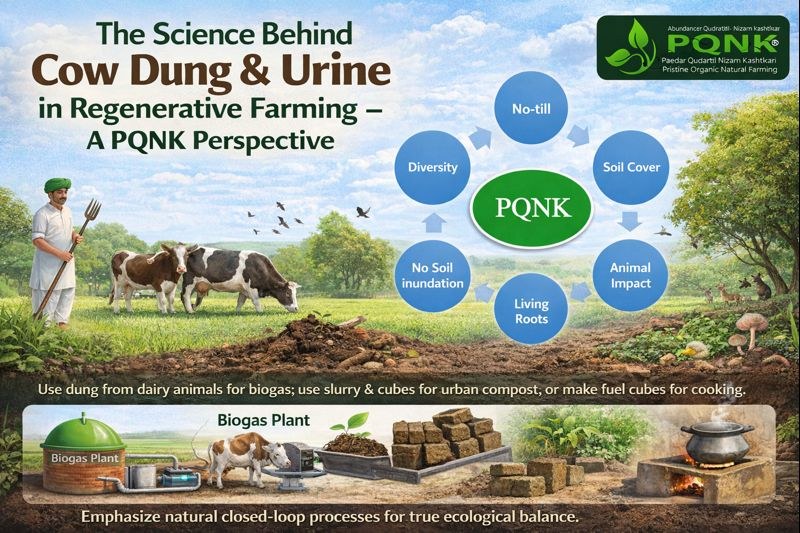
PQNK's resulting position rejects buying or selling dung and urine, rejects fermented concoctions like Jeevamrit or Panchgavya used as soil food, and rejects substituting organic inputs for chemical ones as still being input substitution rather than natural farming. It permits animals only for physical and biological impact, trampling residues, scattering in-situ manure, spreading microbes mechanically, never as nutrient suppliers, and directs commercial dairy surplus toward non-soil uses instead: biogas production, dried slurry compost cubes for urban gardening, and traditional dung cakes for cooking fuel, uses that convert waste into utility without reintroducing agricultural input dependency.
Full Paper
If you use “Listen”, the text of the page may be sent to your browser or operating system’s speech provider, such as Apple, Google or Microsoft, depending on the voice your device uses. Pedaver does not process, transmit or store any audio.
Farmer’s question on the science behind the myth of cow dung and urine
I understand very deeply that any kind of input is harmful in most cases, but I would like to ask you a little about some mythological questions, which I had a lot of earlier. Some questions also arise, but I want to explain this thing in a little scientific way. People do farming with the help of this mythology, and everyone believes this. They also say that the gut of a cow is a special thing. Secondly, like in a forest, there are so many birds, animals, and creatures living there, so their excreta gets accumulated, so that also becomes a kind of fertilizer. So the urine and excreta keep getting accumulated in the clinic. So how should we look at it, that is, how should we look at it in the design of the dairy drain? You see it in a centric way and so much so that some farmers say that we have so many cows and so many buffaloes. So what should be done with its dung? I am never able to answer this correctly. How can I do it? There is a doubt in my mind.
Abstract
This knowledge paper examines the role of cow dung and urine within the PQNK (Paedar Qudratti Nizam Kashatqari – pronounced “picnic”) framework. It clarifies common misconceptions surrounding animal waste, separates ecological function from myth-driven practices, and establishes clear system boundaries distinguishing closed-loop natural ecosystems from input-dependent farming models. The paper further proposes appropriate non-agricultural uses of dairy animal dung—such as biogas, fuel, and urban compost—without violating PQNK principles.
1. Introduction
Across South Asia and many other regions, cow dung and urine are often portrayed as essential fertility inputs in so-called “natural” or “organic” farming systems. These claims are frequently rooted in belief, tradition, or commercial motivation rather than ecological science.
PQNK rejects belief-based agriculture and instead aligns farming strictly with how natural ecosystems have functioned for over 400 million years—without external inputs, without fertility imports, and without dependency.
This paper addresses:
Whether cow dung and urine are nutrients
Why animal waste behaves differently in forests versus farms
How PQNK defines acceptable animal integration
How dairy dung should be responsibly utilized outside agriculture
2. Foundational PQNK Principle
Nothing enters the system unless it is produced by the system itself.
Nature does not import fertility. Nature cycles existing carbon, minerals, and biology.
Any farming system that relies on purchased or imported materials—chemical or organic—is, by definition, non-natural.
3. Scientific Reality of Cow Dung and Urine
3.1 Cow Dung Is Not a Nutrient Source
Cow dung and urine:
Do not create fertility
Do not add new nutrients to soil
Do not replace soil biological processes
They merely contain:
Recycled carbon
Trace nitrogen
Temporary microbial populations
Without correct soil habitat (structure, oxygen, moisture balance), these microbes die rapidly and contribute nothing lasting.
3.2 The Myth of the “Special Cow Gut”
Ruminants efficiently digest cellulose, but:
They do not create nutrients
They do not manufacture fertility
They only repackage existing biomass
Soil microbes perform the same function more efficiently when soil conditions are correct. There is nothing biologically unique in cow dung that soil ecosystems cannot generate independently.
4. Why Animal Waste Works in Forests but Fails on Farms
4.1 Forest Ecosystem
Animals eat forest-grown biomass
Waste returns to the same land
No exports, no imports
Carbon cycle remains closed
Dung functions as recycling, not fertilization.
4.2 Agricultural System (Common Practice)
Animals eat imported feed
Dung is treated as a purchased input
Soil becomes dependency-driven
Natural cycling collapses
Same material. Completely different system behavior.
5. PQNK Position on Animal Waste
5.1 What PQNK Explicitly Rejects
Buying or selling dung and urine
Jeevamrit, Panchgavya, or similar concoctions
Treating animal waste as soil food
Replacing chemical inputs with organic inputs
This is input substitution, not natural farming.
5.2 What PQNK Allows
Animals may be integrated only for physical and biological impact, not as nutrient suppliers.
Acceptable roles include:
Trampling crop residues into soil contact
Scattering small amounts of manure in situ
Mechanically spreading microbes
Increasing biodiversity and disturbance diversity
Dung is a by-product, not an input.
6. Dairy Systems under PQNK
A PQNK-aligned dairy system must follow strict boundaries:
Animals consume only farm-grown biomass
Manure remains on the same land
No purchase of feed
No sale of dung as fertilizer
Stocking density matched to land capacity
Under these conditions, manure becomes internal recycling, not external dependency.
7. Appropriate Uses of Dairy Dung Outside Agriculture
PQNK recognizes that commercial dairy operations inevitably generate dung surpluses that cannot and should not be dumped onto agricultural soil as fertility.
Such dung should be diverted to non-soil-input uses, including:
7.1 Biogas Production
Anaerobic digestion converts dung into methane
Provides renewable cooking and energy fuel
Reduces deforestation and fossil fuel dependency
7.2 Slurry Processing and Urban Compost Cubes
Digested slurry can be dried and compacted
Formed into compost cubes or pellets
Used for urban gardening, landscaping, and pots
Keeps agricultural land free from external inputs
7.3 Fuel Cakes and Cooking Use
Traditional dung cakes remain a viable fuel source
Appropriate for rural cooking and heating
Converts waste into energy without soil disruption
These uses:
Maintain ecological discipline
Prevent agricultural input addiction
Convert waste into societal utility
8. Why Confusion Persists
Farmer confusion arises because:
Input companies replaced chemicals with “organic products”
Commerce was disguised as ecology
Belief and religion replaced system science
Dependency was rebranded as sustainability
PQNK removes this confusion by restoring system integrity.
—————————
Footnote: PQNK (pronounced 'picnic')—the regenerative & sustainable Pristine Organic Farming System—is grounded in Natural Ecosystem Science. This science employs perennial biodiversity, protects soil with organic mulch, and avoids practices like water inundation, tillage disturbance, and leaving soil bare.
It is the process that matters most. PQNK is a pristine production system designed not merely for yield, but for optimal, balanced output—where quality, sustainability, and ecological harmony emerge from a self-regulated, zero-external-input methodology.
www.Facebook.Com/Pedaver
https://www.youtube.com/@pedaverpqnk3167/videos
http://www.youtube.com/@aasifsharif
PDF Knowledge papers: https://drive.google.com/drive/folders/1iadwV6mdUPyrUIpB3oRfNv6DLiackaUL?usp=sharing
WhatsApp +92 320 677 6666
About This Paper
- Problem
- External Input Dependency · Farmer Uncertainty / Diagnostic Skill Gap
- Science
- Soil · Nutrition · Economics
- Evidence
- Philosophical/Framework Argument
- Authority
- Current / Approved PQNK Knowledge
Related PQNK Science
Key Takeaways
- PQNK's foundational rule is that nothing enters the farming system unless the system itself produced it; any farming reliant on purchased or imported material, organic or chemical, is by definition non-natural under this standard.
- Cow dung and urine are argued to contain only recycled carbon, trace nitrogen, and temporary microbes that die rapidly without pre-existing soil structure and biology; they do not create new fertility.
- The same dung behaves as closed-loop recycling in a forest (animals eat local biomass, waste stays local) but as import dependency on a conventional farm (animals eat imported feed, dung treated as purchased input).
- PQNK explicitly rejects buying or selling dung/urine, fermented concoctions like Jeevamrit or Panchgavya used as soil food, and organic-for-chemical input substitution as inconsistent with closed-loop natural farming.
- Commercial dairy dung surplus is directed to non-agricultural uses: biogas production, dried slurry compost cubes for urban gardening, and traditional fuel cakes, rather than applied to farmland as fertility.
Related Knowledge
same problem
The Foundational Primacy of Agriculture Over Industry: A Knowledge Paper Through the PQNK Lens
This paper argues that agriculture, in its pristine PQNK form, is the non-negotiable, self-sufficient foundation of human civilization, while industry is a conditional, derivative superstructure that should serve the harvest rather than the other way around. It closes with a proposal for a national PQNK services entity that would deliver machinery, training, and market access without interfering with farming itself.
same problem
The Global Wheat Crisis Is a Warning: Food Security Cannot Depend on a Production System That Is Failing
The renewed wheat-exporting crisis is usually explained by heat, war, energy costs and disrupted shipping, but this paper argues it exposes a deeper, fourth dependency few are naming: a production model whose own functioning requires stable climate, cheap energy, manufactured fertiliser and uninterrupted supply chains. It argues Pakistan's food security depends less on securing the next shipment of wheat than on rebuilding the biological productive capacity of its own soil.
same problem
The Earth Has Not Stopped Working: A Production-Agriculture Response to Environmental Fatalism, and What PQNK Restores
A widely shared social-media message, built on Lovelock's Gaia Hypothesis, ends in resignation: the planet will correct a stressed system with floods and extinctions, and all we can do is await nature's revenge. This paper accepts that we are not separate from nature but rejects the fatalism. Drawing on more than fifty years in production agriculture, it argues the core error was redesigning natural systems before understanding them, that agriculture is the clearest case, and that a degraded field is a suppressed system rather than an extinguished one, so the answer is not to fear nature's revenge but to stop fighting nature and learn again to produce with it.
same problem
Plant Nutrition Is a Living System, Not an Input Prescription: Why PQNK Restores the Nutrient-Cycling Environment Instead of Feeding the Plant Element by Element
Modern agriculture describes plant nutrition element by element: identify what the plant contains, calculate what the crop removes, replace it from a bag. This paper argues that framing mistakes an accounting exercise for a biological one. A plant's mass is built mostly from air and water, its nitrogen comes from the atmosphere through biological fixation, and the net new mineral draw on the geological reserve after recycling is very small; what determines whether a crop can acquire a nutrient is the living biological interface between mineral and root, not the total inventory in the soil. PQNK therefore restores the nutrient-cycling environment rather than writing an ever-longer fertiliser prescription: manage the habitat, and the living system manages plant nutrition.