

Crop-Specific Guides
Knowledge Paper: PQNK Rose Production
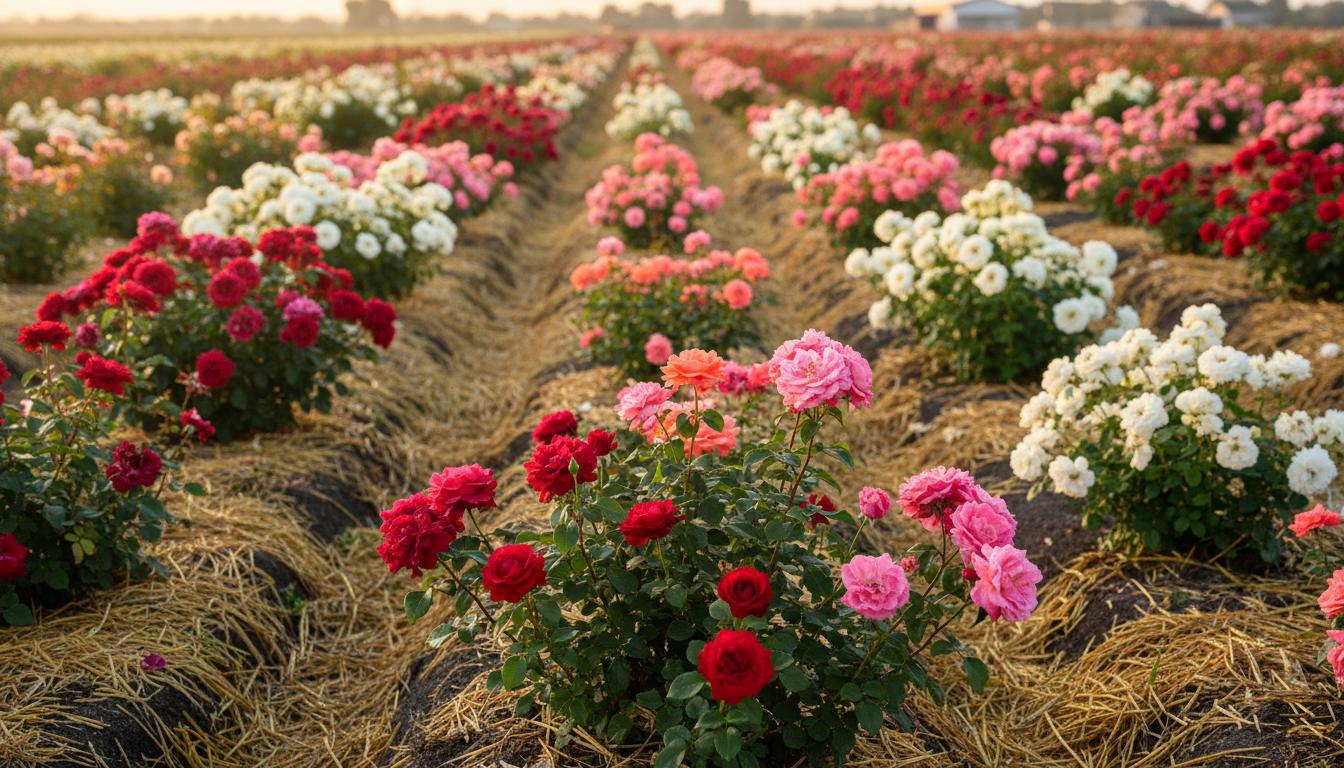
Cut-flower rose production is reframed as a closed-loop perennial system under PQNK, reaching a striking 8,712 plants per acre on twin-row permanent beds, with weeds treated as mulch, alfalfa grown as living nitrogen-fixing ground cover, and strict soil-moisture management replacing scheduled irrigation.
Abstract
The paper positions rose as an excellent PQNK crop: perennial, responsive to soil regeneration, and well suited to closed-loop management, in contrast to conventional rose farming's reliance on synthetic fertilizers, hormones, and chemical pest control. As with other PQNK crops, the field is expected to supply everything, fertility from biomass, pest management from biodiversity, and structure from roots and mulch.
Establishment follows the now-familiar PQNK sequence adapted to rose's biology. A one-time subsoiling breaks the hardpan to 18-24 inches, letting rose's strong, branching root system reach deeper moisture and improve drought resilience. Where pH rises above 7.5-8, a deep leaching irrigation paired with a one-time 8kg-per-acre sulfuric acid application corrects it toward rose's preferred 6.0-7.0 range, supporting vibrant blooms and healthy foliage. The standard bed-furrow profile is fixed at 42 inches across the top, 52 inches at the base, an 18-inch furrow top narrowing to 8 inches at the furrow bottom, and 8 inches of bed height, adjustable to the tractor's wheel track. Those beds are then sown with Jantar (Sesbania) for 60-90 days before its roots are retained in place and its biomass chopped into a 4-6 inch mulch layer.
Rose is then planted no-till, directly through that mulch, in a distinctive twin-row geometry per 42-inch bed: 10 inches from each bed edge to the first row, 24 inches between the two rows, and 24 inches plant-to-plant within each row, yielding roughly 8,712 plants per acre across a 220ft by 198ft acre. Pruning follows a four-stage seasonal calendar rather than a single event: hard pruning in late winter/early spring (Feb-Mar), removing dead, weak, or crossing canes and cutting remaining canes back by a third to a half to stimulate strong new flowering shoots; deadheading of spent flowers just above an outward-facing bud after the first bloom flush (May-June) to encourage repeat blooming; light maintenance only, removing diseased or damaged wood, during the second growth flush (July-Aug); and no heavy pruning in late autumn (Nov-Dec) beyond removing dead or diseased wood, to prevent winter damage. All pruned biomass is returned as mulch on the bed, with no external hormones used.
A distinctive philosophy runs through weed and living-mulch management: weeds are treated as mulch, not competitors, since their roots don't meaningfully compete with crop plants once soil biology is healthy, and are only topped (never herbicided) if they begin shading the roses. Alfalfa is grown as a living mulch between rows and in furrows, fixing nitrogen, suppressing weeds, sheltering beneficial predators, and requiring only a single initial seeding to self-regenerate within the system thereafter. During the first 2-3 years before canopy closure, the same beds carry a seasonal intercrop rotation: Jantar, moong, and guar in the Kharif (monsoon) season for biomass and soil regeneration, and gram (chickpea), lentil, and barseem in the Rabi (winter) season for nitrogen fixation and mulch, with all residues returned to the bed.
Pest and disease pressure from aphids, black spot, and powdery mildew is managed through pruning hygiene, naturally occurring Bt and predator insects (the paper cites over 1,700 predator species enabled by PQNK soil), plant vigor from deep roots and permanent mulch, and weed/alfalfa management that removes pest habitat, all without synthetic fungicide or insecticide. Soil Moisture Management (SMM) is treated as a strict, non-negotiable requirement: furrow irrigation only, applied slowly and deeply, and only when soil checked at 4-6 inch depth feels dry to the touch, with no inundation irrigation permitted beyond the one-time leaching exception. Cut flowers are harvested when buds show color but before petals open, cut at a 45° angle above a five-leaflet leaf, with unsold or spent flowers returned to the mulch layer so nothing leaves the field.
The paper closes with a year-by-year cut-flower yield projection for the 8,712-plants-per-acre design: 15,000-25,000 stems per acre in years 1-2 while the planting establishes and soil builds, 60,000-85,000 stems in year 3 as the first meaningful harvest arrives, and 130,000-170,000-plus stems per acre in years 4-5 once the system is sustained and soil organic matter has risen, a range the paper notes can exceed 170,000 stems by year four at 15-20 stems per plant per year.
Key Takeaways
- The twin-row bed geometry (24 inches between rows, 24 inches plant-to-plant) packs roughly 8,712 rose plants per acre onto standard 42-inch permanent raised beds.
- Projected cut-flower yield rises from 15,000-25,000 stems/acre in years 1-2 to 60,000-85,000 in year 3, reaching 130,000-170,000+ stems/acre by years 4-5.
- Pruning follows a four-stage seasonal calendar: hard pruning in Feb-Mar, deadheading after the May-June flush, light maintenance in Jul-Aug, and no heavy pruning in Nov-Dec.
- A 2-3 year intercrop rotation shares the same beds before canopy closure: Jantar/moong/guar in the Kharif season, gram/lentil/barseem in Rabi, all residues returned as mulch.
- PQNK treats weeds as mulch rather than competitors, topping them only if they shade the crop, and never using herbicide.
- Alfalfa is grown as living mulch between rows, fixing nitrogen, suppressing weeds, and sheltering beneficial predators, after a single initial seeding.
- Soil Moisture Management is strict: furrow irrigation only, applied slowly and only when soil at 4-6 inch depth feels dry, with no inundation.
- Aphids, black spot, and powdery mildew are managed through pruning hygiene, native Bt and predator populations, and plant vigor rather than fungicides or insecticides.
- Harvested stems are cut at a 45° angle above a five-leaflet leaf when buds show color but before opening, for maximum vase life.