
Crop-Specific Guides
PQNK: The Pristine Organic Production System for Onion and Garlic Cultivation
A propagation-focused guide to onion and garlic under PQNK, comparing seeds, large bulbs, and offsets as planting material before laying out the full 10-step PQNK transition sequence, from hardpan-breaking through raised-bed formation to harvest timed by leaf yellowing.
Abstract
This guide is distinct from PQNK's yield-and-economics literature on garlic and onion in that its focus is propagation method and system transition rather than cost modeling. It opens by comparing the three planting materials available for alliums: seeds, which take 4-6 months to mature but offer the broadest genetic base and let growers select for traits like disease resistance; large bulbs planted as 'sets,' which establish in 2-3 months with good uniformity but can carry disease if not properly selected or stored; and small bulbs or offsets, genetic clones of the parent plant that combine the speed of bulb propagation with the highest uniformity of the three methods.
Offsets are presented as generally optimal for commercial production: they are cheaper than both seeds and large bulbs, multiply rapidly, and reduce crop-management variability because every plant is genetically identical to its parent. The guide details their full handling chain: collect after the main crop matures and begins to die back, dig carefully and separate with clean tools to prevent disease transmission, air-dry for a few days in a cool ventilated space, then store at 4-10°C in breathable mesh containers if not planting immediately. Planting guidelines specify a 1-inch depth with the pointed end up, 4-inch spacing between plants and between rows, and consistent low moisture maintained through mulch rather than frequent irrigation.
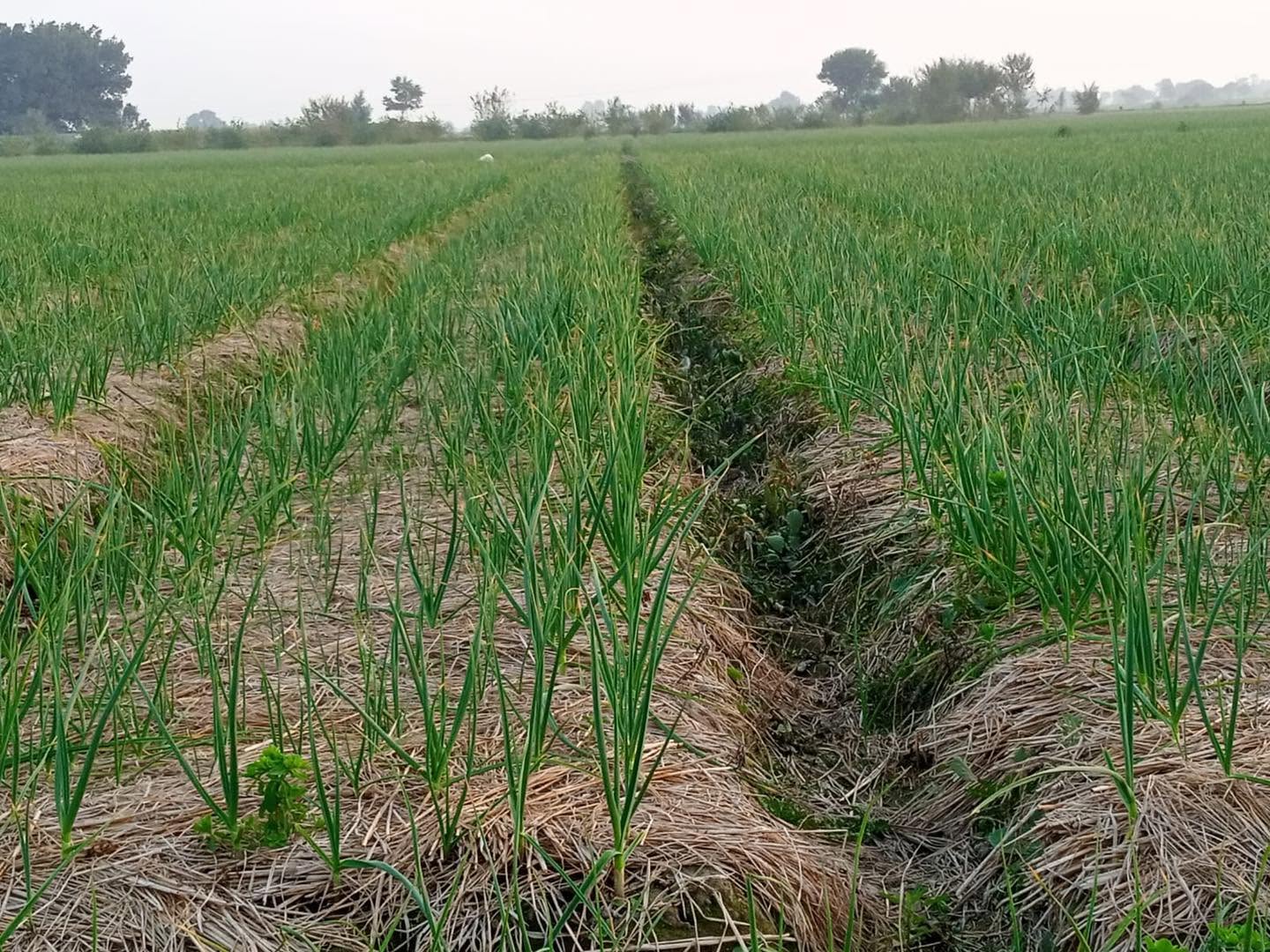
The second half of the guide lays out a 10-step conventional-to-PQNK transition sequence that applies identically to both onion and garlic: laser-level the plot, break the hardpan (the compacted layer 8-22 inches deep) to restore water and air infiltration, flood-irrigate once to leach salts and chemicals and reconnect soil layers, form 42-inch raised beds with 18-inch furrows sized for 60-inch tractor tracks, establish and then mulch a cover crop in place without disturbing the soil or its root systems, plant propagules at 4-inch spacing for a target density of roughly 235,224 bulbs per acre, and eliminate all purchased fertilizer, pesticide, and herbicide inputs. Irrigation under this system is reduced to whatever is needed to hold soil pore water content at roughly 35%, and harvest timing is read directly off the crop, triggered once 60% of plant leaves have turned yellow rather than by calendar date.
Because the same 10-step sequence and the same offset-propagation logic apply to both crops, the guide treats onion and garlic as functionally interchangeable within the PQNK system, differing only in variety-specific detail rather than in method.
Key Takeaways
- Three propagation options compared: seeds (4-6 months, high genetic diversity), large bulb sets (2-3 months, good uniformity, disease-carry risk), and offsets (2-3 months, clonal, highest uniformity, lowest cost).
- Offset handling chain: collect at die-back, separate with clean tools, air-dry a few days, store at 4-10°C in breathable containers if not planting immediately; plant 1 inch deep, pointed end up, at 4-inch spacing.
- The 10-step PQNK transition applies identically to onion and garlic: laser-level, break the 8-22 inch hardpan, flood-irrigate once to leach salts, form 42-inch raised beds with 18-inch furrows, mulch a cover crop in place, then plant.
- Target planting density is roughly 235,224 bulbs per acre at 4-inch spacing, with all purchased fertilizer, pesticide, and herbicide inputs eliminated.
- Irrigation is calibrated to hold soil pore water content near 35% rather than run on a fixed schedule, and harvest is triggered once 60% of plant leaves turn yellow.