
Soil Science & PQNK System
Cropland as a Carbon Sink: Responses to a Student's Questions
A 15-question exchange on why farmland, not just forestry, should be treated as a primary national climate lever, covering the biology of soil carbon storage, the four PQNK principles, and how Pakistan should balance forest protection against agricultural transformation.
Abstract
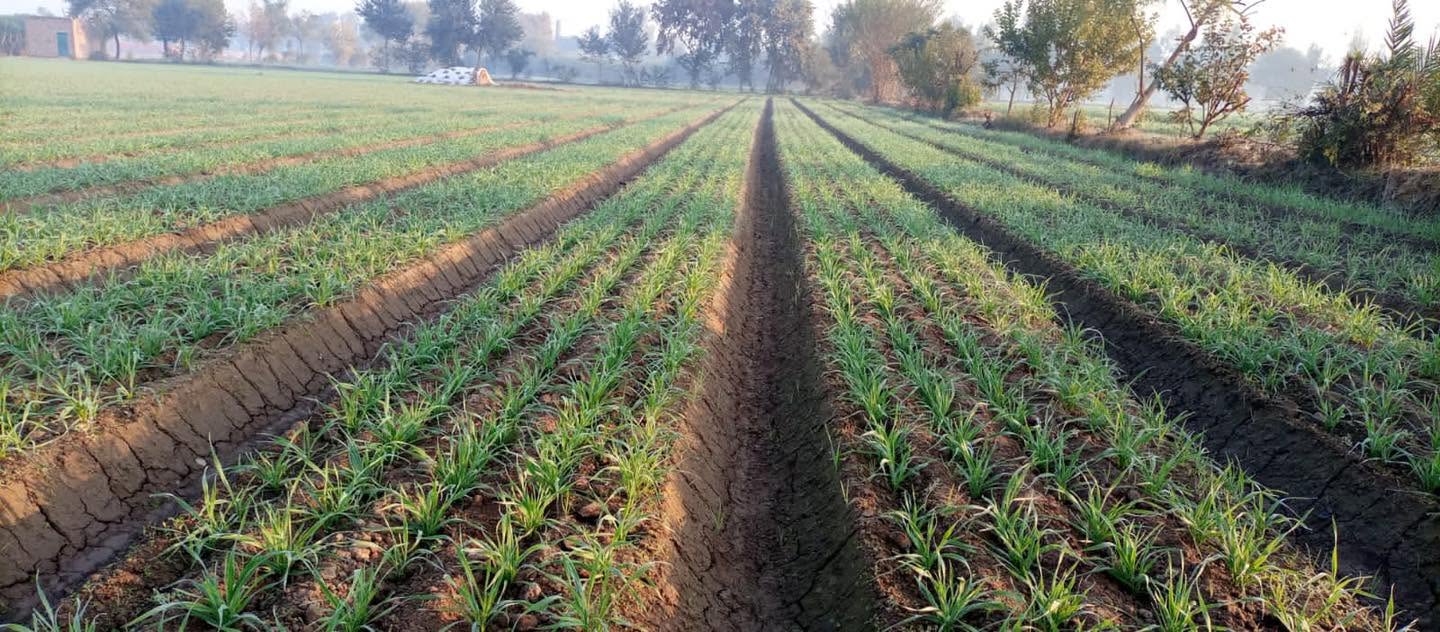
The paper's opening argument is that climate policy has wrongly separated land into two categories, forests that store carbon and farms that produce food, when every green plant, crop or tree, performs identical photosynthesis. The real difference is post-capture soil management: forest soil stays covered, rooted, and undisturbed so carbon remains in stable organic matter, while agricultural soil is routinely ploughed, left bare, or flooded, exposing captured carbon to oxygen and accelerating its return to the atmosphere as CO2.
Responding to why no single practice suffices, the paper explains that the four PQNK principles, no soil disturbance, no inundation, permanent biological cover, and maximum biodiversity, must operate together because each protects a different failure mode: no-till alone can still leave soil bare or biologically inactive, cover alone does not stop flooding-driven anaerobic collapse, and removing any one principle weakens the whole system rather than merely reducing its benefit proportionally.
On national strategy, the paper argues Pakistan's agricultural land occupies a far larger share of total area than its forest land, so even modest per-acre soil carbon gains across cultivated land could produce a larger cumulative climate effect than forestry expansion alone, without taking land out of food production. It proposes a three-tier priority: protect existing mature forests first since they cannot be quickly replaced, restore degraded land in watersheds and riverbanks second, and transform agricultural management nationally as the third and largest-scale lever.
The paper is explicit that the biggest obstacle to farmer adoption is not awareness but institutional lock-in: government recommendations, university teaching, machinery markets, credit systems, and procurement policy all currently reinforce ploughing, flooding, and input-intensive practice, so an individual farmer converting alone faces outsized risk. It closes by proposing outcome-based success indicators, soil organic carbon and biological activity, rainfall infiltration and runoff reduction, and long-term yield and input-dependence trends, in place of simple counts of trees planted.
Key Takeaways
- Photosynthesis is biologically identical in crops and forest trees; the difference in long-term carbon storage comes entirely from whether the soil beneath is disturbed after harvest.
- The four PQNK principles (no disturbance, no inundation, permanent cover, maximum biodiversity) must be applied together; removing any one weakens the whole system rather than just reducing the benefit.
- Pakistan's agricultural land area is described as far larger than its forest area, meaning modest soil-carbon gains across cropland could outweigh the cumulative climate impact of tree planting alone.
- The paper proposes a three-tier national priority: protect existing mature forests, restore degraded watershed and riverbank land, and transform agricultural soil management at national scale.
- The main adoption barrier for farmers is identified as institutional lock-in (extension advice, machinery markets, credit, procurement policy), not lack of awareness of regenerative methods.
- Recommended success indicators are soil organic carbon and biological activity, water-cycle improvement (infiltration, runoff, recharge), and long-term production and input-dependence trends, rather than trees-planted counts.