

Periodic Production Engineering
VIPP — Vertical Insertion Precision Planter
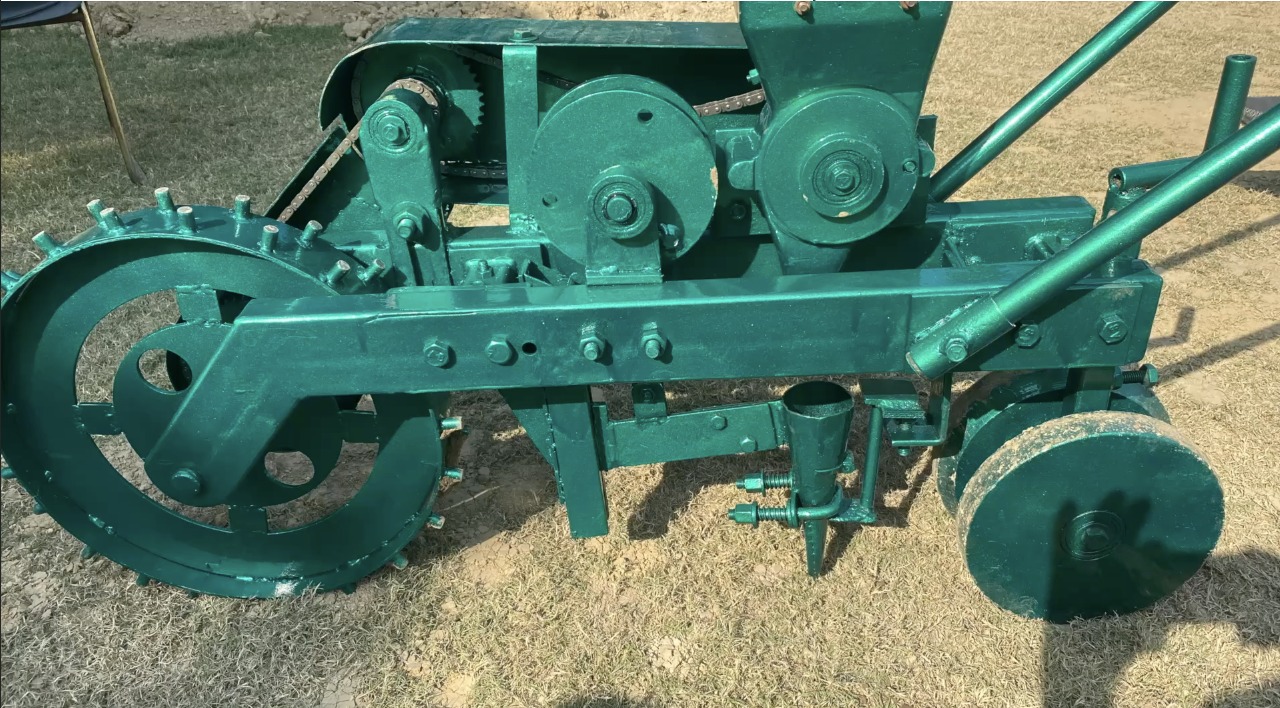
A vertical beak that touches the bed only at the exact point a seed needs to go.
Why It's Needed
Like SIPP, VIPP exists because conventional planters assume bare, cultivated ground. Where field conditions or crop requirements favor a vertical opener over a slit, VIPP solves the same mulch-planting problem from a different angle.
Operating Principle
Instead of cutting a slit, a narrow, cone-shaped beak moves straight down through the mulch and soil, opens a single placement point, deposits the seed at the set depth, and withdraws. The field isn't sliced open along a line, it's touched only where a seed is actually needed.
Because it enters vertically rather than dragging horizontally, VIPP handles thick residue without the hairpinning and blockage that trips up conventional openers, so the mulch layer keeps doing its job of buffering temperature, holding moisture, and feeding soil biology.
Relationship to PQNK
SIPP and VIPP solve the same PQNK requirement, planting directly through mulch on a permanent bed without inverting or disturbing the soil, from two different engineering directions: slit insertion and vertical insertion. VIPP is not a variant of SIPP; it is a distinct opener design built on the same underlying principle of minimizing disturbance.
Engineering Characteristics
- Vertical, cone-shaped insertion point — a narrow beak that presses straight down rather than dragging a horizontal slit.
- Exists in two confirmed forms: a mechanized version, and a light, hand-pushed prototype built for smallholders who can't justify heavy no-till equipment. Whether mechanized or hand-operated, the underlying vertical-insertion principle is unchanged.
Field Operation
Used at planting, every season, directly through the mulch layer on an already-established permanent bed — periodic, maintenance-stage machinery, like SIPP.