

One-Time / Transition Engineering
The Raised Bed Shaper
One pass of engineering that establishes decades of permanent farm architecture.
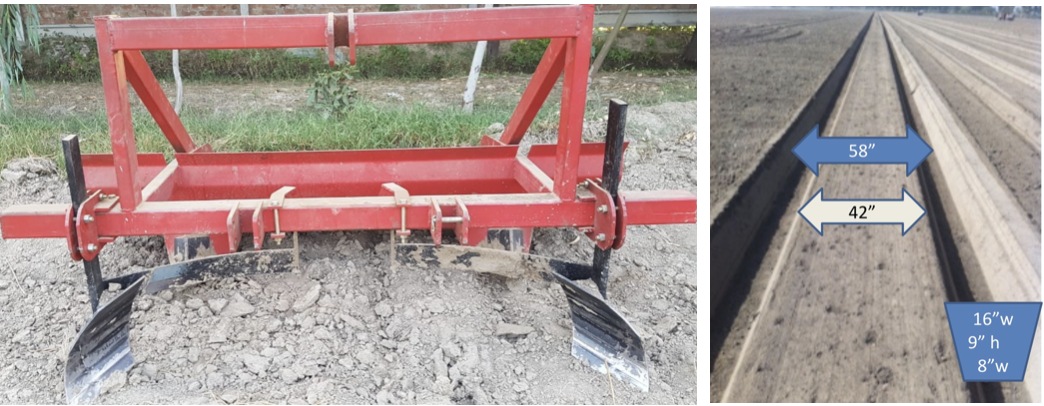
Why It's Needed
Conventional ridging is rebuilt every season: the same ground is repeatedly reshaped and run over by machinery. A growing zone that never stabilizes can't build the permanent soil structure a living ecosystem depends on. Unlike conventional ridging, the PQNK bed is not made for a single crop, it is made for an ecosystem.
Operating Principle
The raised bed shaper builds horizontal organization in a single pass: permanent beds with fixed furrows and traffic corridors, engineered so that wheels always run in the furrows and never on the growing bed.
The machine's job is completed in a matter of hours; its consequences last for decades. Once shaped, the bed fixes where water moves, where roots explore, and where machinery travels, so that season after season, operations happen within that architecture instead of reconstructing it.
Relationship to PQNK
That permanence is the point. Biological continuity depends on physical continuity: a field that is not rebuilt every year can invest in long-term soil structure instead of starting over each season.
Engineering Characteristics
- Typical bed width: 42 inches, with 18-inch furrows.
- Furrow spacing is matched to standard tractor wheel track, so wheels always run in the furrow, never on the growing bed.
- Bed and furrow dimensions can be adjusted to match different tractor tracks or crop spacing needs — the fixed, uncompacted growing zone principle stays constant across configurations, so no single dimension set is universally mandatory.
Field Operation
Formed once, after the hardpan has been broken and any soil chemistry correction completed, before the first crop is planted on a given plot.