

One-Time / Transition Engineering
The Hardpan Breaker
The most important machine in the transition is the one used the least.
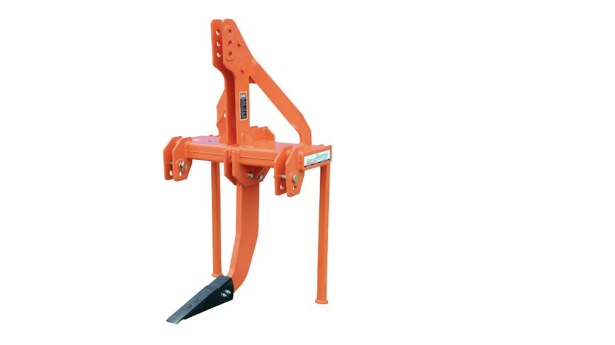
Why It's Needed
Decades of tillage, traffic, and flood irrigation compress a dense layer beneath the topsoil that roots, water, and air can no longer cross. Because the damage sits below the depth of normal cultivation, it stays hidden, farmers see declining yields and respond with more fertilizer or more irrigation, never touching the actual restriction.
The most common tillage tool, a spring-tine cultivator, only reaches the upper 4–6 inches of soil, and its spring-loaded tine has a smearing action that compacts the soil immediately below the tilled layer rather than breaking it up. Disc or mouldboard ploughs go somewhat deeper, roughly 8–10 inches, but the same compaction recurs beneath whatever depth the implement reaches. The resulting hardpan's depth and density therefore depend on the tillage implement used, tractor weight, and number of passes over time, it is not the same in every field.
Operating Principle
The hardpan breaker's job is narrow and specific: reopen the compacted layer once, restoring vertical connectivity between the surface and the deeper soil profile. It is not a tillage tool and does not invert or pulverize the soil, it simply removes the barrier so roots, water, air, and biology can reach the full profile again.
Relationship to PQNK
This is a transition operation, not a routine one. Once the profile is open and the field is managed to preserve that connectivity, roots and soil biology take over the job of maintaining it. Repeating the operation unnecessarily would undo the very structure it was meant to restore.
Engineering Characteristics
- A subsoiler tool, used to shatter the compacted layer without inverting the soil.
- Because hardpan depth varies by field, tillage history, tractor weight and number of passes, PQNK recommends digging a pit on each field to check where the hardpan actually sits before setting the subsoiler's working depth.
- A working depth of up to 24 inches is commonly used as a safety margin, to make sure the subsoiler reaches below the hardpan even where its exact depth is uncertain, not as a fixed depth required on every field.
Field Operation
Carried out once, before the first planting on a given plot, wherever compaction is present — not repeated season after season once the profile is open.