
Industrial Devastation To Natural Abundance
Acknowledgements and Appendices · Appendix B
PQNK and Agricultural Swaraj: Restoring the Farmer’s Freedom
From agricultural dependency to ecological independence, village prosperity, and human dignity
Release 1.0 · 2026-10-30
If you use “Listen”, the text of the page may be sent to your browser or operating system’s speech provider, such as Apple, Google or Microsoft, depending on the voice your device uses. Pedaver does not process, transmit or store any audio.
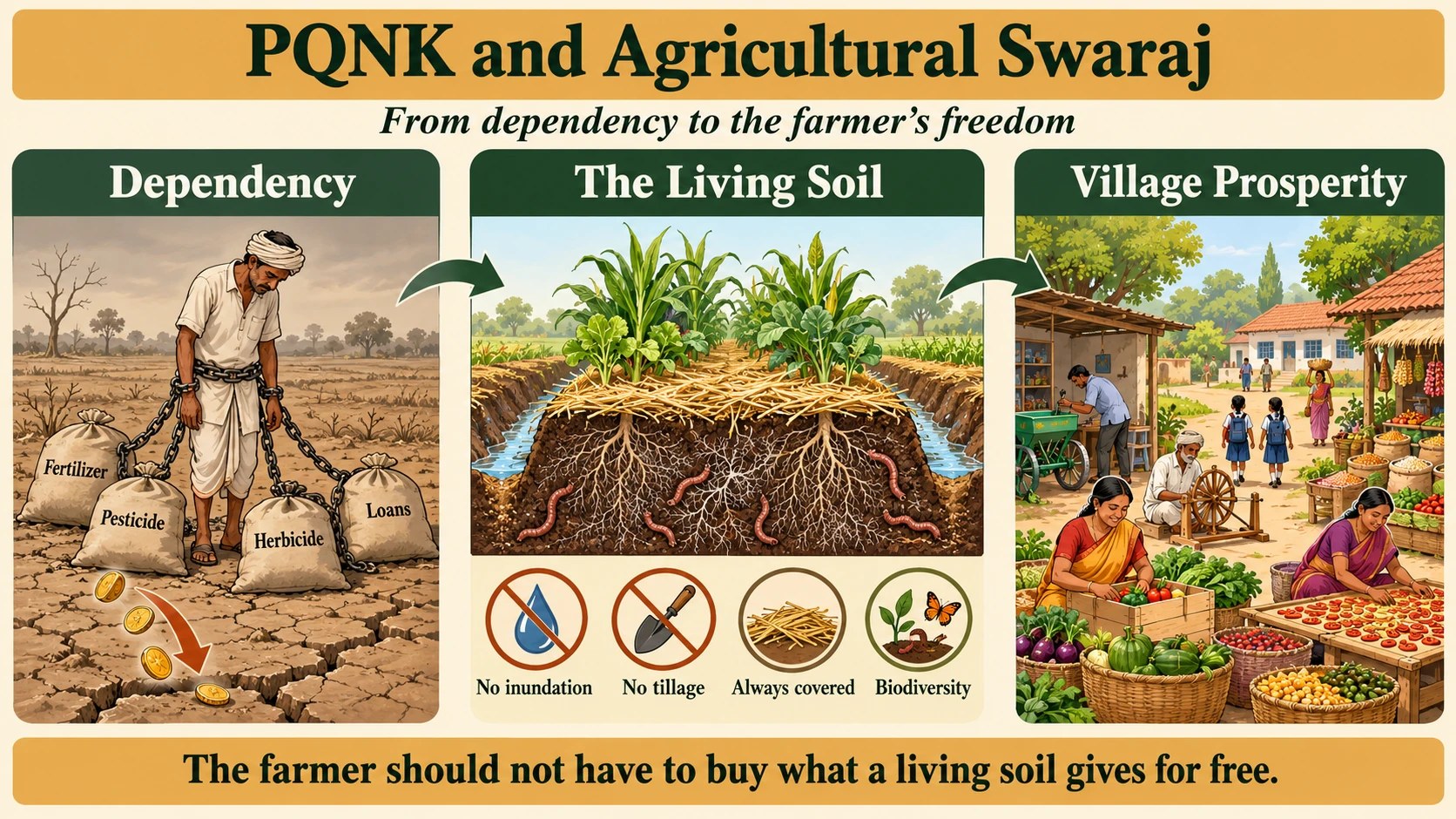
PQNK and Agricultural Swaraj: from dependency to the farmer’s freedom.
“The farmer should not have to buy, season after season, what a living soil gives for free.”
Asif Sharif, Lahore, 2026
THE UNFINISHED QUESTION OF RURAL FREEDOM
Political independence does not necessarily bring economic independence. A nation may govern itself, yet millions of its farmers may remain dependent upon external institutions, commercial suppliers, financial lenders, and markets over which they exercise little control. The farmer may own the land, provide the labor, bear the risks of production, and produce the food that sustains society, yet remain among its least economically secure members.
This contradiction lies at the heart of one of the most important questions facing agricultural civilization: How can the producer of humanity’s most essential necessity remain dependent upon others for the means of producing it?
Mahatma Gandhi’s vision of Gram Swaraj, or village self-rule, addressed a closely related problem. His conception of freedom extended beyond political sovereignty to include economic self-reliance, productive village communities, dignity of labor, decentralized enterprise, and the participation of ordinary people in shaping their own livelihoods. He regarded the village not merely as a settlement requiring development, but as a potential center of productive and social life.
PQNK, Paedar Qudratti Nizam Kashatqari, the regenerative and sustainable Pristine Organic Farming System, approaches the question of rural independence through the biological foundations of agriculture.
It begins with a proposition that is both simple and far-reaching: the farmer should not have to purchase, season after season, the biological functions that a healthy natural ecosystem can perform.
The significance of this proposition extends well beyond agricultural technique. It concerns the relationship between human beings, natural resources, economic institutions, and the freedom of the producer.
FROM PURCHASED PRODUCTION TO NATURAL PRODUCTION
Ancient Conventional Industrial (ACI) agriculture has progressively reorganized food production around purchased inputs. Soil fertility is commonly associated with manufactured fertilizers, crop protection with pesticides, weed management with herbicides, and water management with increasingly intensive irrigation infrastructure. Mechanization and commercial seed systems introduce additional costs and dependencies.
These technologies have contributed to substantial increases in agricultural production under many circumstances. Yet their economic consequences are not distributed equally. For a marginal farmer with limited financial reserves, the recurring cost of inputs can become a source of indebtedness and vulnerability. Crop failure, market fluctuations, or rising input prices may threaten the viability of an entire household.
PQNK changes the underlying production relationship rather than merely reducing the price of individual inputs.
Its four governing rules, no inundation, no tillage after conversion, continuous organic soil cover, and encouraged biodiversity, are designed to restore the conditions under which soil organisms, plant roots, fungi, natural predators, organic residues, and the soil-water-air system perform their ecological functions.
Instead of repeatedly rebuilding the cultivated field, PQNK breaks the hardpan once with a subsoiler and establishes permanent raised beds. Instead of disturbing the soil to prepare each crop, precision planting introduces seed through the protective mulch. Instead of relying routinely on manufactured nutrients and chemical crop protection, the system relies on biological nutrient cycling, plant resilience, and ecological regulation. Instead of flooding the root zone, Soil Moisture Management maintains the balance between moisture and aeration.
During conversion, purchased inputs fall step by step. Once the soil is mature, crops are produced without recurring purchased inputs, sustained by a functioning soil ecosystem.
The pace of this change depends on the variety chosen, the maturity of the soil, and the accuracy of planting. Its direction does not change: the farmer’s dependence on recurring external purchases falls, and that represents a fundamental change in the economics of production.
The farmer begins to recover control over the means of production.
AGRICULTURAL SWARAJ: INDEPENDENCE ROOTED IN THE SOIL
The word Swaraj is commonly associated with self-rule. In the context of PQNK, agricultural Swaraj may be understood as the farmer’s practical ability to manage production with increasing independence, using the regenerative capacities of the natural ecosystem rather than depending primarily upon recurring commercial inputs.
This does not imply isolation from science, technology, trade, or society. Nor does it require rejecting useful machinery or modern knowledge. PQNK itself employs purpose-developed machinery, including the subsoiler and precision planting equipment, to establish and maintain its production system.
The distinction is between technology that strengthens the farmer’s independence and a production arrangement that makes the farmer perpetually dependent.
A precision planter that enables repeated no-till sowing on permanent beds can serve the farmer for many seasons. A biologically functioning soil ecosystem can continue cycling nutrients, receiving organic matter, supporting plant roots, and regulating ecological relationships without requiring the farmer to purchase each of these functions separately.
The machine is an enabling instrument. The ecosystem is the continuing productive foundation.
This distinction becomes particularly important for smallholders. A farmer cultivating one or two acres may not possess the capital to sustain expensive seasonal input programs, but may still possess the land, labor, local knowledge, and biological resources necessary to develop a productive PQNK system.
The purpose of agricultural Swaraj is therefore not simply to make farming cheaper. It is to change the farmer’s position from that of a financially vulnerable purchaser of production inputs to that of an increasingly independent manager of a living productive ecosystem.
FROM AGRICULTURAL INDEPENDENCE TO VILLAGE PROSPERITY
The economic implications of PQNK need not end at the farm boundary.
Gandhi’s concept of Gramodyog, or village industry, recognized that rural prosperity requires productive activities beyond the cultivation and sale of raw agricultural commodities. Processing, preservation, manufacturing, craftsmanship, and local exchange can distribute economic opportunity across a wider section of the village population.
PQNK offers a natural agricultural foundation for such enterprises.
Lower production costs and more continuous harvests, across whichever crops a village chooses to grow, open opportunities for village-level food processing, grading, packaging, drying, storage, seed preparation, and the manufacture or maintenance of agricultural implements.
A village producing vegetables, fruits, grains, oilseeds, pulses, spices, and other crops across different seasons can support several small enterprises rather than depend upon the sale of one seasonal commodity.
The principle of Circular Production, planting the next crop promptly after harvesting the previous one wherever climate and crop biology permit, can also help distribute employment and income across more of the year.
These opportunities are especially relevant to women, whose contributions to agricultural production, household food security, seed preservation, processing, and local commerce are frequently undervalued or insufficiently remunerated.
Village enterprises built on PQNK production could provide opportunities for women to participate as skilled producers, processors, entrepreneurs, and decision-makers. Real empowerment, however, requires more than additional labor. It requires fair compensation, access to productive resources, control over income, appropriate training, and meaningful participation in enterprise ownership and management.
In this wider conception, agricultural independence becomes the foundation upon which more inclusive rural economic development can be built.
PROSPERITY WITHOUT DEPENDENCE
The conventional measure of agricultural success is frequently the quantity of produce harvested per unit of land. Yield is important, but it is not sufficient to measure the prosperity of the farmer.
A crop may produce a substantial harvest while leaving little income after the costs of seed, tillage, fertilizer, pesticides, irrigation, machinery, finance, and marketing have been deducted.
For a small farmer, the decisive question is not merely how much the land produces, but how much of the value created remains with the farming household.
PQNK therefore invites a broader assessment of agricultural performance: production, net farm income, recurring input expenditure, water use, soil condition, resilience, and the opportunities created for additional crops and enterprises.
A farmer who retains a greater share of the value of production gains more than purchasing power. Greater financial security can strengthen the household’s ability to educate children, improve nutrition, withstand adverse seasons, invest in useful equipment, and participate in community life without excessive financial pressure.
This is where ecological restoration and human dignity become connected.
The restoration of soil biological functions is not only an environmental objective. It can also become a means of restoring economic agency to the person whose livelihood depends upon the soil.
A CONVERGENCE OF TWO ASPIRATIONS
It would be historically inappropriate to claim that Mahatma Gandhi would necessarily have endorsed PQNK, a system developed long after his lifetime. His philosophy arose from the political, social, and economic circumstances of his era, while PQNK has emerged from decades of agricultural engineering, field experimentation, ecological observation, and practical crop production.
Yet a meaningful convergence exists between their underlying aspirations.
Gandhi sought to strengthen the independence and productive capacity of the village. PQNK seeks to strengthen the independence and productive capacity of the farmer by rebuilding agriculture around natural ecological processes.
One begins with the social and economic organization of rural life. The other begins with the biological organization of agricultural production.
Both invite us to reconsider systems in which those who perform essential productive work remain dependent upon institutions and resources beyond their control.
The significance of PQNK, therefore, should not be judged solely by its potential to conserve water, reduce purchased inputs, improve soil conditions, or support crop production. Its wider promise lies in the possibility of combining these outcomes with a more independent, prosperous, and dignified rural life.
That promise is already visible in PQNK fields, in the field record set out in Appendix A, and in the farmers who have made the transition. A philosophy acquires enduring value when its principles are translated into demonstrable improvements in human lives, and PQNK’s field record shows that this translation is possible.
For the marginal farmer, the ultimate meaning of agricultural Swaraj is neither political rhetoric nor romantic attachment to the village. It is the practical freedom to produce food, earn a secure livelihood, maintain the productive capacity of the land, and participate in economic life without unnecessary dependence.
The farmer should not merely be the producer of society’s food. The farmer should also be an independent beneficiary of the prosperity that food production creates.
That is the larger human purpose toward which PQNK aspires.