

Industrial Devastation To Natural Abundance
Acknowledgements and Back Matter · About the Author
About the Author
Release 1.0 · 2026-11-08
If you use “Listen”, the text of the page may be sent to your browser or operating system’s speech provider, such as Apple, Google or Microsoft, depending on the voice your device uses. Pedaver does not process, transmit or store any audio.
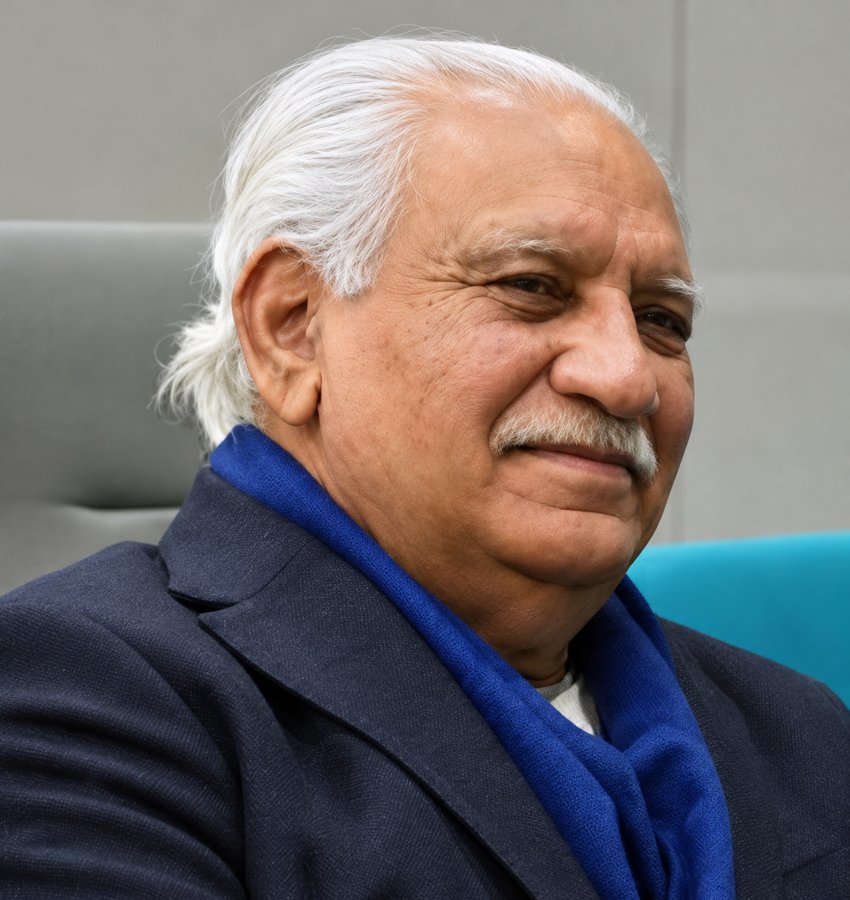
Asif Sharif was born in Faisalabad into the SirGroh family, a family whose commitment to education and public service had already shaped the district long before his birth. His grandfather, Mian Khair Mohammad, had established a free school in 1917 in a village fifty-six miles from the nearest institution of learning; the literacy rate that Toba Tek Singh subsequently achieved in rural India was, in no small part, his inheritance. It is a lineage that leaves a particular kind of obligation.
Sharif’s engagement with agriculture began in the late 1960s, not in a laboratory or a lecture hall, but in the fields of the Punjab watching crops, watching soil, and watching the widening gap between what the natural ecosystem had always done and what industrial production was forcing it to do. What began as observation became, over the following decades, a program of systematic experimentation that would eventually produce PQNK, to be pronounced as ‘picnic’, which stands for Paedar Qudratti Nizam Kashatqari, and means: the regenerative and sustainable Pristine Organic Farming System.
The system’s development required more than agronomy. Over a career of more than fifty years that took him from the cotton fields of Punjab to farms across South Asia, the Middle East, and into the Amazon basin, Sharif designed and developed agricultural machinery spanning the full range of production operations from land preparation and precision seeding to harvesting, processing, and post-harvest handling. He introduced and established the operations of major international agricultural equipment manufacturers in Pakistan, including Sperry New Holland, Ford New Holland, and Case IH. He developed methods for growing rice on raised beds in moist soil, achieving a seventy percent reduction in water use. He created the One Acre Prosperity program to demonstrate that smallholder agriculture, properly supported, could deliver financial independence rather than perpetual subsistence.
His wider professional life encompassed roles as President of the Pakistan Belgium Business Development Forum, Honorary Consul for the Republic of Poland, and member of the Board of Directors of Zarai Taraqiati Bank, Pakistan’s Agricultural Development Bank. He has presented technical papers across five continents and trained with institutions in the United States, Australia, and Europe.
In 2011, the peer-reviewed publication of the PQNK rice results in the International Rice Journal, supported by the engagement of Professor Norman Uphoff of Cornell University, brought the system into formal scientific literature for the first time, confirming through independent review what the field record had already established over four decades of documented practice.
Sharif is the Researcher and Developer of PQNK and the founder and chairman of Pedaver ‘The Transformative Producer’, the organization through which PQNK is developed, documented, and extended to farming communities. He lives and works in Lahore.